News about Learning with Duolingo

Tags

, , , , , ,

Dear readers,

I have some interesting news to share about this language learning site that purports to be the best and largest one – some news are good, some bad, and also, at the end, some could be funny or absurd or annoying, depending on your disposition.

First, some good news. Those who are native Dutch or Hungarians can now learn Chinese, Japanese and Korean as well as the previous basic pairs. What’s more, the new courses, at least into Chinese, improved the methodology: it is not only possible to switch off the so-called pinyin version, which is the Latinised and accented pronunciation and writing help to the Chinese signs, but they make you actually type the pinyin to insert, and thereby learn, the signs. Not using the pinyin together with the signs has helped my memory well so far from English, now I hope actually writing the signs will help me further. A problem could be, though, for most Hungarians that the course doesn’t help us to learn how to use the keyboard to that effect, so you’ll need somebody to help first. And it doesn’t hurt for you to get a Chinese dictionary to be able to check yourself first and get familiar with the Chinese writing system.

Unfortunately, this new feature is still unavailable for English speakers, at least for starters this January, when I re-started my courses. And here I also feel the need for some clarification and bad news: I had to abandon my original subscription because most of the courses I had taken – and had described here last year – had finished during last year. So I had nowhere to go further, and practically no way to revise, which I badly needed even in German or Russian, but there was and is only the possibility for revision in one circle per day, which, however, was a highly repetitive and boring opportunity which did not recycle most of the previous material for weeks and months. Outright useless.

Good news is, it is possible to open a new account while letting them close down the old one. This is what I did at the end of last December. It has been working very well for me as to the revision and recycling of basic vocab and structures in all of my languages, although I haven’t re-started French yet.

One interesting fact remains, though, and this is that while on my new profile the real starting date of my new account, based on my other e-mail address, was correctly displayed, after a good month they suddenly switched and inserted February 2019 as my starting date. This is highly wrong as I hadn’t even heard about them at the time – I only started my first course with them in late 2021 but I’ve complained in vain, no response has been provided, as ever. Quite rude if you ask me, from people who brag about being so friendly and helpful.

So far so good, you could say, and because of the original bad quality of some material has also stayed the same, they stick with their – perhaps secret – policy of not responding to any criticism or request for improvement, except that they were graciously able to close down my original profile as requested. Now, finally, I have that particular final news. For the small bunch of fellow Hungarians who are wicked enough to dare to take up Chinese, the bad news is that they should re-learn their mother tongue. Or otherwise we could better understand now why Chinese people in Hungary speak our language often so badly. Here is what kind of language has appeared quite early on on the course, together with the correct solutions:

and/or

For those who do not speak Hungarian, ‘kínaiul’ is an adverb. The correct phrase above would be ‘kínai tanár’. The above examples are serious mistakes. An example of the correct use can be seen below, although the full example will also be a problem.

Unfortunately, contrary to earlier practice, the list of authors has disappeared from the menus of the courses, so I have no way of knowing who contributed to the material but my guess is that here we’re faced with native Chinese people who haven’t checked the validity of their work with native Hungarians.

My fear is that the latter is the case as there have already appeared a few other examples where totally correct Hungarian translations are rejected by the course, for example this one, where I don’t think any Hungarian would accept or say the suggested correct translation :

So once again, if you dare to start learning Chinese from Hungarian, don’t be too surprised at certain places.

Otherwise, good luck to everybody with trying to learn to speak any language with the owl – they may (or may not) succeed one day.

By P.S.

p.s.:And indeed! Not very much later on in the course, more and more very strange features prove that the authors of the Hungarian-Chinese course had/have been having difficulties with the source language. They’ve forgotten about the vary basic fact that the third person singular personal pronoun, ‘ő’ in Hungarian, refers to both sexes, as almost all nouns referring to people in this language. Although the authors sometimes remark at the bottom of a Chinese solution that, i.e. instead of 他, 她 is also possible as from the point of view of the Hungarian source the Chinese ‘he’ and ‘she’ are interchangeable, sometimes they reject one or the other Chinese solution. For no reason at all.

It is also quite basic that the Hungarian ‘tanuló’ means a student both in primary and secondary education, we don’t normally make any difference. Besides, after the course first teaches us that in Chinese a student is 学生,a couple of lessons later the same is rejected because the course has introduced 中学生 in the meantime, which means secondary school student, or, in Hungarian, the tedious-sounding ‘középiskolai tanuló’ or ‘középiskolás’ for short, although neither is used frequently at all.

Another feature of Hungarian is often neglected when the free word order is punished at various places. Although the Chinese phrase for ‘is that right/correct’, i.e. 对不对 is placed at the end of a question, in Hungarian, we often put it close to the beginning, like in ‘Te ugye nem gyakran mész étterembe?’. Similarly, ‘Ugye nem mész gyakran étterembe?’ is just as normal, the place of ‘often’ and the negative being mostly interchangeable. Except that we would usually ask, ‘Ugye nem jársz gyakran étterembe?’, if at all. Also, the personal pronouns are mostly left out, like in Russian – thankfully, this is not punished by the course.

Otherwise, the course is full of ‘tejtea’, ‘Egy csésze kávét akar’, ‘Akarod a cukrot?’, ‘Akarok cukrot’ and similar silly phrases. And I’m only through with the seventh section… Sweet Jesus, what is still ahead of us?

However, my largest laugh has been brought recently by the phrase ‘I often eat Japanese/Chinese kitchen’, i.e. in HU, ‘Gyakran eszem japán/kínai konyhát.’ 我尝尝吃日本菜/中国菜 means Jap./Ch. food but the unfortunate authors have lifted ‘kitchen’ out of the HU phrase ‘szeretem a japán/kínai konyhát’, where it indeed means the kind of food made in the kitchen(s) of the countries mentioned. But in HU you can only say you like that food, you can’t eat a kitchen! Completely preposterous, though an understandable – but huge – mistake.

Theses may seem small problems but they would probably irritate any Hungarian who’s just ventured into the discovery of the difficulties of Chinese. Some may probably give up, seeing such basic and blatant negligences coupled with the above-mentioned serious mistakes.

By P.S.

Treasures of Austria – lesser known towns and cities, churches etc.: Schallaburg

Tags

, , , ,

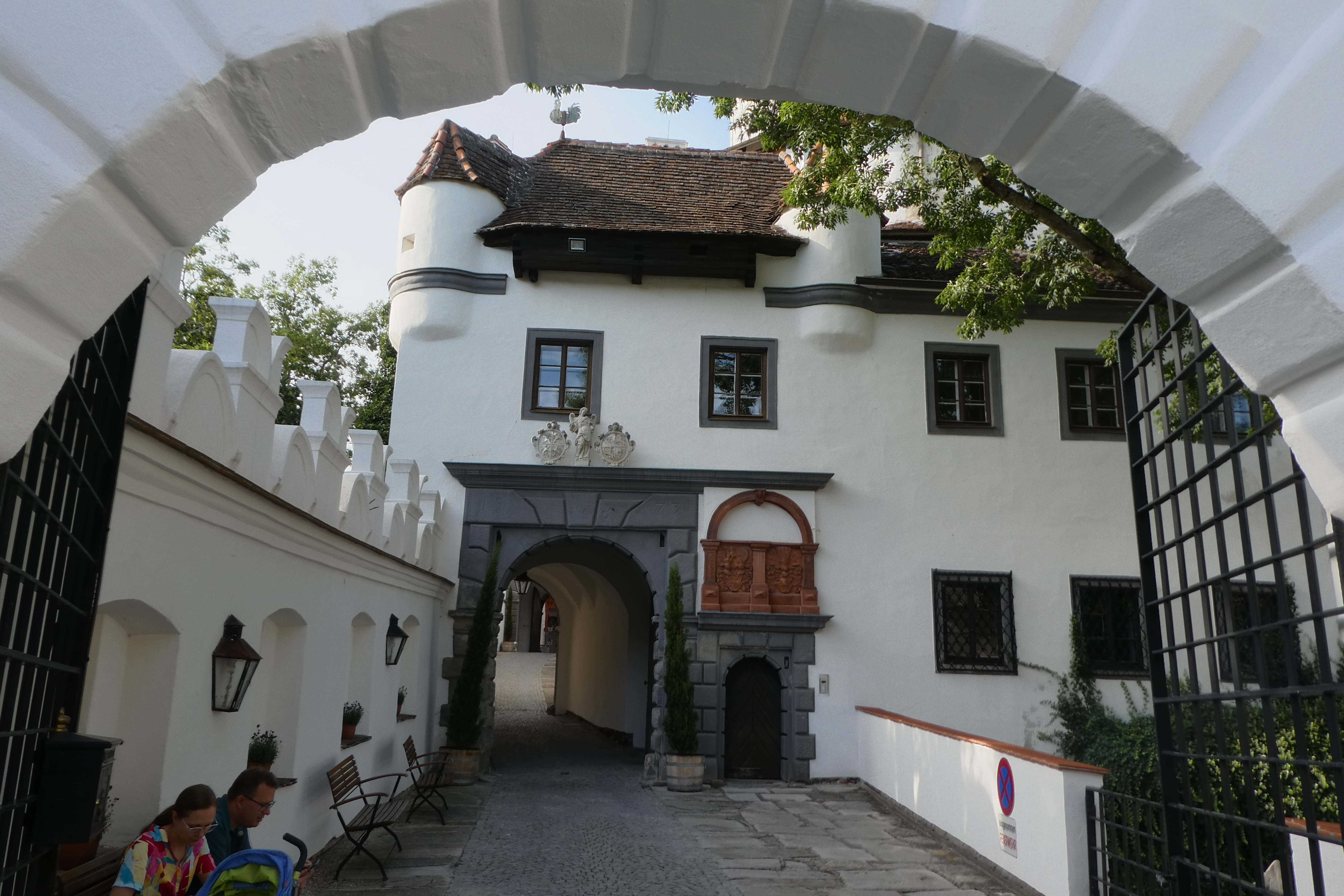
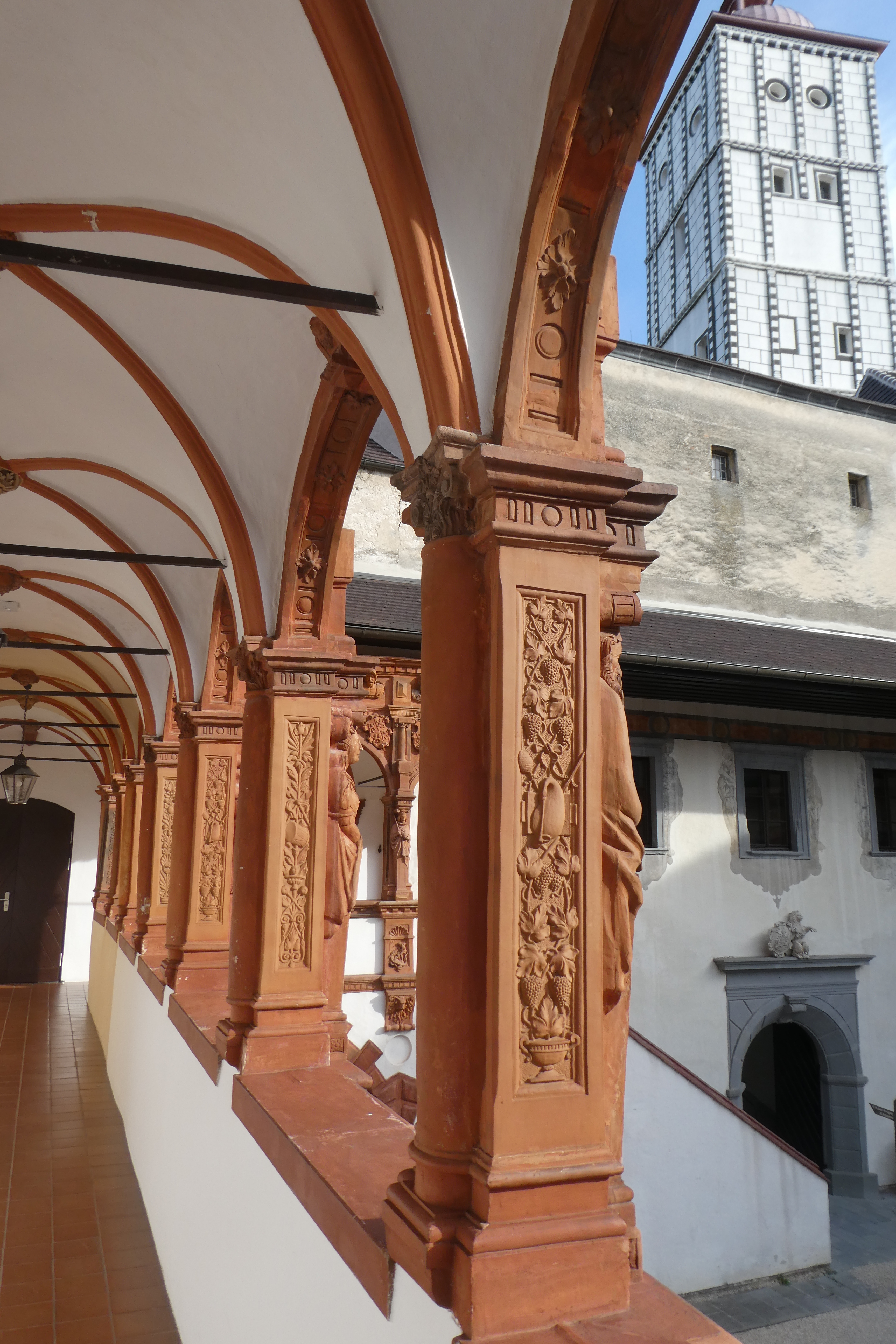
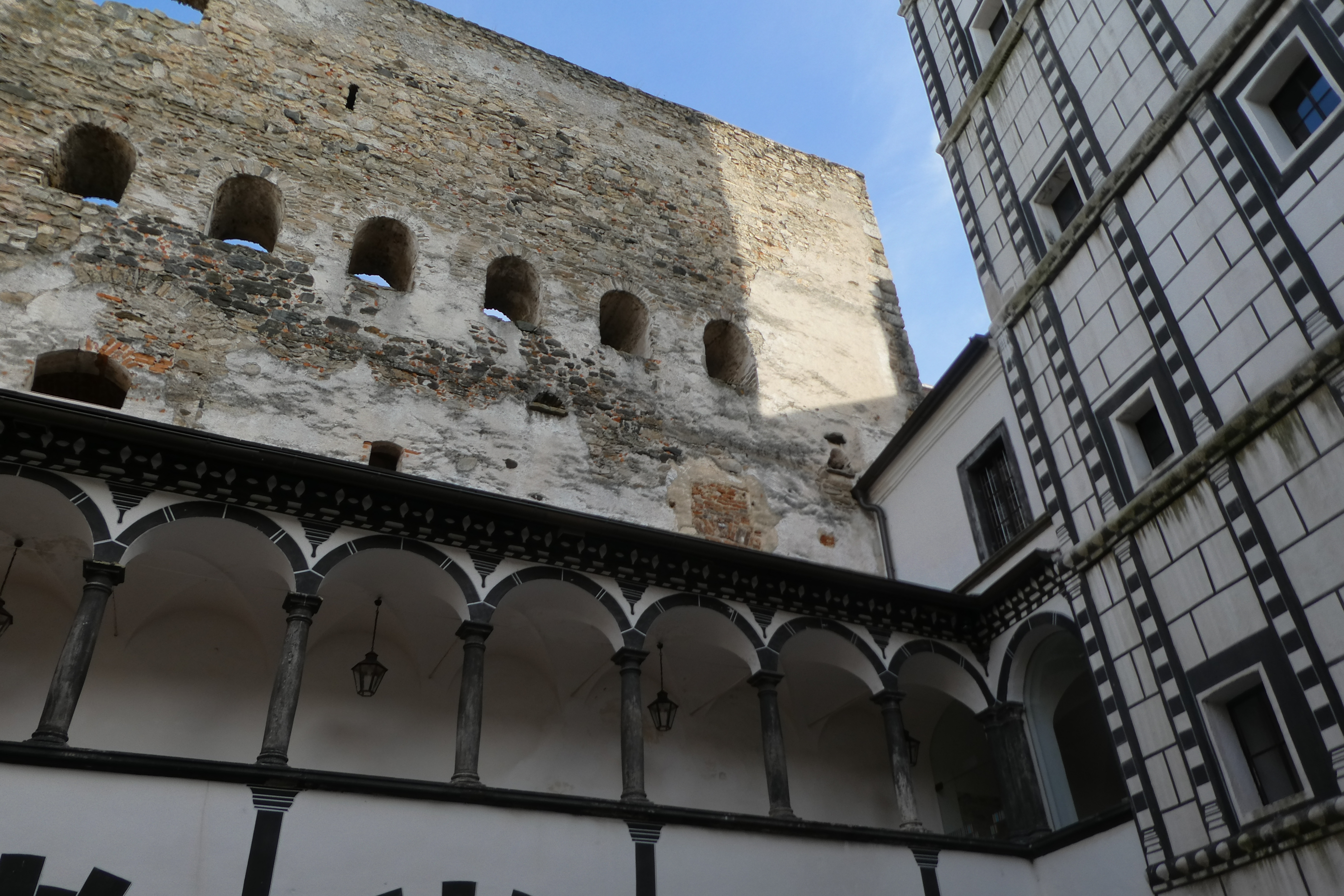
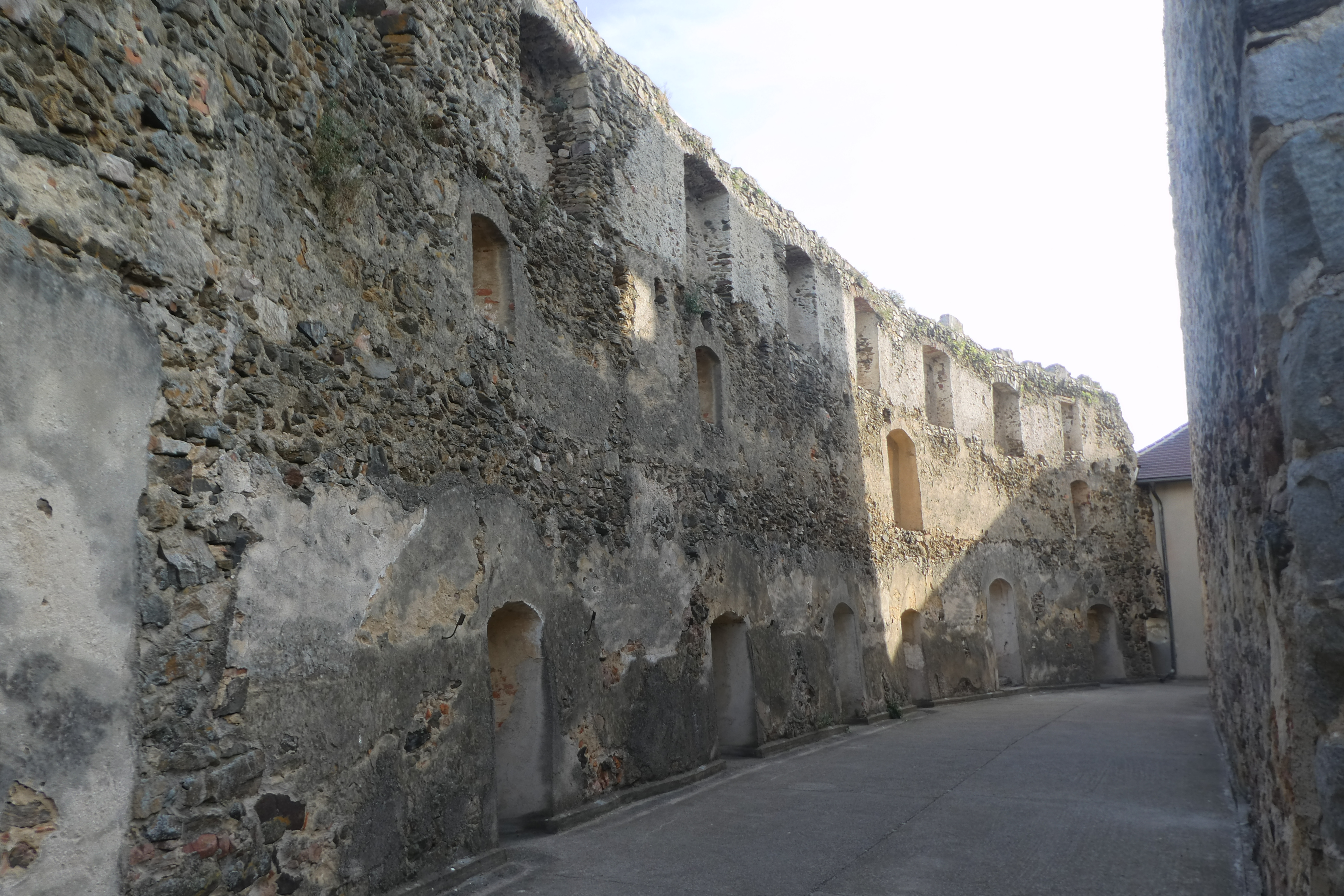
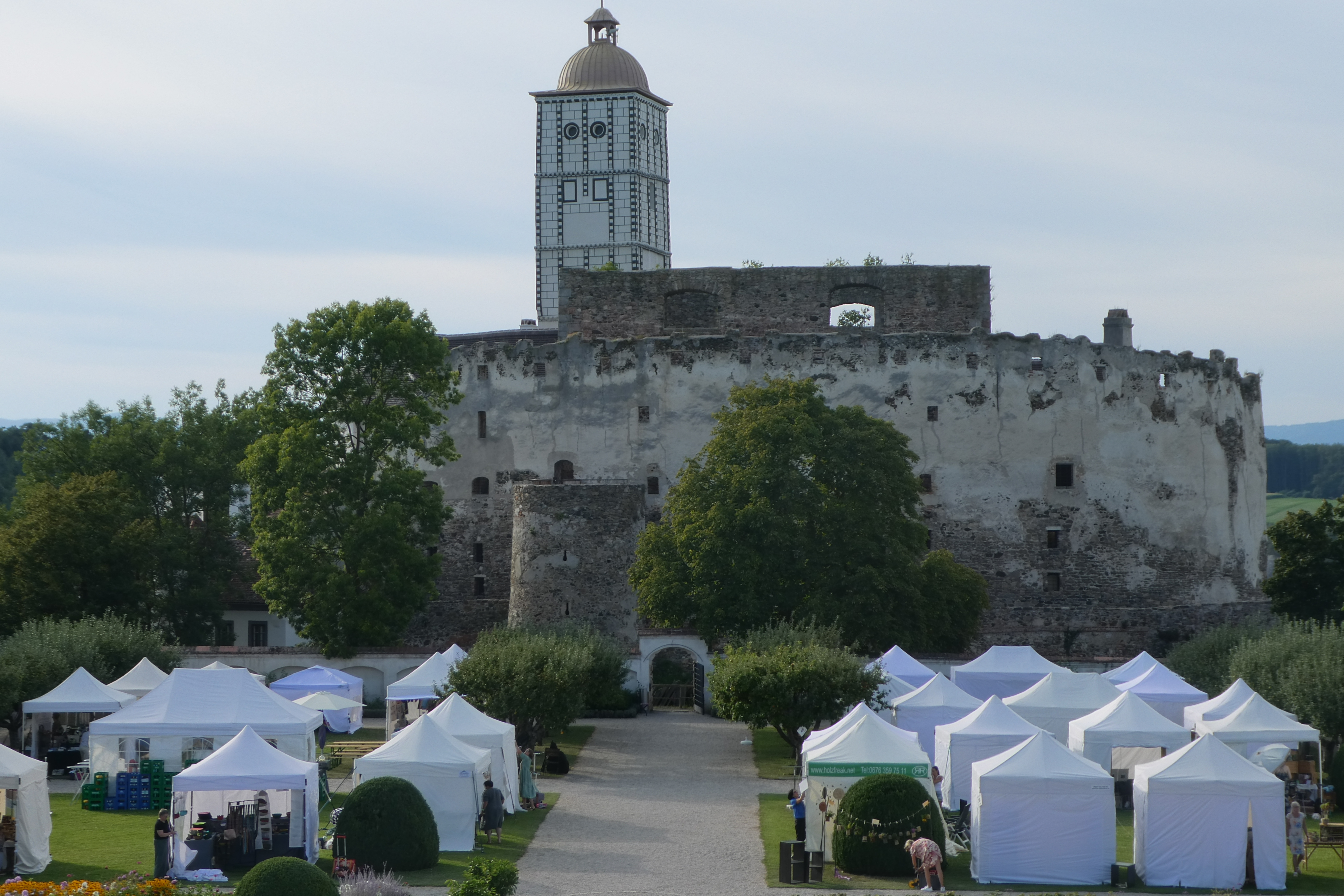
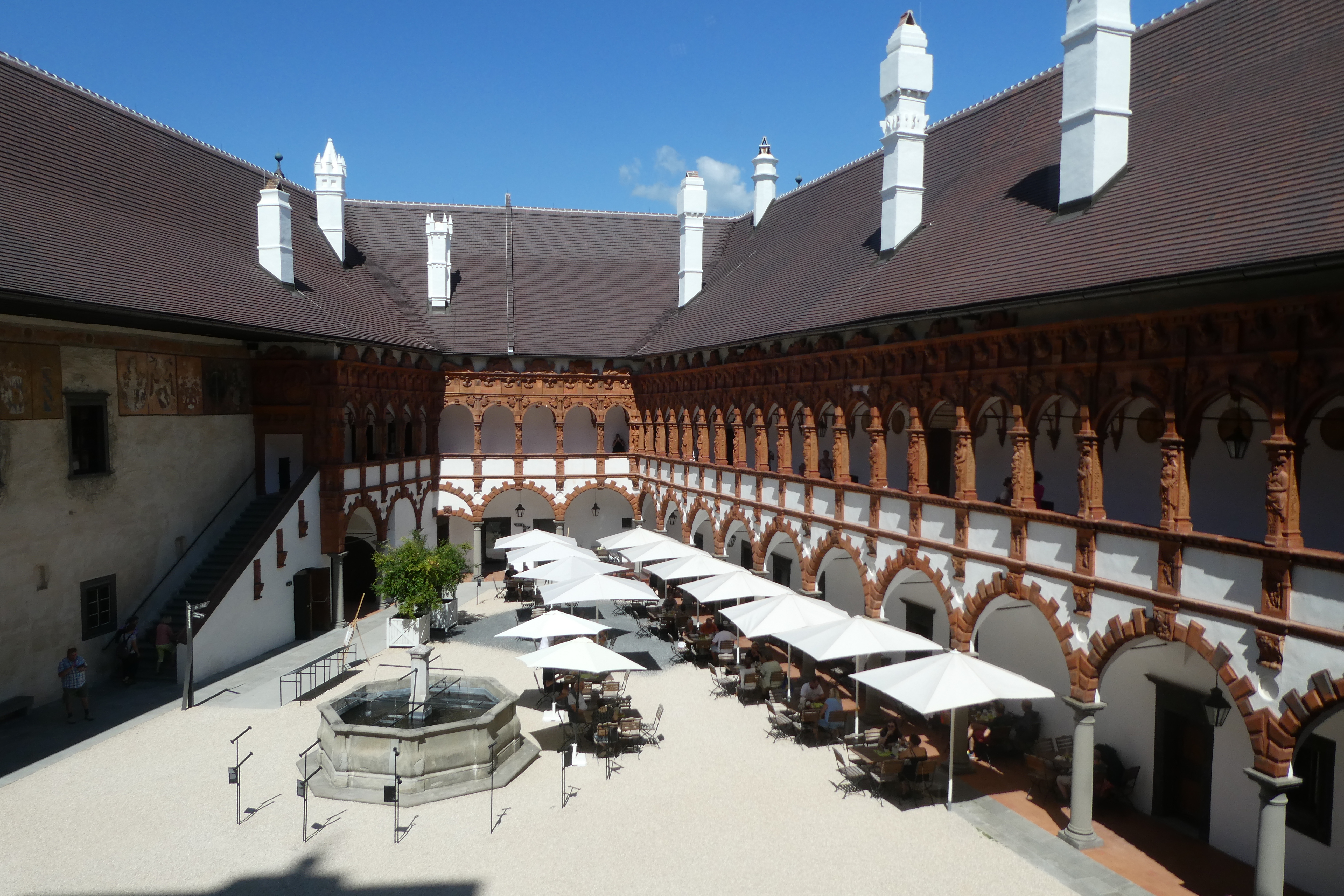
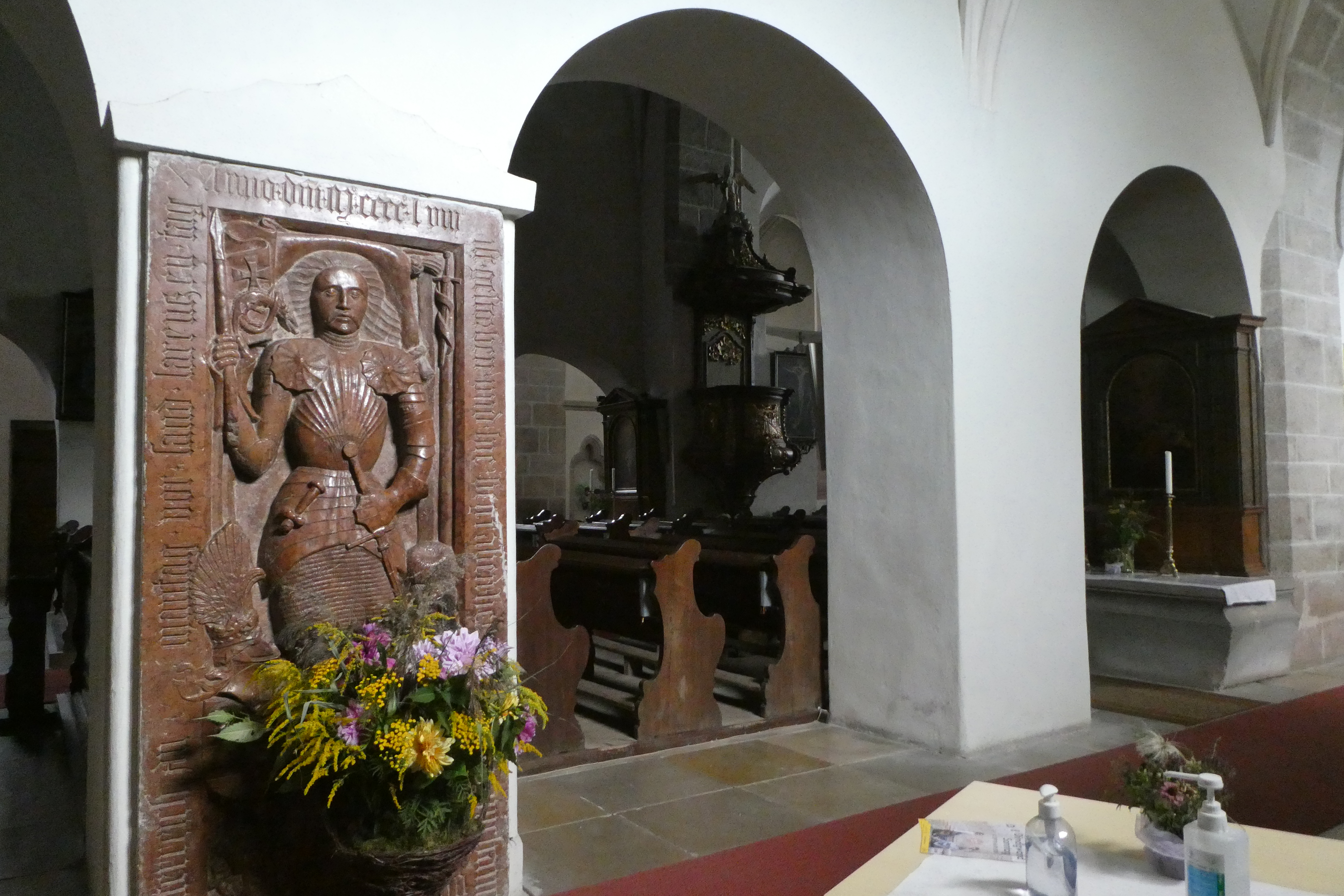
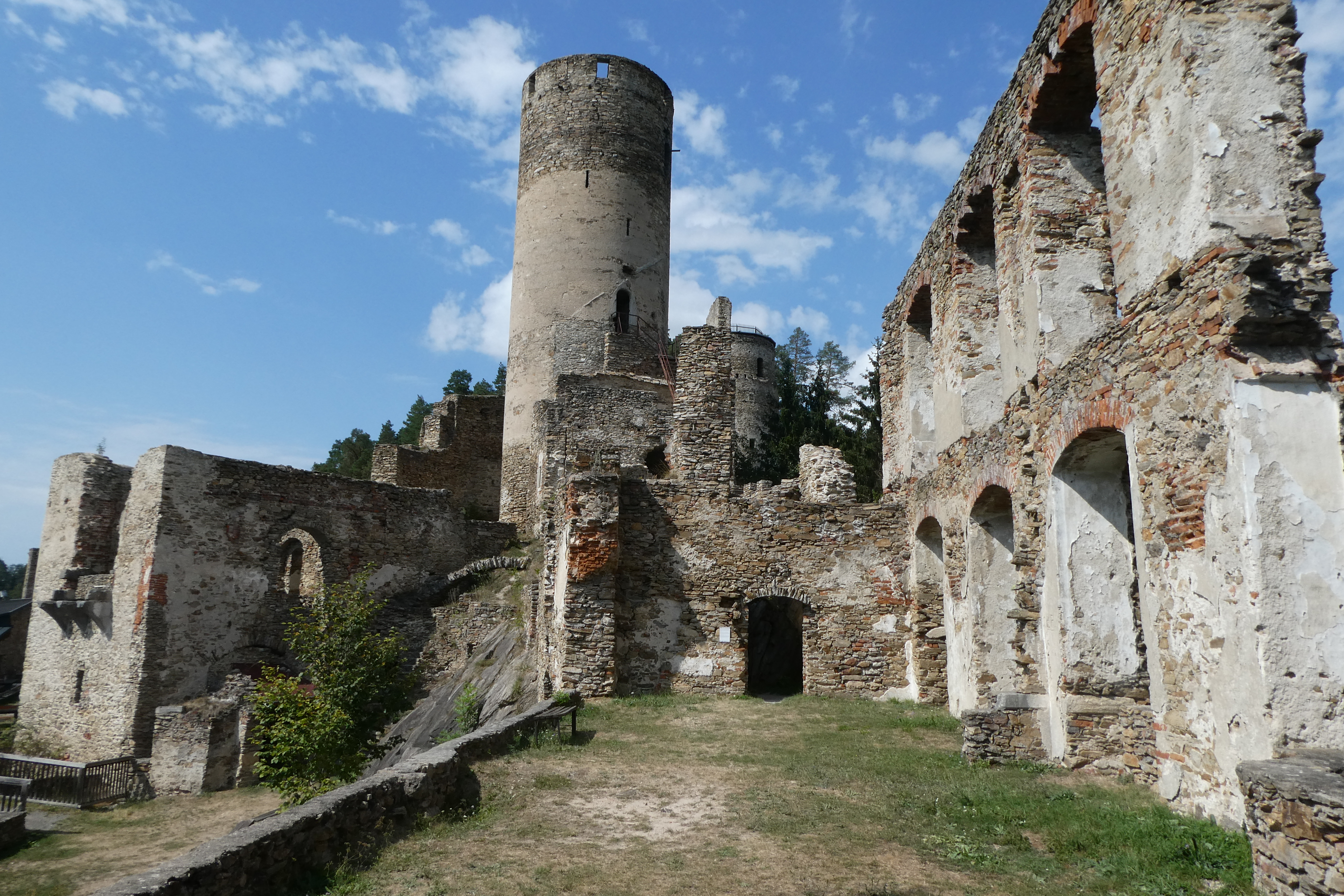
On the evening of my arrival I was late to be admitted further into the castle but what I saw that evening was enough for me to want to come back the following day. Who wouldn’t? Although I wasn’t sure I could see anything better, here are a few of the photos I took the following day.

Hope your interest has not been raised.

By P.S.

Treasures of Austria – lesser known towns and cities, churches etc. – Sankt Pölten

Tags

, , , , ,

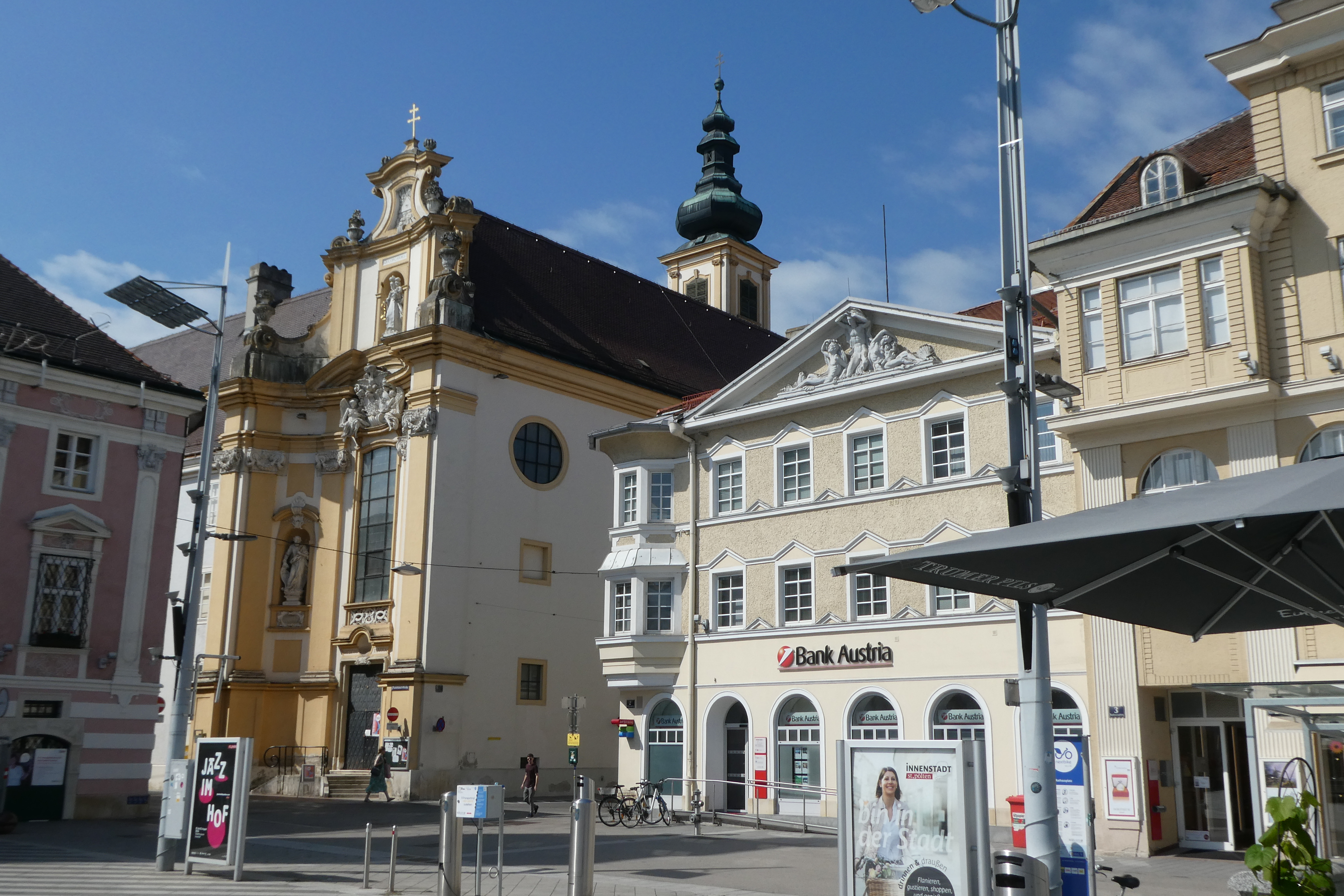
St. Pölten has only been the capital of the Niederösterreich, the largest province (or state) and second most populous one of Austria, since 1986, although it may be the smallest of the provincial capitals with its 57 thousand heads. Although it is among the oldest inhabited towns in Austria, it is probably one of the lesser-known cities but it is a really nice place with several beautiful old buildings, churches, so very well-worth visiting.

Its main square is relatively well-known, not without a reason.

When I visited there, the famous Rathaus (City Hall) was difficult to see behind the tents of the market. It was a very busy day for the locals and visitors.

The Franziskanerkloster (monastery) and the Franziskanerkirsche are among the most valuable sights in town.

Unfortunately, I missed the Dommuseum, but saw a few other beautiful places instead on my short visit.

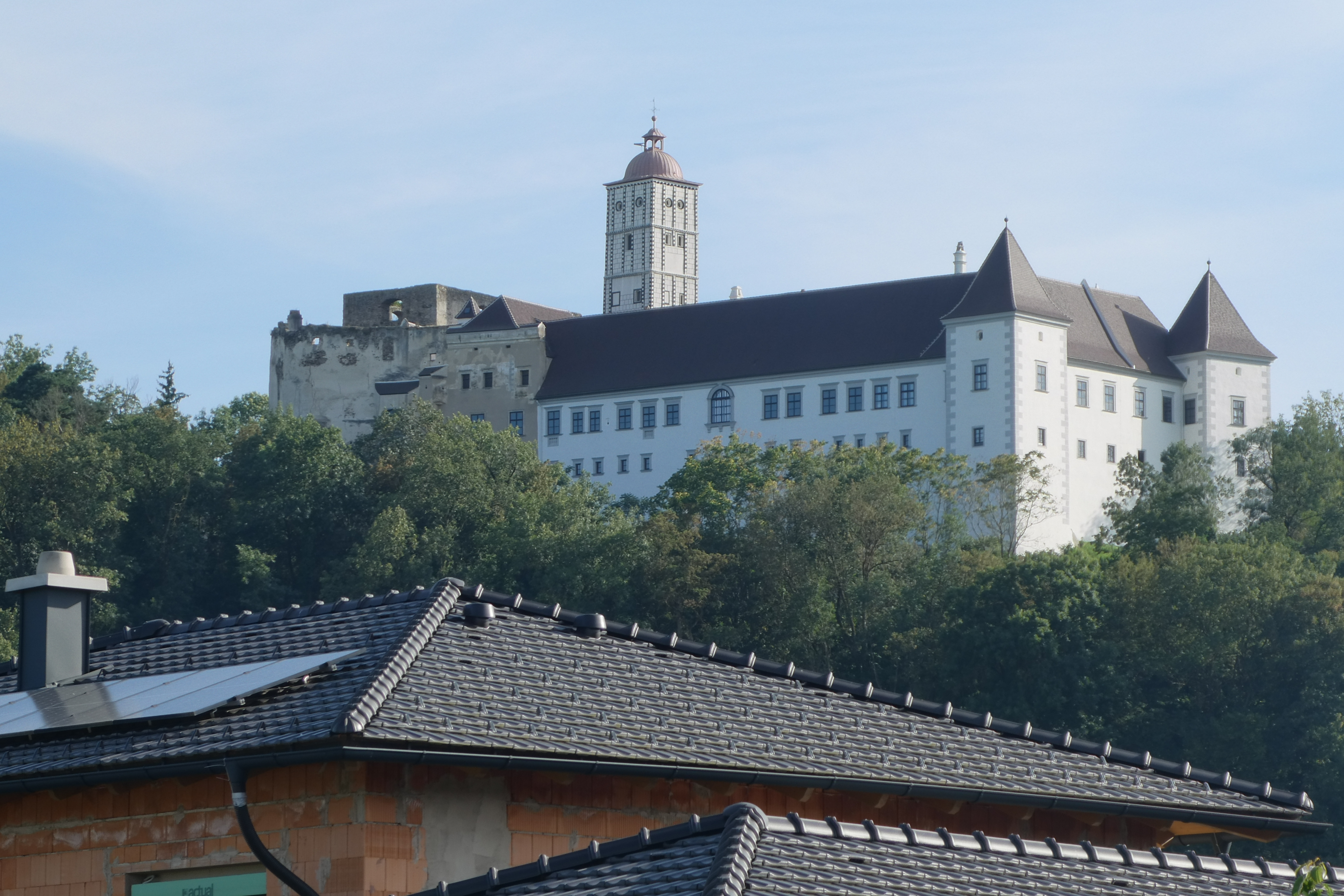
The reason why I was in a hurry was this beautiful castle nearby, for which I was late the previous evening but didn’t want to miss it altogether.

This was the castle of Schallaburg, where I was able to peek around and record the end of an event the previous evening – see below – but will show you more of, as I found it the following day, in my following post soon.

by P.S.

Treasures of the Thaya valley in Niederösterreich – Raabs an der Thaya, Schloss Raabs

Tags

, , , ,

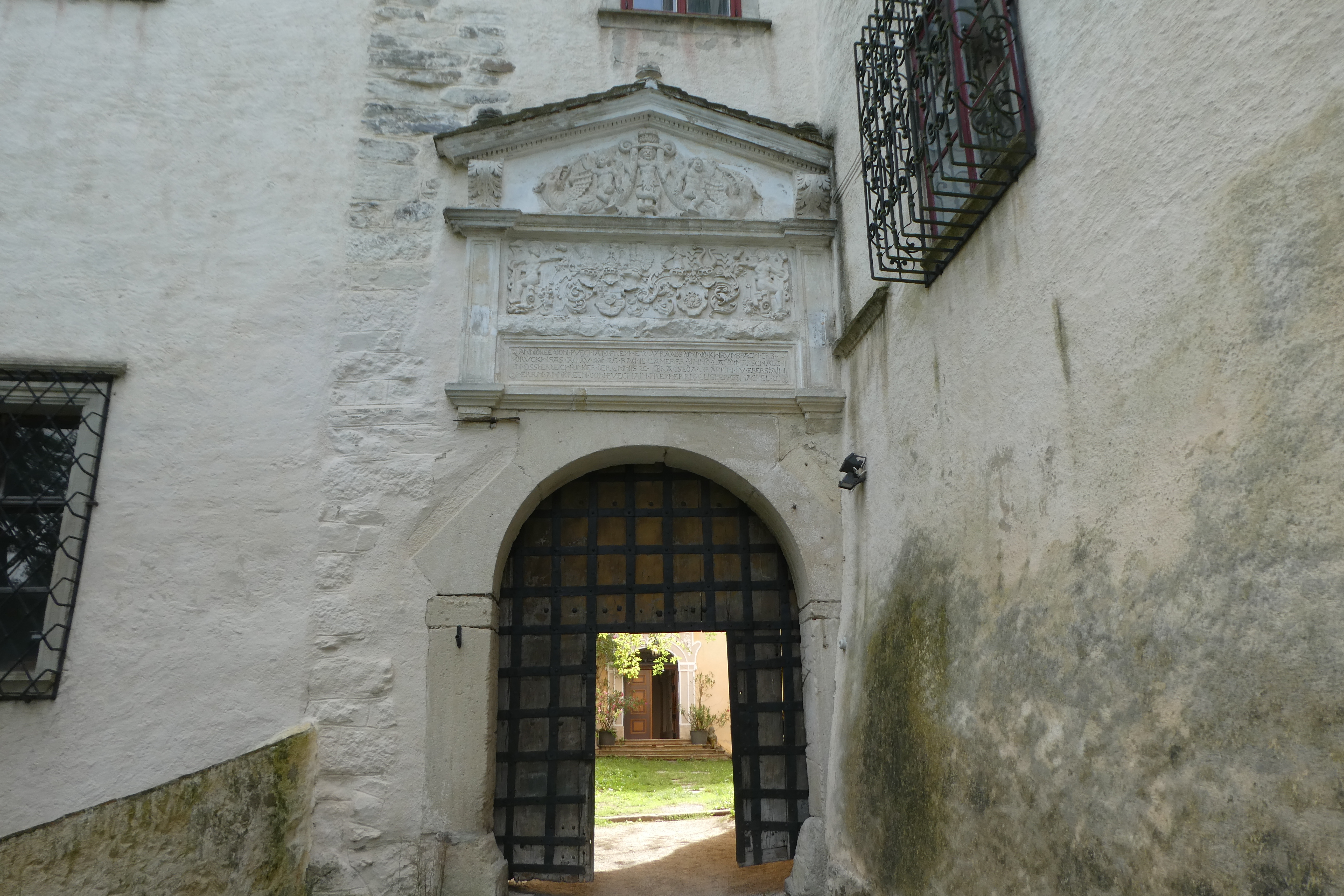
This beautiful place was a great surprise on my way – I never imagined I would find such a great point to stop.

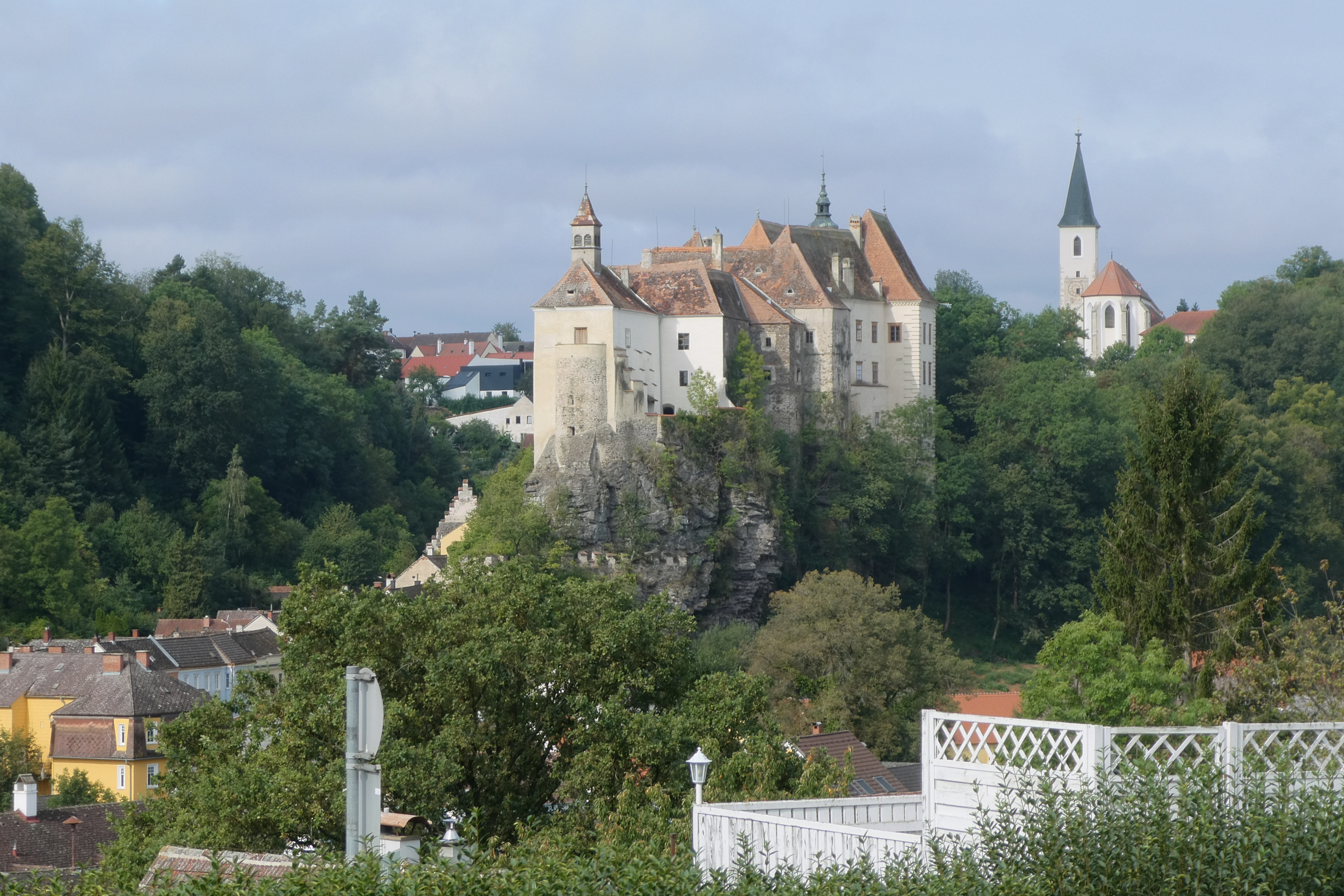
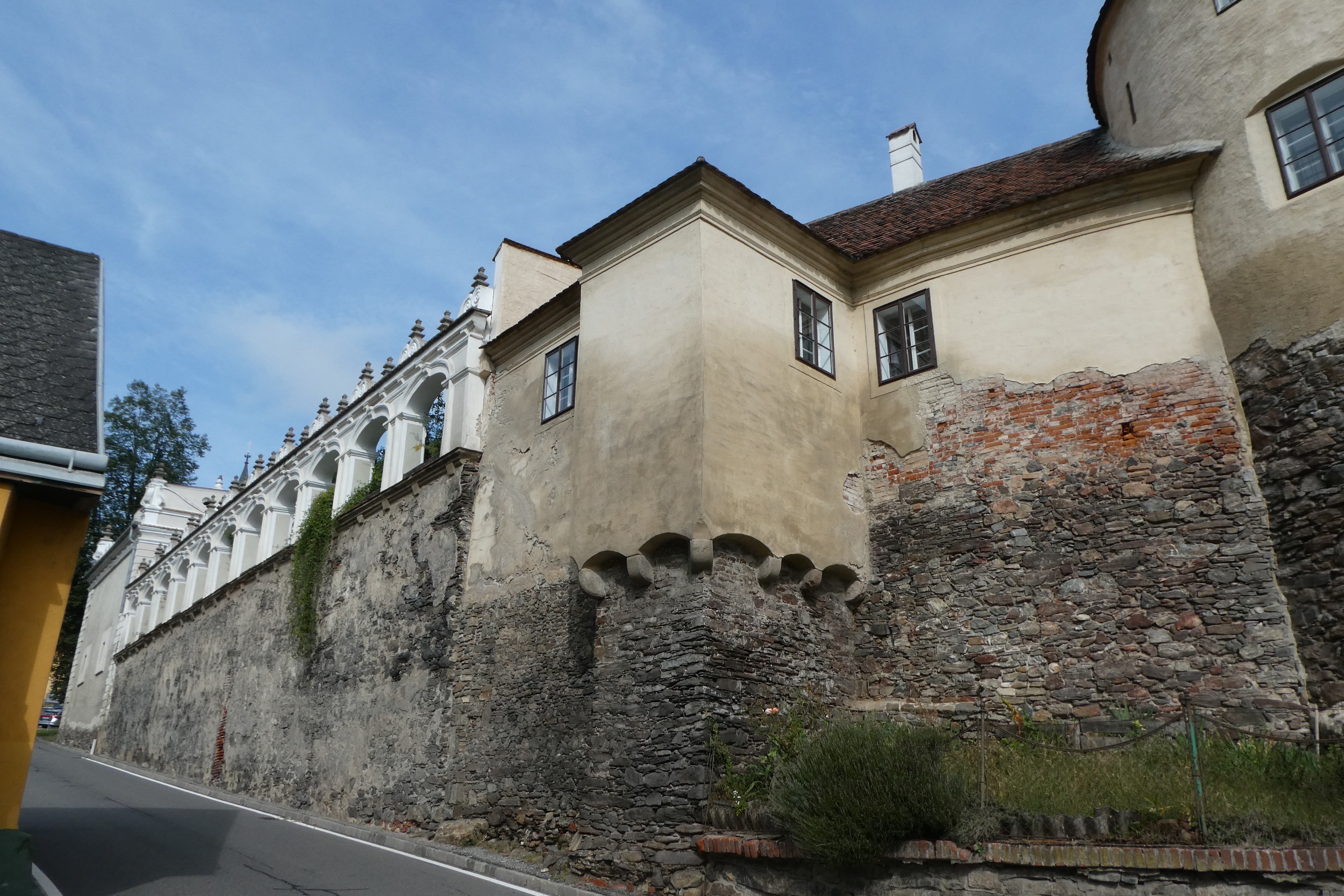
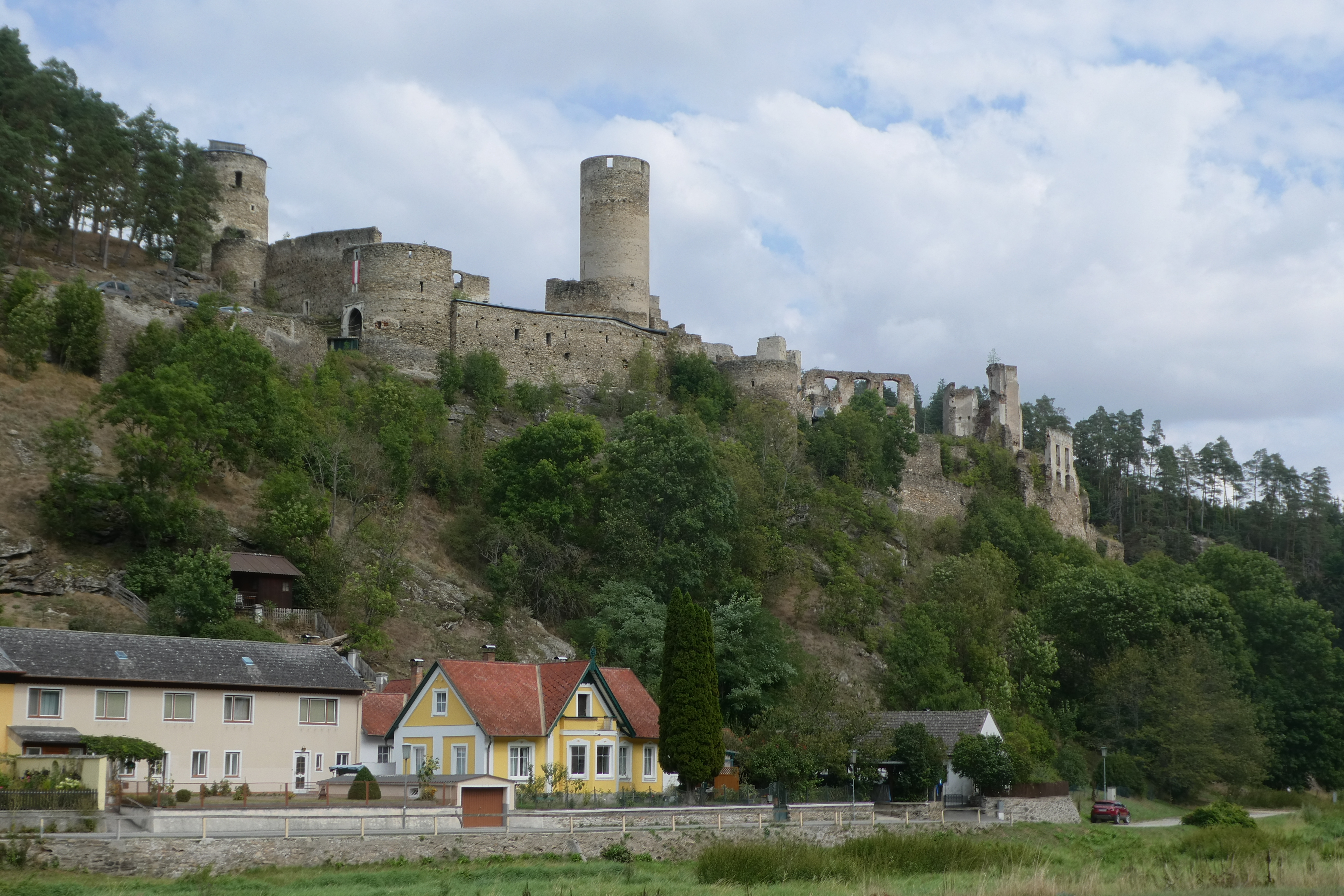
The town didn’t feel very interesting first but it was nice and it also has a couple of pretty churches to visit. But the castle, standing on a rock outcrop by the river and going back to the 11th century, was a unique experience.

At this point a solitary woman informed me that the castle was not open in spite of the flyer on the gate declaring otherwise, which I pointed out to her. And which also meant that I shouldn’t have entered but, with my curiosity, I did – without an entrance fee at that.

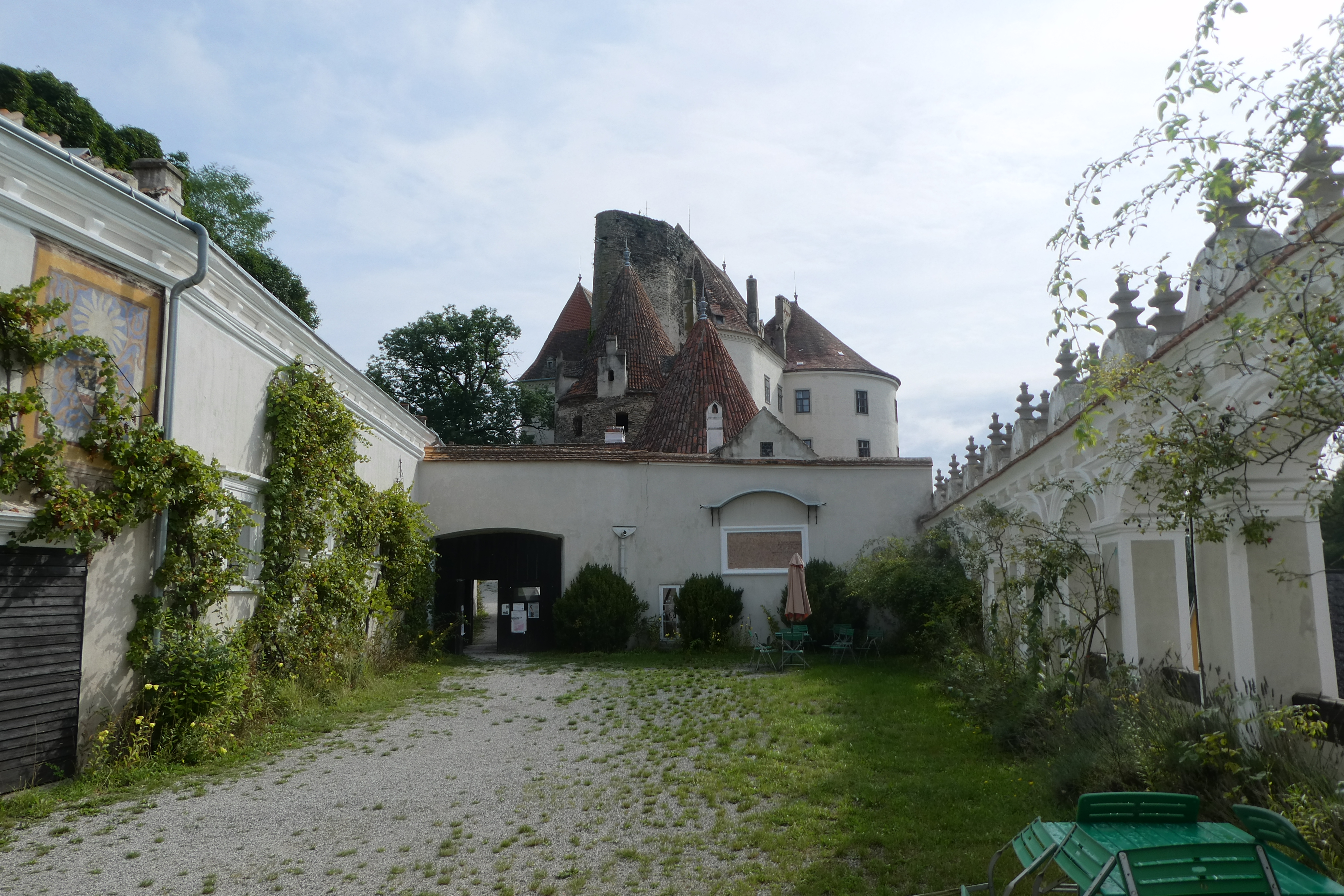
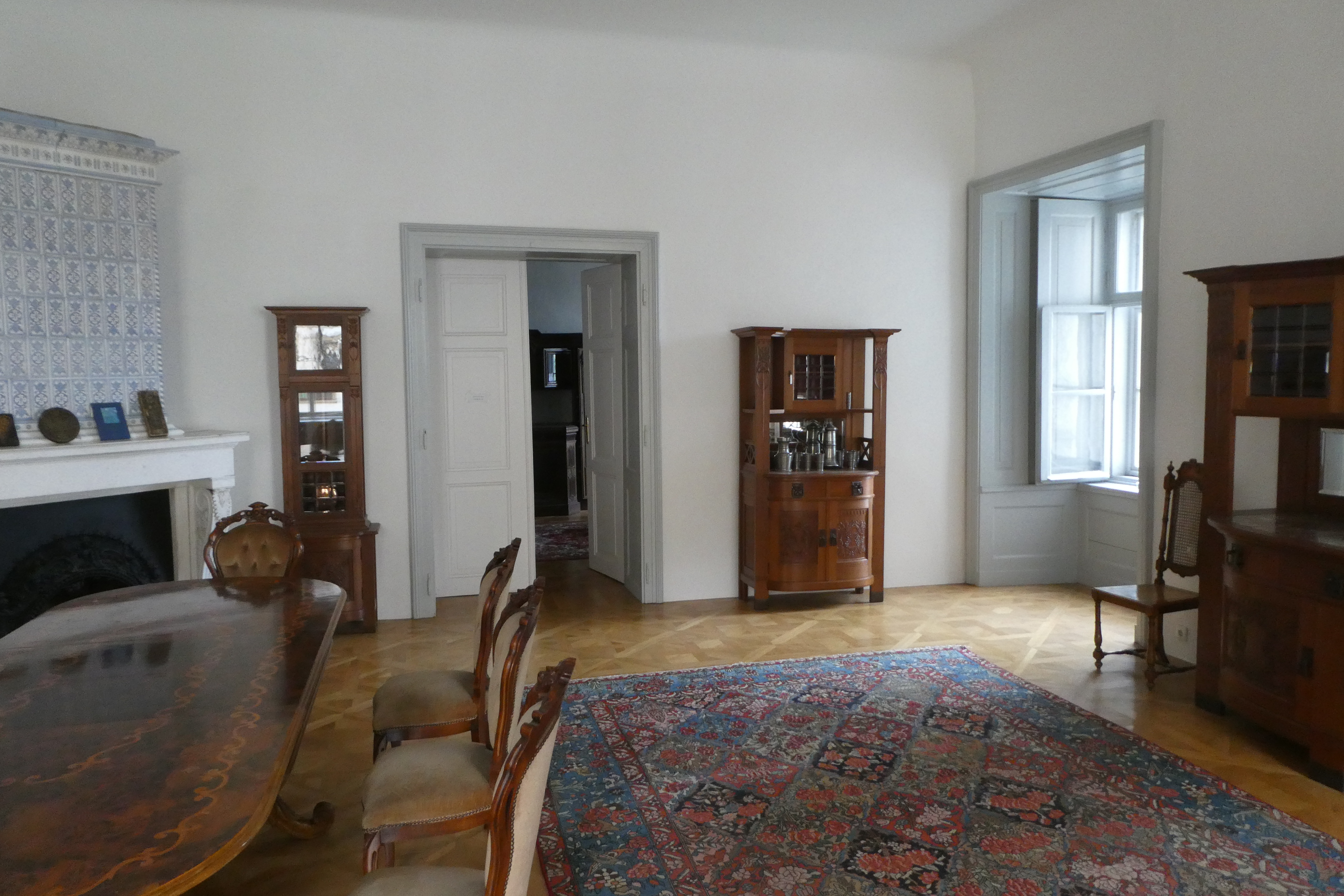
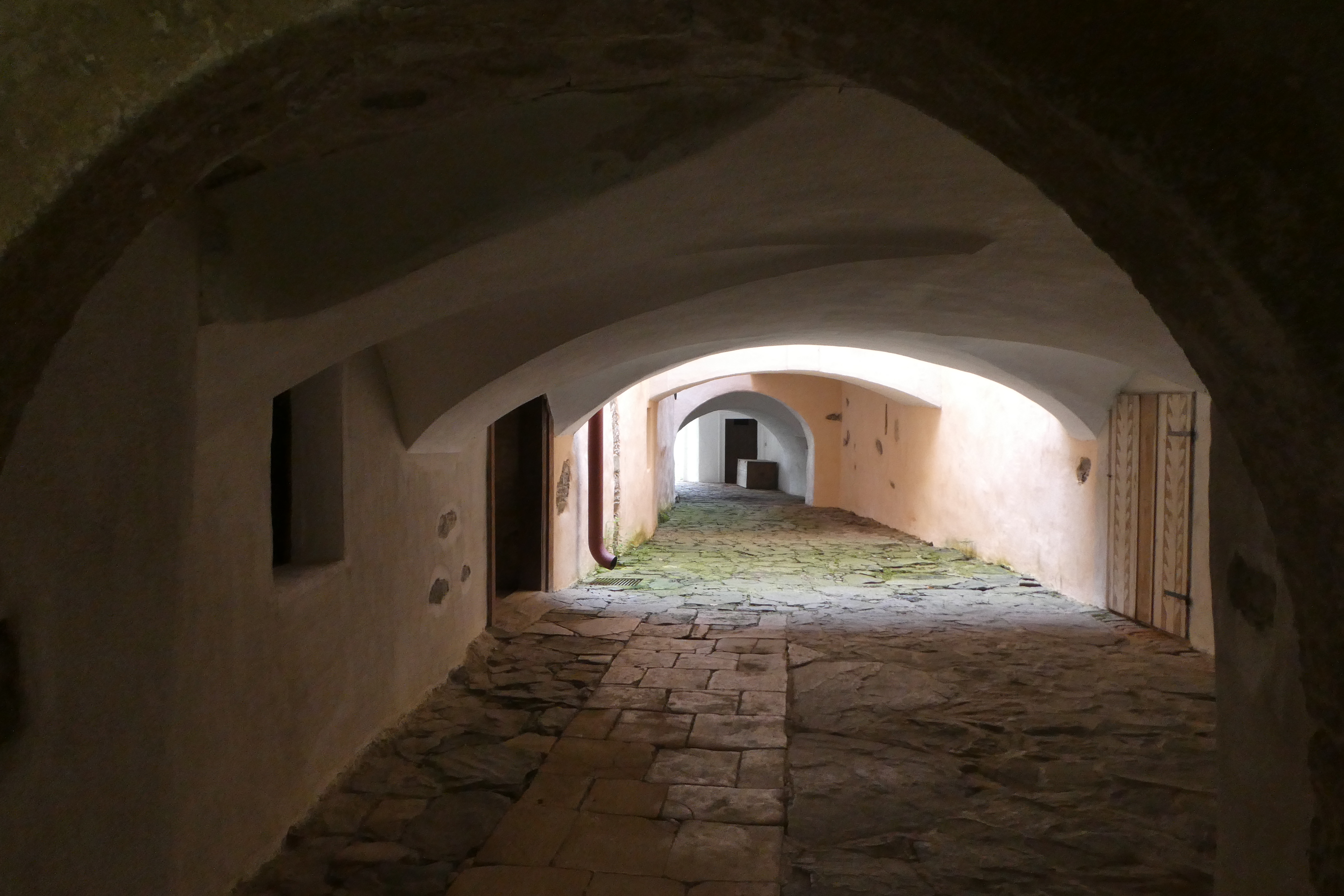
The castle proved to be near empty, save for a group of policemen, which I could have guessed from the presence of the two or three police cars parked outside. They seemed to be taken on a round tour – of what kind, for what reason, I neglected to find out: I just kept walking around, up, down, around again, to avoid them. What I found was a place without a semblance to a museum but with lots of signs of having been inhabited shortly before: by children. Lists of names could be found on most doors of what seemed to be dormitories. Good luck to me!

Other than this adventure, I found the whole complex quite interesting with a pleasant atmosphere outside as well.

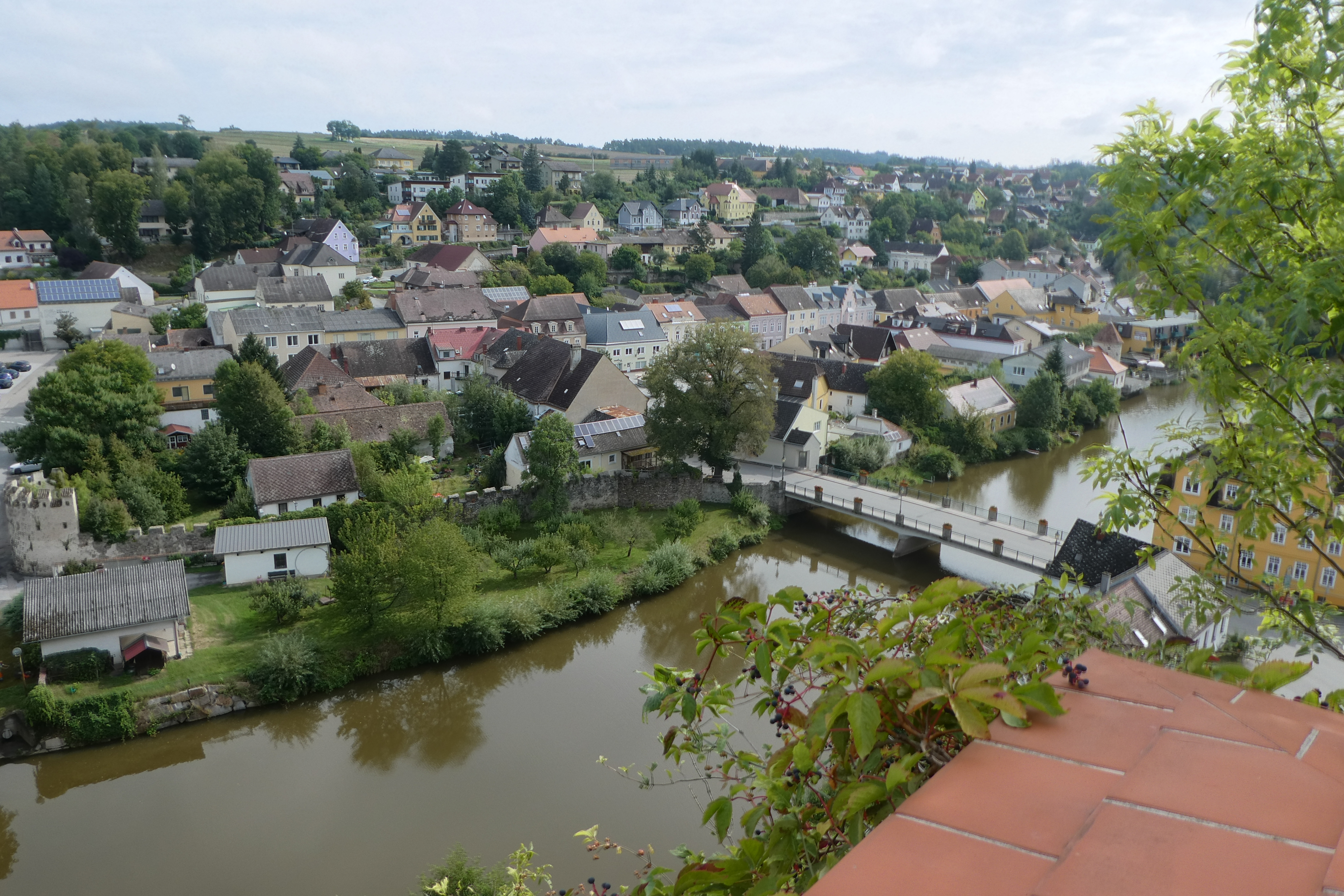
The view was also great, with the river and the Thaya.

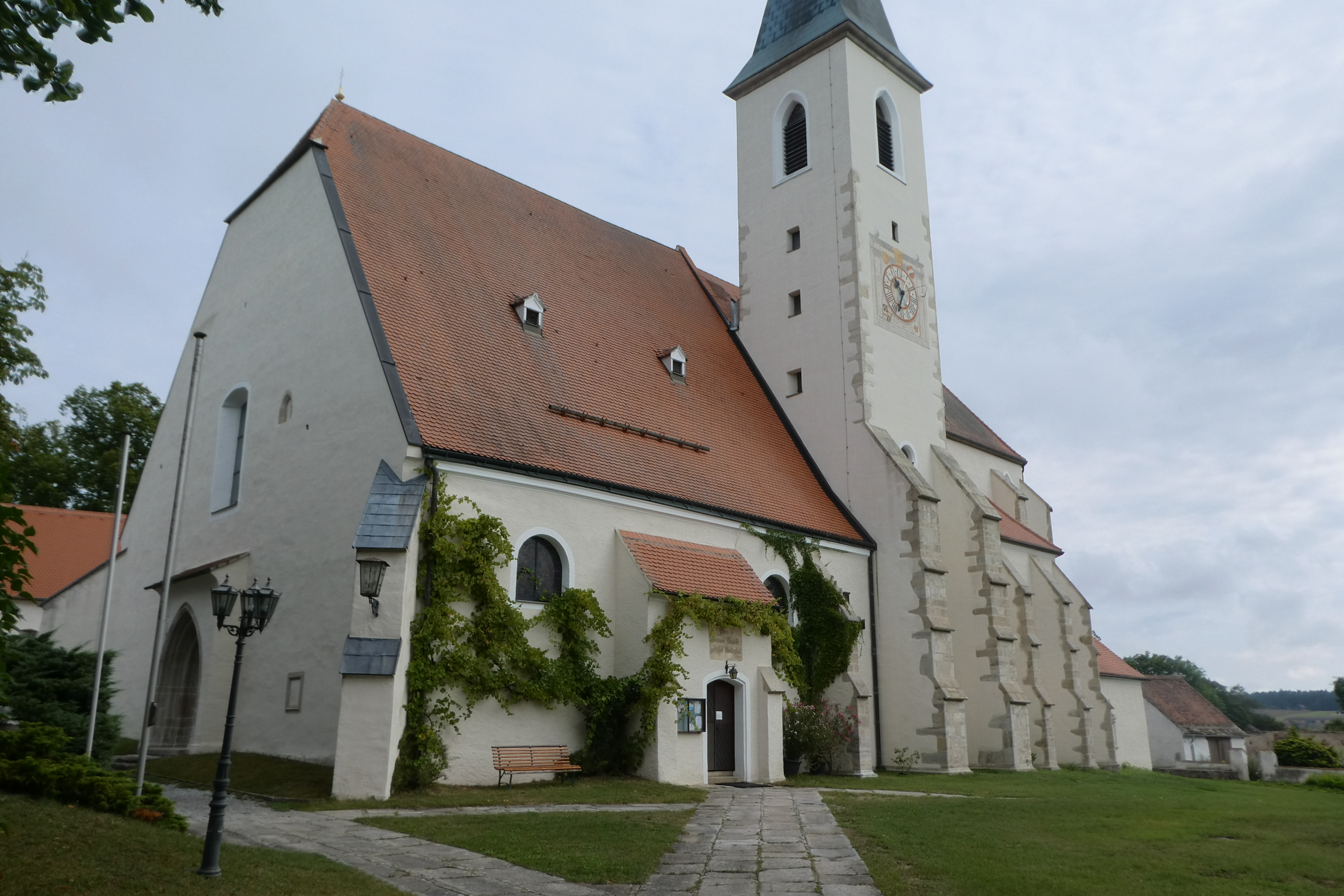
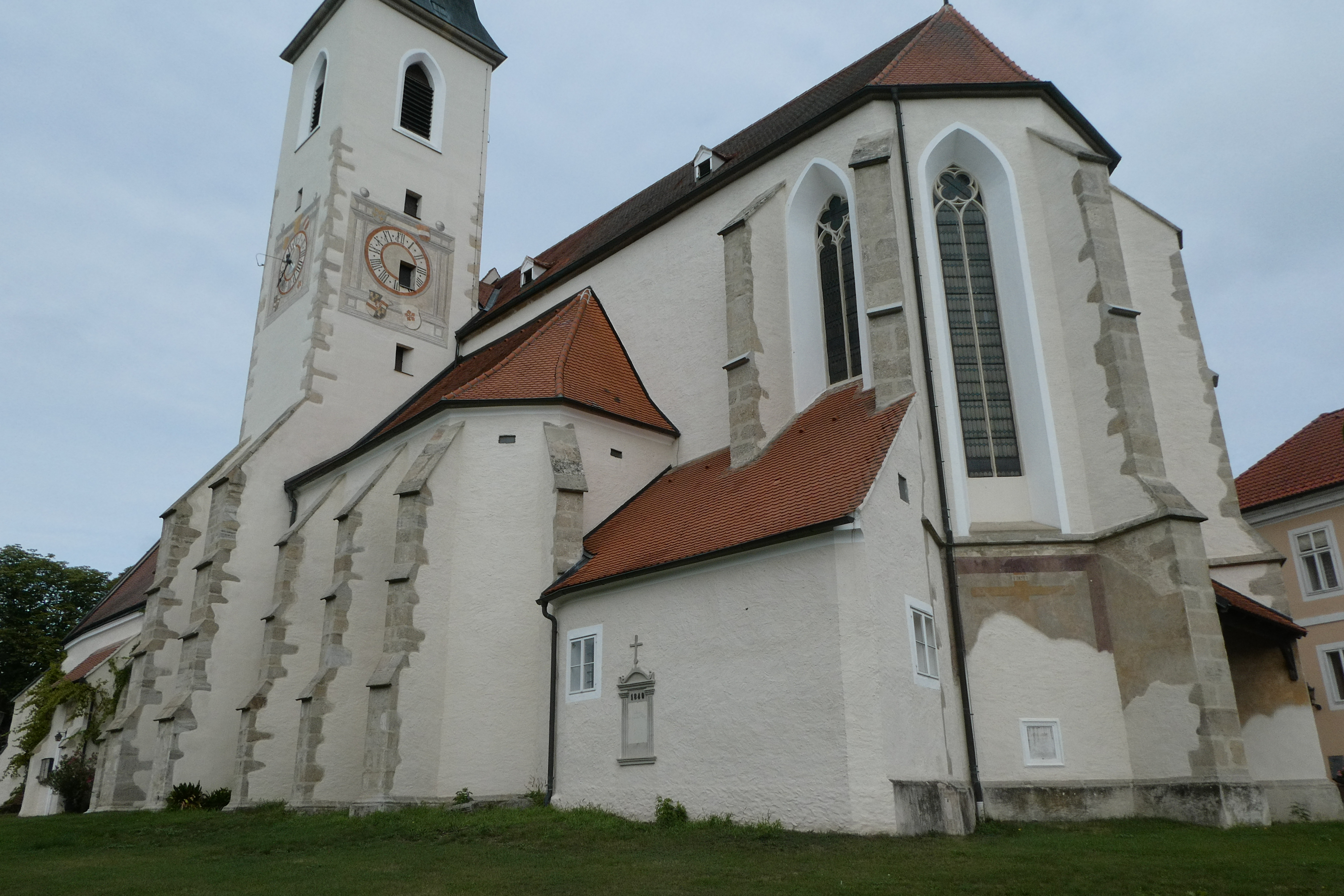
A bit further on the rocky outcrop, I found an old church that seemed to be worth looking. It turned out to be the Pfarrkirche “Zu Maria Himmelfahrt auf dem Berge”, meaning the Parish church ‘To Mary’s Assumption on the Mountain’.

It goes back to possibly the 11th century (the level of the German courses from three different languages I’ve finished on Duolingo didn’t give me enough German to understand this decisively) with some gothic elements and late-romantic elements and an altar picture donated by Queen Marie Therese.

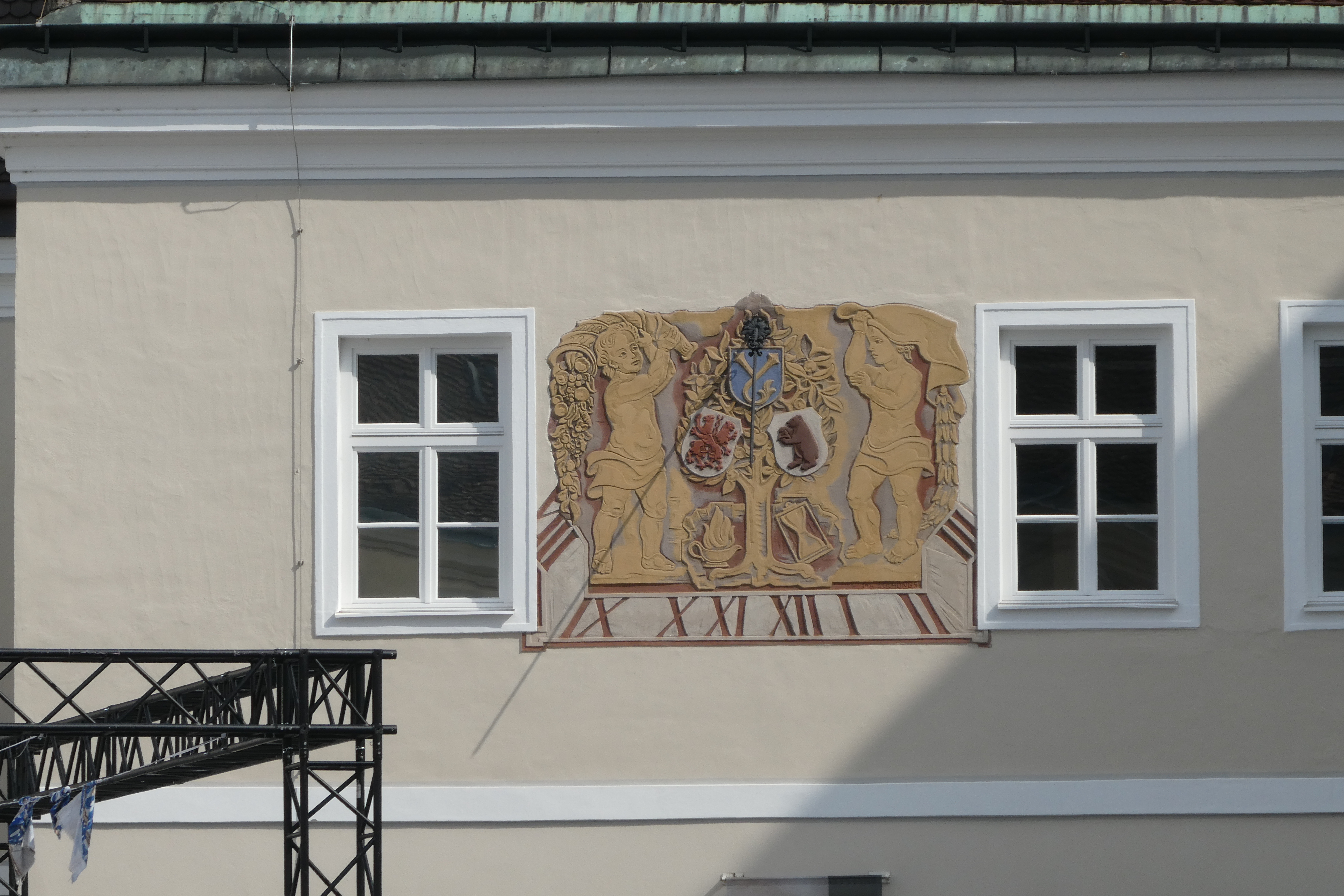
Interestingly, it has the oldest clock in Austria with a numeral face dating back to 1343.

On the way back I stopped shortly at the triangular Hauptplatz – it would be misleading to call it the Main Square but, functionally, that’s what it is -, a nice place

but, looking back, the castle is the absolutely best reason to visit this little town.

By P.S.

Treasures of the Thaya valley in Niederösterreich – Burgruine Kollmitz

Tags

, , , , , , , ,

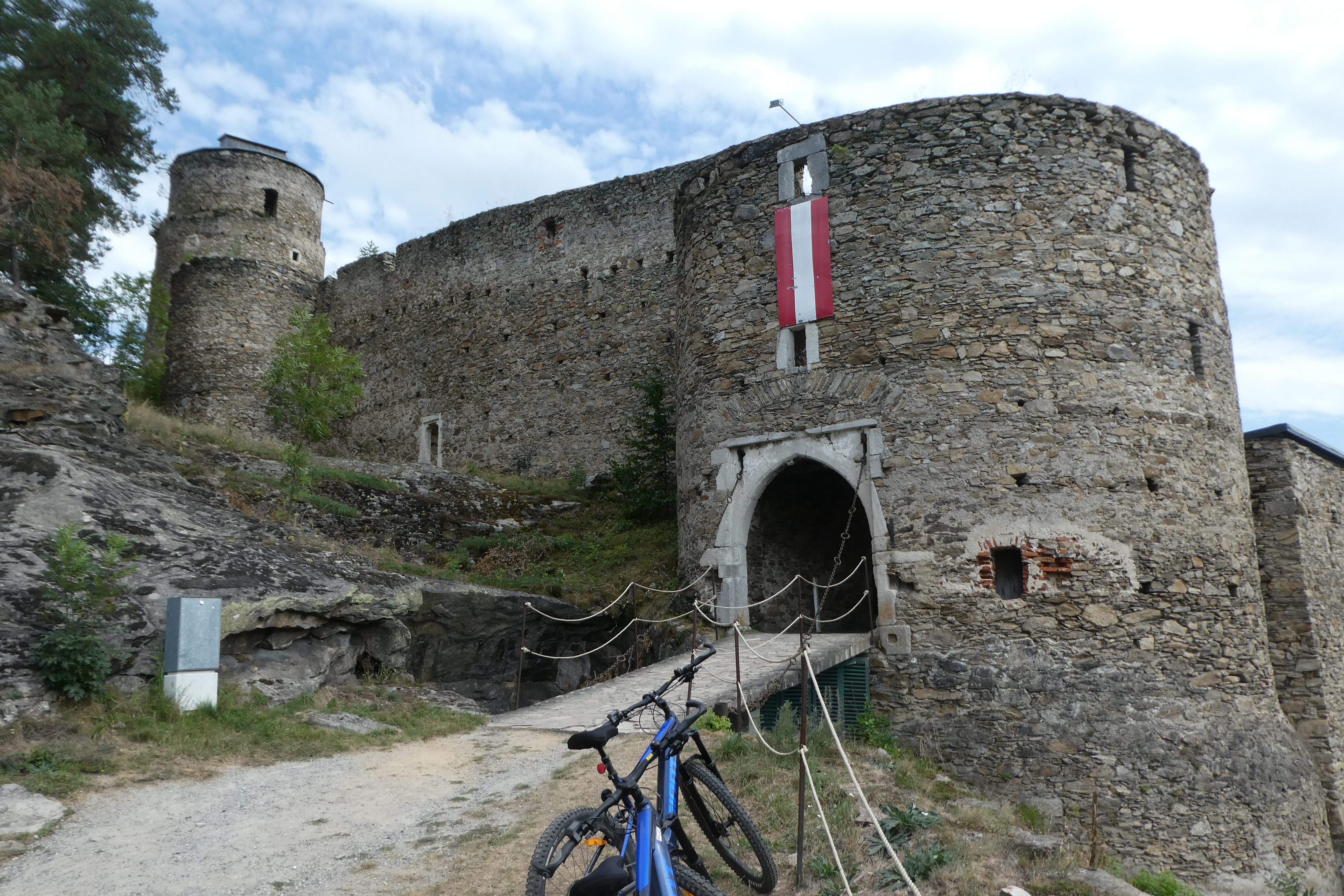
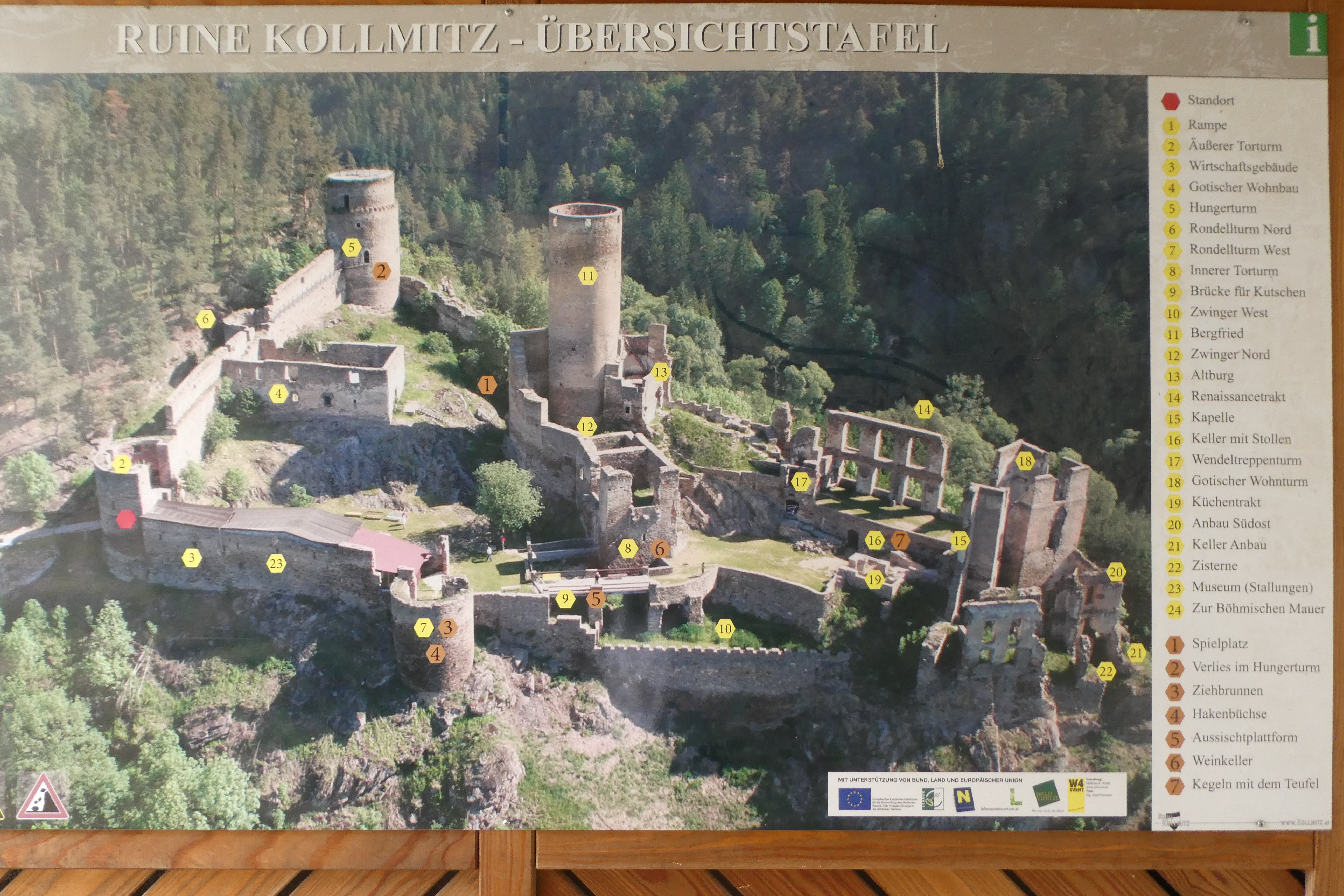
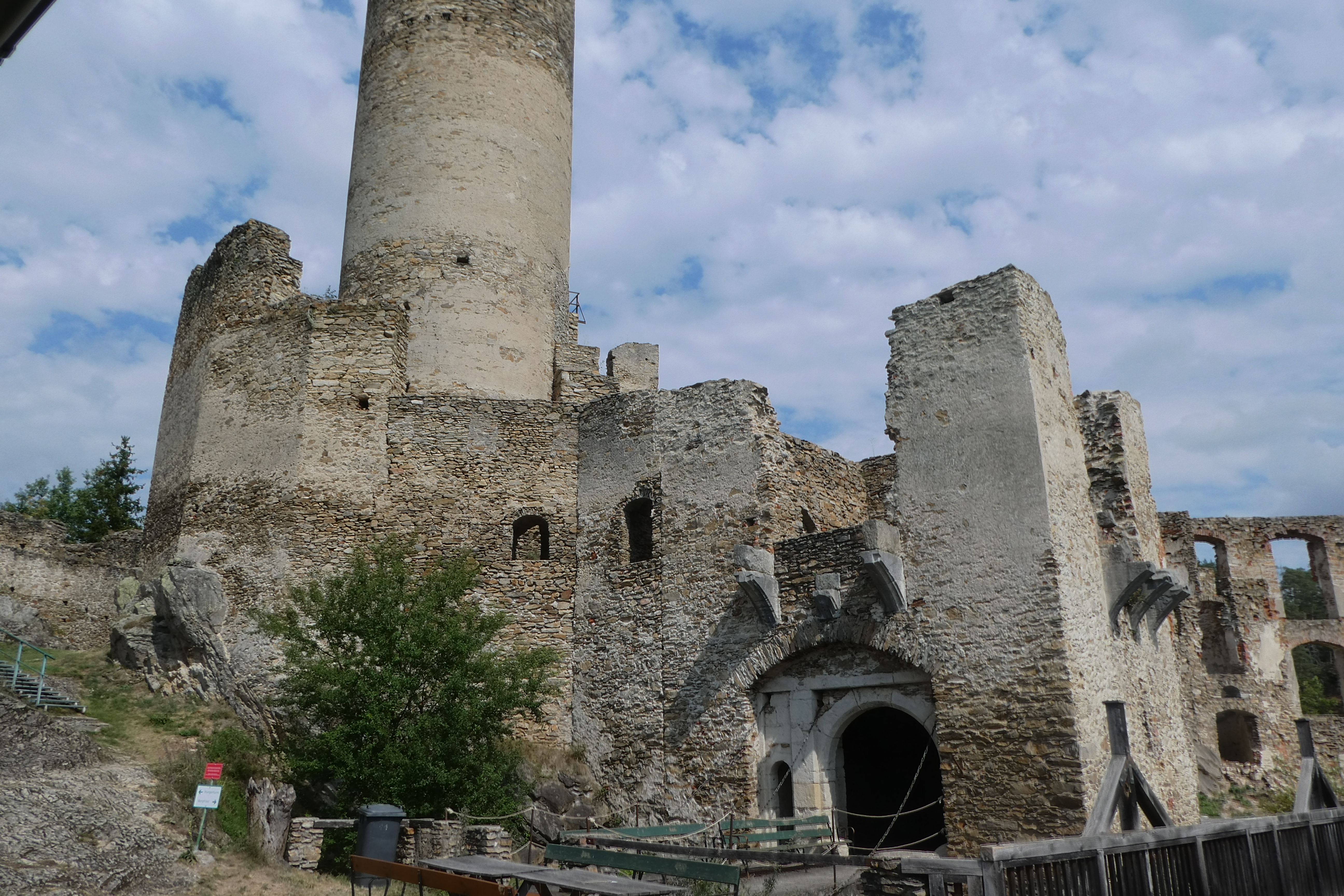
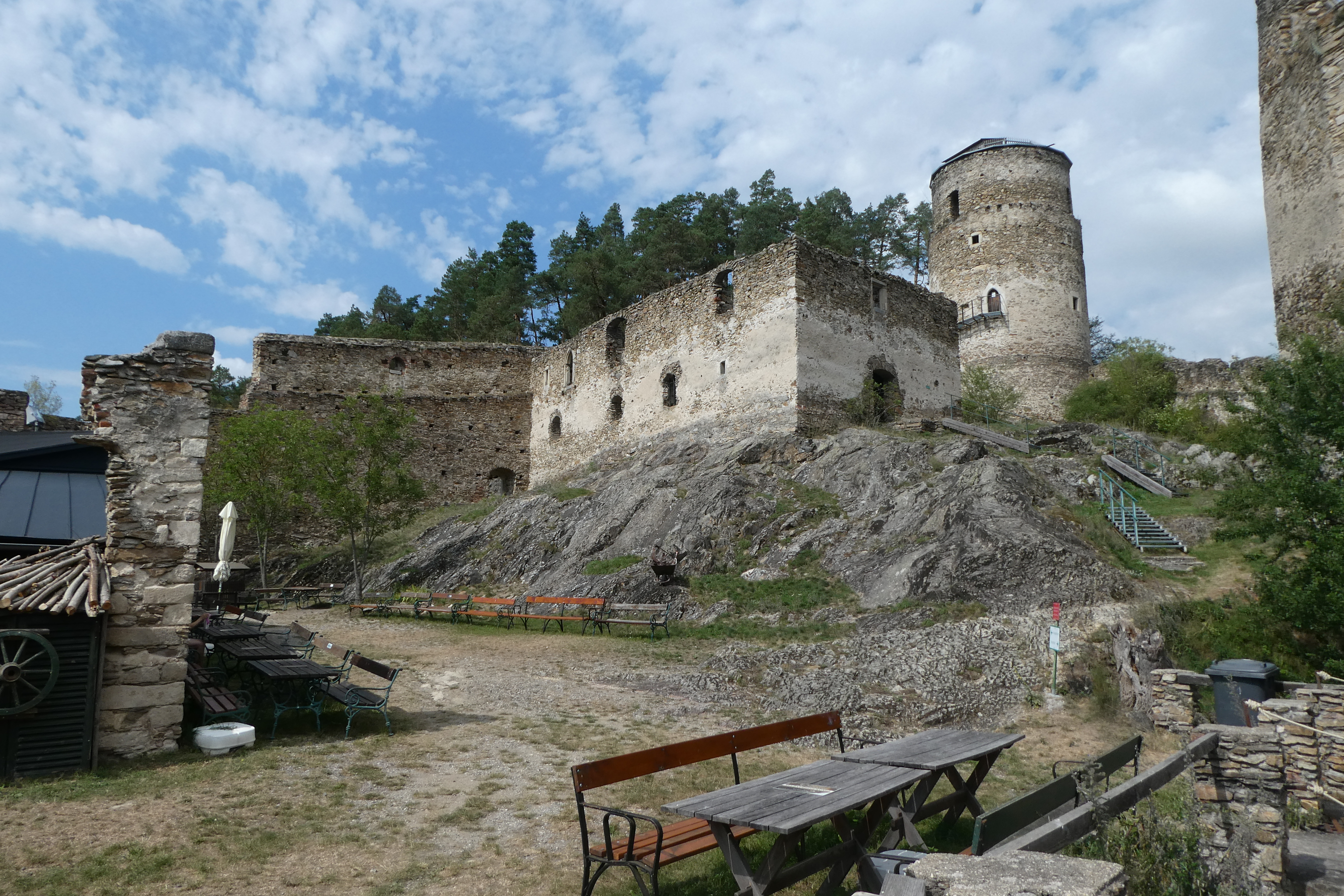
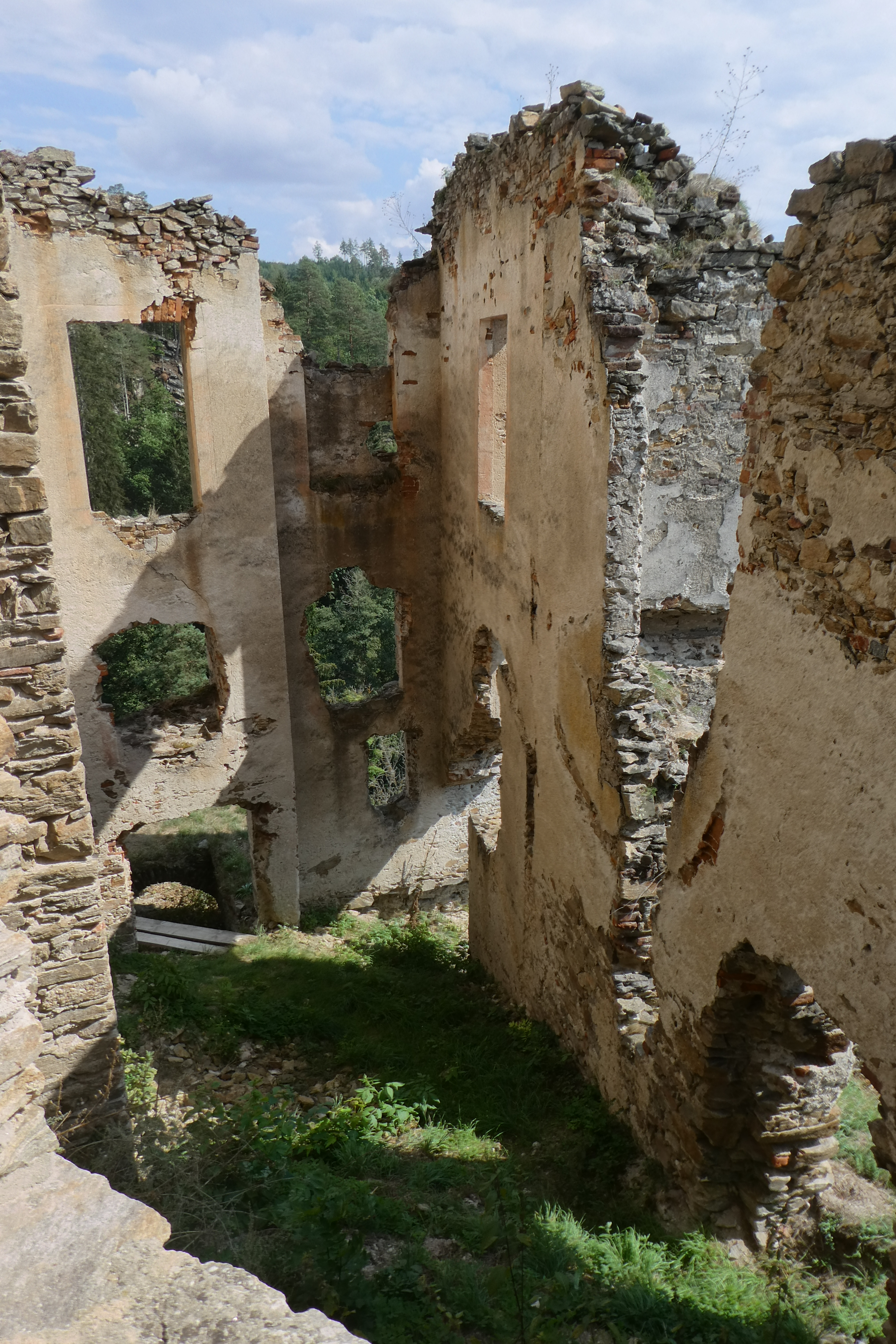
As I promised a few days ago, I’ll be posting photos of nature and historic places on this site from now on. The first area I went to was the Thaya valley on the Austrian side, in Lower Austria (i.e. Niederösterreich in German), to which an earlier university co-student and friend of mine, Prof. Dr. Dénes Lóczy from Hungary, drew my attention. When we studied Geography together, we never ever heard of the river or the area but now I can assure everyone that it’s worth visiting for a wide range of reasons. See below some of what I’ve seen in the area on my first journey – I’m sure I won’t stop short at this stage, health permitting.

You could see the river in my previous post, now I’m starting out with a view of the sight of the castle of Kollmitz and will lead you inside.

A little view of the rocks of the surroundings as we look back from the bridge:

The Thaya in August, and below the dam, looked little more than a stream – I’m feeling deeply for the locals during the difficult times of the heavy rains in the middle of September, when I’m writing this post.

Now, on into the ruins.

Here we can have a good look-around towards the South-South-West:

Climbing the towers, though one feels really high, is worth the effort:

That was it. Great pleasure, so much so that I felt I had to let the guards know how much I appreciated my visit – so I told them in my brand-new German. Learning with Duolingo for hundreds of hours wasn’t a complete waste after all…

But not enough for me – I’d seen that the ruins can be seen from across the river after it has taken a sharp left turn. So I set out to find such a place. Again, I had to ask local help in German – no English, please.

Well, I couldn’t really get to a point where the ruins were visible together with the river but perhaps you can try it with a drone next time. Until then, hope you’ve enjoyed these photos. Other places are coming later.

By P.S.

Changing direction

Tags

, , , ,

My dear readers,

Although I don’t teach English any more as I retired a few years back, I’m still learning languages in the Netherlands. Teaching is basically about learning – from our notions of what we can do to help our students to learn to the notions of other people concerning how teachers are notoriously assessed based on what their learners have achieved – and learning is basically about teaching – at least that’s what bad students think: they blame the teacher so I need not change much about the title in these respects.

Besides, all the space on my three related WordPress photo websites has run out and, to be honest, I find it a drag to set up yet another one when there’s still loads of space on this one, consequently, I’ve decided to temper with the name of this site a bit and add some of my latest photos here. If you liked my posts on my other sites, I can promise you’ll like these as well.

Part of the reason is also that I’m convinced that referring only to English is rather limited and limiting. I’ve realised having wasted decades of my life by exclusively sticking to it whereas for people living in large parts of Europe and Asia, other languages are at least equally important for everyday life, not to mention Latin-America, where it is far from being the most important language. As a result of my new-found passion in languages, I’d like to encourage my open-minded readers to learn other languages by showing you the beauty, like above, of sceneries and historic relics of where I happen to pass on my occasional journeys.

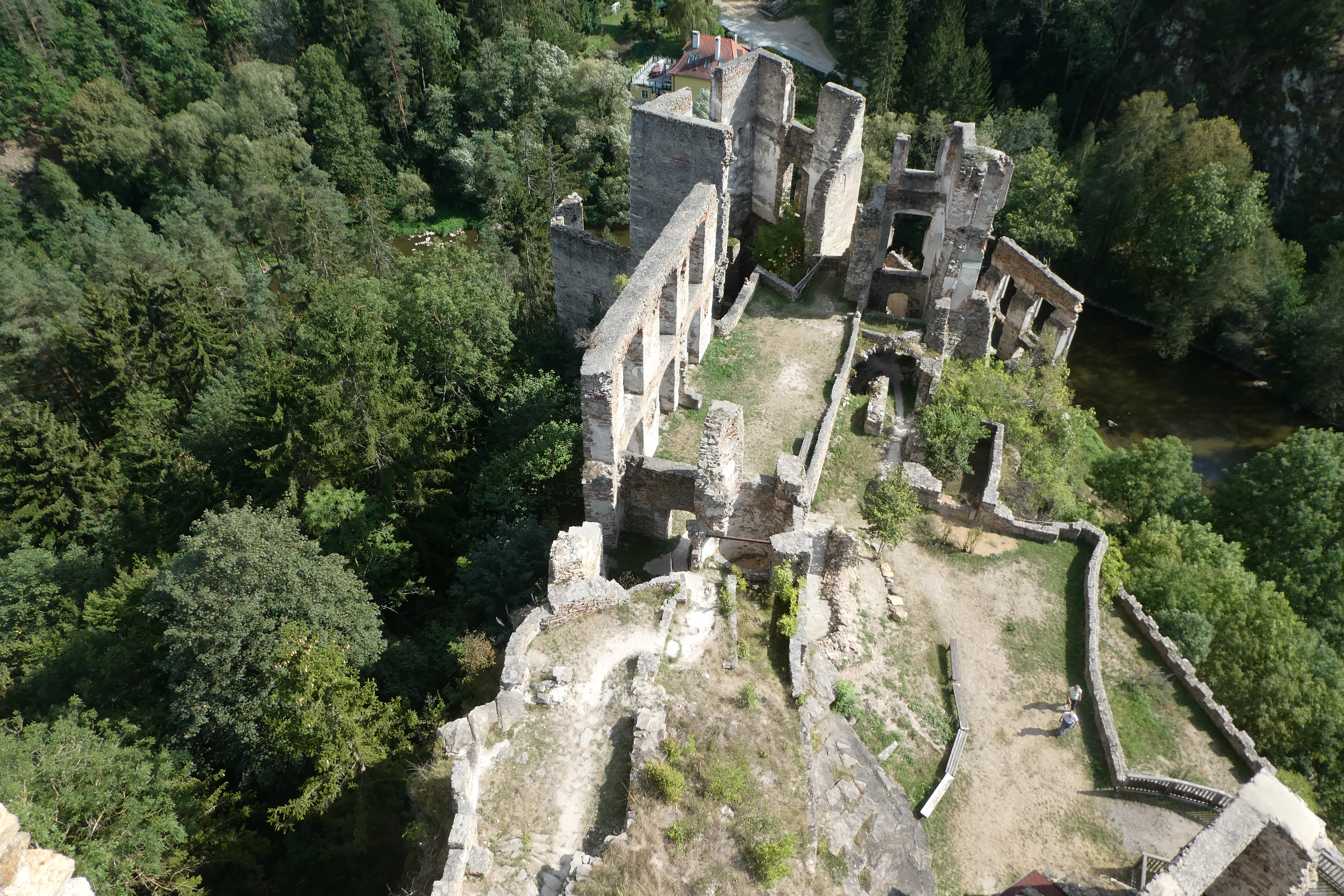
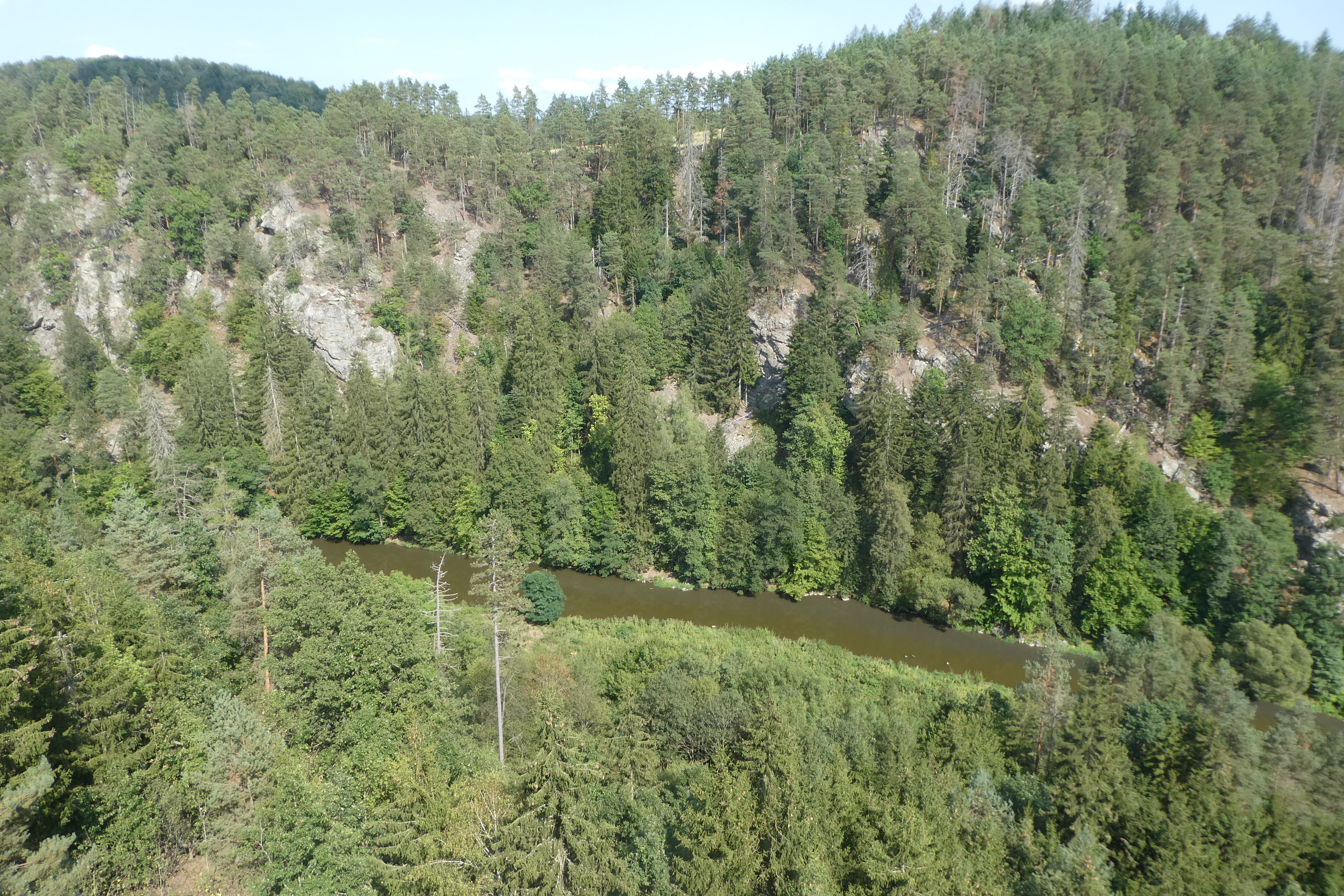
That said, I’d like to whip up your interest at my soon-to-come next posts, which will be about the north of Niederösterreich, more specifically, the region of the river Thaya, seen above and here below, from above, looking down from Burgruine Kollmitz:

Hope you’ll like what is coming soon. Otherwise, if you haven’t read my age-old, earlier posts on this site, you may still find something worth reading. Enjoy!

By P.S.

Learning Languages with Duolingo – extra no.2

Tags

, , , , , , ,

As a warning to Duolingo-learners who may need to get into touch with English on any of those courses, I feel the need to keep warning you about the quality of their English versions wherever they make obviously serious mistakes.

This time, again on the English-German course, as a translation of ‘Kannst du bitte die Teller abtrocknen?’, ‘Can you dry the plates, please?’ is rejected. They put in ‘Can you please dry the plates?’ as the “correct” solution. Probably because in German ‘bitte’ has a rather fixed position. But it’s a lot more flexible in English!

So, a serious warning to all people still learning English: both questions mean the same. They are simply identical. If you’re an English teacher, please don’t hesitate to point this fact out to your students and warn them about any other potential mistakes they are sure to encounter on English courses from any other language – a few months ago, I simply couldn’t help but hold my head in my hands in disbelief when I saw what my friends’ kids were supposed to provide on the Dutch-English course as “correct”, in dozens of cases.

A similarly strange rejection presents itself at some point on the Hungarian-German course when the simple sentence, “Kérem aláírni” needs to be translated. As an answer, “Unterschreiben sie bitte” is rejected in favour of “Bitte unterschreiben”. Just because, I guess, the original Hungarian sentence started with the equivalent of “bitte”. I wouldn’t even complain if the first were not very often presented on the various German courses in either word order. Do some course authors have to be so stick-in-the-mud? Not to mention the almost zero probability of native Hungarians actually saying that sentence – even the roughest official would tell you, “Írja alá, kérem!”

On top of it all, such problems beg the question, to what extent learners can trust the correctness of their courses on any other languages. They may have built a reasonable system of courses but, in the small details, they are prone to having made lots of mistakes. Be careful and, if you suspect anything fishy, try to double-check. Especially, as I pointed out in my original post on them, their use of English tenses and their unfamiliarity with ‘he likes doing sg.’ v. ‘he likes to do sg.’, the latter having very limited use but coming up in their courses all the time in wrong contexts.

by P.S.

Learning Languages with Duolingo – extra

A new discovery on these – otherwise “excellent”, as you can read in my previous post – language courses! On top of all the problems and shortcomings I amply described and explained before. But this one is so excellent that I can’t resist but share it with you. You can find it at the beginning of Section 6 Unit 11 of the English-German course.

What is the difference between this:

“schreiben sie auf dass ich fünfhundert euro in der tasche hatte”

and this:

“Schreiben Sie auf, dass ich 500 Euro in der Tasche hatte.”

The fact aside that the courses, thankfully, make no difference between small and capital letters, they accept sentences with or without commas, fullstops or even question marks, it is that in one, the number is written in letters.

Yet, one is not accepted – I tried a couple of times, just to be sure. Guess which one…

By P.S.

Learning Languages with Duolingo

Tags

, , , , , , , , , , , ,

Or Duolingo, the really helpful language teacher, which offers courses on beginner, intermediate and advanced levels

Or, the meaning of “The largest language learning community in the world”

Or, “Did you know that you can learn a language by learning 15 minutes a day?” (But we won’t tell you how many years it will take.)

I’ve met a lot of such slogans, countless many times, from the beginning since I started studying on Duolingo more than two and a half years ago, then starting with German based on English.

During that time I added several other courses I was interested in, depending also on availability, but my original doubts about those slogans and the usefulness of their system and methods have grown to considerable disappointment in spite of my considerable progress and achievements. Below I’m going to discuss why.

For the sake of those who don’t know me from these, much earlier posts, I better introduce myself before delving into the below, rather critical, essay.

I’m a native Hungarian English teacher and teacher trainer with CELTA/B, with teaching experience of more than 30 years, mostly done in Hungarian secondary schools and tertiary institutions and 3 years of work experience in a school and at a university in China. Afterwards, I moved to the Netherlands and, after odd jobs and learning Dutch fairly properly, I became a translator with a degree exam from the University of Budapest and an ATA certificate. I’ve been translating loads of texts among the three languages mentioned above, translated two Hungarian books into English and wrote and published a book about classical singing in the USA, as you can see in another part of my site(s).

Despite the above, I’m not a talented language learner. I’m average at best, sometimes even lousy. With the somewhat solid theoretical basis and the expansive experience, and despite the fact that I had tried learning eleven languages through my years, I only speak English well, which I started at 14 like most people around that time and on which I worked hard and much to build a career on. We all had to start Russian at around 10 as part of the friendship package back then. I was good at it for some years but at secondary school it faded and by the time I had to take my closing exam halfway dawn the university, I had practically forgotten everything. But I passed the exam owing to my excellent translation at the written part.

Afterwards, I studied some other languages on and off, either for a year or for a few months before I went on one trip or another abroad and thought I needed them, tried Chinese in China with only very basic success, enough only for travelling around and getting by at the market and shops, otherwise nothing. But I was above 45 at the time, and 55 by the time I started Dutch, with which I got success at the high-level state exam after two years of very intensive learning. Yet, to this very day, understanding fluent native speech often beats me.

These above led me to start learning what I considered a missed must, German, with Duolingo, and a feeling of missed opportunities to start revising some I’d learned – and forgotten – many years before. Starting Arabic along those proved to be a failed experiment.

Now, having established as a fact that I know how to teach – and probably learn – languages but that I’m very far from being a gifted learner, over to the matter of this language learning platform that advertises and promotes itself with the slogans more-or-less quoted as subtitles above. I believe my insight and opinion will be validated by my background and will be useful for lots of people out there.

As to the choice of languages, perhaps this platform truly offers the largest selection of language courses available nowadays. Especially if one doesn’t look too hard around the world.

However, there are limitations: as a Hungarian native, I rue the fact that there is only English and German offered for native speakers of this language. I know for a fact that there are still hundreds, if not thousands, of Russian teachers who could and perhaps would gladly do a course for this self-anointed champion under the right circumstances. Something similar may go for teachers of French, and if no teacher of either language were willing, there are thousands of capable students, at least, who could do it after being acquainted with the general content requirements of other language pairs.

Add to this how soon some courses are cut short: that Hungarian-Germain course is just a few dozens of sets long, and I know for a fact that some of my earlier students who studied German at secondary school and wanted to brush up and develop their German 15 or 20 years after graduation soon left Duolingo, as they said because it’s so predictable and stops at such a low level, it doesn’t help them any further. Of course, to me, as a beginner, it was useful as long as it went but the German courses based on my other languages are for more extensive and useful.

The EN-Dutch course is hardly longer – these two courses should at least be twice as long and deep for a reasonable level of grammar and vocabulary to be reached. The comparison is there with other German courses, for example, or the rather fast Russian course, where one reaches the level of using participles for abbreviated clauses within a few months of intensive work, whereas I can’t even get near that in Dutch, were I learned several times more in a year in the Netherlands a few years ago. Which base language should I use to learn Dutch nearly half properly if English is not good a basis enough? I’ve browsed all source languages: no other source language offers Dutch, not even Bahasa Indonesia – and the EN-Dutch source is very weak, to say the least. Nothing, if you ask me. Perhaps if, as one rather good in Dutch, I’d chose English as a target language, I could delve into a lot more Dutch but I would be bored to death apparently learning English, my professional language for over 50 years. Unfortunately, the Dutch-German course is also not very long or deep: it is cut short at the end of Section 4 while the EN-German course is, thankfully, nowhere near the middle in Section 6. So much about teaching – and thus learning – languages on all levels.

Now, a few weeks after I first wrote this article, however, I have to add that my EN-German course suddenly – and very-very strangely – is cut off at the end of Section 5 Unit 44. What I supposed to be going on in Section 6 doesn’t exist – it has transformed itself into a daily practice circle, to which I could come back if I didn’t want “to get rusty”, as they write. They write, “Don’t get rusty — come back each day to refresh your skills!” – and I’m given practically the same sentences to solve every day I come back. How can one avoid getting rusty by repeating or solving the same 40 or 50 sentences for weeks on end?? And where is the course forward?? The same story with Russian: at the end of Section 3, Unit 39, it’s suddenly stopped, with those practice circles left. Those helpful guys behind that “totally helpful” Duolingo simply cut my studies short. And I pay for smoother progress! Not for very much longer, I’m sure.

Another problem is the painfully wanting grammar range offered, mostly on the English side of courses. Not only are the present continuous and past continuous sadly almost completely missing or used at surprising places in most courses I’ve been doing (“My grandkids are studying at the University of Vienna now”, as if they were to switch universities any time soon), so does Present Perfect seem to be unknown for the authors even when using the famous prepositions since and for.  Never have I seen a sentence begging for the Present Perfect but doing without it having a time adverb added when used in the Simple Past, like in “Guest workers worked in Germany” – always? in the 12th century or when? How can one properly learn the real meaning of the German past tense, which says, “Gastarbeiter haben in Deutschland gearbeitet”, which seem vague enough but is the German and the English tense system parallel? I very much doubt it.

I have to admit that in the EN-Russian pair, the Pres. Perf. and Pres. Progressive Tenses, unlike in the other pairs, often appear properly but I’ve never had the opportunity to see a single use of the Pres. Perf. Continuous Tense anywhere. Similarly, the Past Perfect is also missing although, for ex., as a translation of “Die Römer in Trier sind aus Rom gekommen”, it seems more proper than the use of the Simple “came”, everything having taken place in the distant-enough past. Even so, all these courses abound in sentences like these taken from the Russian course, “Unfortunately, this phenomenon is not studied enough” or “The substance is not studied yet” while in another example with the Pres. Perfect T., if I enter the logical “yet”, the programme throws it back as a mistake because the original sentence doesn’t contain ещё. Although the authors of the Russian course seem to speak the best English among the authors of my pairs, they still mostly insist on word-for-word translations and forget that even though the RU sentence doesn’t use ещё, the translation should be in the Pres. Perf. and, therefore, the use of “yet” should be considered absolutely normal and acceptable.

The above grammar appears to be non-existent in America but please, is every author of these courses completely ignorant of British EN usage and the Cambridge or Oxford Intermediate EN exams, or the Advanced Level or Proficiency levels thereof, or are they? Otherwise, they wouldn’t have made other, though not completely prevalent mistakes for which they’d be failed in any of them.

As a result, where the Pres. Progressive is used, for example, it is used in the wrong sentences, like in the German course it says, “The number of problems is growing with the city”, or, in the French course, “You aren’t sleeping enough”, apparently in answer to questions regarding somebody’s reason for being tired. This kind of, sadly and totally wrong, use of the temporary is prevalent when a general tendency is described and vice versa.

Another glaring example of blatant mistakes is the type of basic sentences like “There is a tree.” Just like that. These kinds of stupid “sentences” (begging the question, are the trees in my garden non-existent?) mostly appear in the French courses, whether from Dutch or English.

Other glaringly stupid shortcomings abound in most courses, like several examples of the type “Can you pronounce this word slower?” or, on the EN-Russian course, the translations of “такой же”, which is translated as “the same” without fail in sentences like “Я хочу такой же велосипед” or “Я хочу такой же пуловер”, which is absurd if somebody else already has that one.Are they promoting stealing? Or simply forget about the fact that “такой же” doesn’t only mean “the same” but also expresses the notion of “(a) similar” or “such as/like”? As yet, this stupidity is culminating in the translation “We have the same sweaters!” Two owners of the same wearables at the same time and place? Joint ownership of sweaters? That would usually be expressed a bit differently, wouldn’t it?

Just one more example from the middle of the EN-German course. When I’m asked to translate this, “Wenn sie nich verheiratet sind, dann sind sie ledig”, my solution from the offered pieces as “If you’re not married, you’re single” is deemed wrong for the omission of “then”. The writer must be a Hungarian or something like that without proper EN education because in English, contrary to Hungarian, no second connector is necessary after a conditional, and its use is at least strongly contra-indicated. They should have at least allowed for the usual correct solution instead of punishing it.

Above these problems, add the fact that sometimes a certain word is accepted on one German course but not on another. Examples are unfortunately numerous. All told, I guess these facts slowly undermine the learner’s confidence not only in the capabilities of the writers in English but, by extension through this inconsistency, in German – or any other target language, for that matter.

I must also mention the lack of context of meaning in all this, except in the conversations, which are only a small addition to the bulk of it all. The basis of learning on this platform consists overwhelmingly of single sentences. The learner is rendered helpless as to what the field of meaning most of the basic words belong to. Only one glaring example from the Hungarian-German course: one is supposed to translate “Van még egy menet?” into German. Well, this word has around a dozen meanings in Hungarian. Try looking them up and choose the correct (? no, the required!) ‘equivalent’. Guess which of them fits, according to the authors? No, none of them! Their choice is ‘Tour’. How come?? For the sake of those who don’t understand Hungarian but perhaps they do Dutch, here is the sentence “Na het eindexamen wil ik in België studeren” to be translated into German. Fine, but which ‘eindexamen’? The kind after secondary or tertiary education? No clue. And, of course, if you guess wrong, your answer is not accepted even though, through a large part of the courses, synonyms or optional sentence structures are accepted.

Some positives now, with some more problems following afterwards.

The courses are mostly well-structured, and a bit similar in this regard. The target language courses have similar build-ups so they will be familiar from other languages if one does another target. On the other hand, target languages from different source languages are reasonably different so one can not only reinforce from the second course what one has already learned from the first one but can also get new insights. Especially useful for French, where EN as a source offers a whole lot more than Dutch.

Learning some of the target languages involve good cultural background. I have found the treatment of famous tales and references to the Grimm brothers refreshing on the German courses – one mentioned Der Froschkönig, another one the tale of Rotkäppchen (Little Red Riding Hood). I’m still wondering how much learning about them in German will add to my German conversational abilities but they are still interesting. Sure, the EN-German course amply discusses the former existence and then the fall of the Berliner Mauer (the Berlin wall), which is certainly useful, while, on the other hand, no valuable cultural references appear on the HU-German course, which is also strangely cut very short, without going into the depth of the language. Similarly very short and shallow is the EN-Dutch course, which stops short somewhere at the lower intermediate level, offers little grammar, a very limited vocabulary but a lot of useless references to Belgian matters.

A detailed discussion of the old city of Trier and references to Bayern München can also be interesting for some people, just like some (Belgian?) Dutch or Chinese food specialities, not even avoiding Hong Kong food. However, I must also mention that I’ve never met most of those foods (except for the dumplings, or “jiao zi”) while living in China or since I’ve moved to the Netherlands, where there is a huge Chinese culinary presence. To me, the other words mean nothing, and I wonder if I will ever meet them, thereby doubting the value of their presence on the language courses.

The Chinese course otherwise mostly lacks cultural content, except if one finds such example sentences as “My mom threw away my game” as typically Chinese culture – I find it so since I know a few Chinese parents who, sadly, often react in such aggressive manner to their kids’ actions. Later on, the course suddenly jumps on features like Otaku, a Japanese word meaning “people with consuming interests, particularly in anime, manga, video games, or computers” (Wikipedia) or Weibo, Chinese for a microblogging website. Unfortunately, these are completely out of scope for most non-Chinese learners or those without an interest in such things, or those simply older than game-besotted young teenagers. Again, this is very similar to the food on the Dutch course, where we would be supposed to learn or remember meaningless things we have no idea about. Add to theses problems the hilariously wrong English that the Chinese course actually demands.

At a later stage of the course, in Unit 10 of Section 3, where they suddenly delve into investing and business risks, supposing perhaps that the learner has learnt everything before, beside such sentences to be translated as “No need for the honorable, my last name is Wang” or “Excuse me, what is your honorable last name?” where, obviously, no native or highly educated learner would ever use hono(u)rable, there are really disturbing translations demanded, from or into, “What is your honourable’s business/company/investment etc.” on account of the fact that, in such situations, polite Chinese does use 贵 (guÌ) a lot, and the word “honourable” does exist in English. But is not used in this way! I can’t even understand what the authors had in mind there. Compared to the strangeness and folly of such sentences, it matters really little that the pup-up meanings of Chinese words, even the new ones, are so often wrong throughout that the English speaker is usually left scratching their head as to what to do with the translations.

As far as the Russian course is concerned, it lacks culture other than, in parts of the course, containing sentences that, to me at least, harks back to the times of the party state and the questions a KGB agent might have asked people. Otherwise, this is the only course that deals extensively, to my mind a bit too much, with spacecraft, space research or the size of the cosmos and contains references to the world wars. How much that is due to Russian culture is a matter to ponder but the German courses also contain some references to cities or structures destroyed in the wars. No wonder. Then, towards the end of Section 3, after not very deep into daily language, the course plunges into deep science, experiments with elements and such, becoming completely irrelevant to the average language learner’s needs. And then the whole course is suddenly cut short.

The whole system features cartoon characters on the side representing various speakers all through all the courses I’ve seen. They make various movements probably intended to be funny. But these cartoons do not help learning itself except in the EN-French course, where they are sometimes used as background to what happens in the example sentences. Otherwise, some characters are outright exasperating, especially when one of them, Eddy, needs at least five seconds to pronounce some things like “Natürlich, Junior! Es ist dein Geburtstag!”, like this, “Natürlich… Junior! … Es ist… dein… … Geburtstag” on the Dutch-German course, or when, having finished a pronunciation practice session, Duo the owl begins to dance, apparently happy and in wait for the programme to provide you with your points so that you can go on to the next task but he goes on dancing and dancing for a minute, two minutes,… who knows how long the programme can get stuck – at such points you have to stop it altogether and start another practice task. A lot of time wasted.

Cartoon characters used for good mood is fine (for some…) but a further important element is the collection of points, which ranks people from beginners, and it all allows learners to move up from the lowest tiers called precious metals and stones like ruby up to the highest one called the Diamond League. Utilising people’s urge to compete, urged by silly figures, is one thing, however, and creating an unlevel field to do so is completely different: there are big differences as to the provision of opportunities to collect points among various languages, which I find quite disturbing.

Several language pairs, I guess mostly involving the large western languages, contain conversations along the courses to practice and collect points by. Additionally, they offer revision opportunities. Completing such sections of 10 sentences, which could be revision batches, listening or speaking sets, awards the user 20 points instead of the maximum 15 points for successfully going through a normal set of 17 or 18 learning examples of fill-in or choice questions or sentences. This is a bit lop-sided, but when one considers that some courses have no stories to listen to on the course, or even worse, no speaking practice sets at all, like the EN-Chinese course, which, in itself, is a lot more difficult than most other courses, given the fact that one has to master characters, the gap among the possibilities offered by different languages can be considered outrageously huge. And I can’t even start to explore these features with the Arabic course, given the almost insurmountable obstacle of learning the special writing system. I’ve spent a good amount of time on Arabic but did not get anywhere further than the first few characters without remembering anything solidly so gave up.

The Chinese course has a lot to be wished for even on its own. I’m quite sure that one can’t learn those characters simply by pairing them up with what one hears pronounced and other very simple methods while no meaning to the characters is provided whatsoever. Except in Chinese primary and secondary schools, where the little ones are tortured hours on end per week for over a decade to memorise those characters – but they have an advantage: they already speak their mother tongue, so when they hear how a character is pronounced, they have a meaning to it, helping the memory. Still, even university students don’t always perform well enough on their Chinese final exams. Here, the character is pronounced, we have to match it to the one where it is written in Pinyin (the Latinised writing can be used for the sake of foreign learners to recognise at least the pronunciation) with the intonation provided, then it is done vice versa once, which can be done except if one has no hearing at all, and then that’s it – no meaning to anything at all, just recognise it! Then go on and learn it. So, one is supposed to remember meaningless scratches on the screen, basically, based on a pronunciation system totally new for speakers of European languages. Shall I say, well done!?

Fortunately, after months of trudging through the material – if you haven’t already given up and thrown your gadget in the corner –, you do have a chance to scrape, from parts of various words or sentences here-and-there, a couple of characters the meanings of which suddenly light up the darkness in your head. Otherwise, you can trust yourself to remember and sooner pair up the Chinese words based on the EN meaning and their Pinyin than remember the meaning of any character simply based on the sound. Or you can turn off the Pinyin, but then, how do non-Chinese learners recognise the differences among so many characters and remember them for good?? And again, in 15 minutes a day? Crazy if you ask me!

Added to this is the problem that there are no pronunciation practice sections at all, which is not only a difficulty if the learner wants to collect points but also given the fact that Chinese syllables can have four different tones, and each tone provides a distinctive character to the syllable, which is a basic problem to speakers of any Western languages used to sentence intonation, not to this syllabic kind. So, adding pronunciation practice would help a lot. Its lack doesn’t mean it is impossible to learn Chinese or similarly character-based languages like Japanese or Korean, or Vietnamese, which is reputed to have seven, not only four intonation variations, but understanding what one is trying to learn and practicing it as it is spoken would probably speed up the speed of learning somewhat – or considerably, which would suit the self-proclaimed best learning method in the world.

Speaking of pronunciation practice, which – probably – most other languages offer, there you may encounter some strange problems. Normally, the speech recognition system can correctly identify your sentence as correct, sometimes otherwise when it’s incorrect, but not very rarely, it simply cannot hear and accept correct sentences. In such cases, the learner can repeat the sentences twice more. You will often find that where for the first time it says something was not correct, it instantly accepts the same pronunciation for the second time. Sometimes only for the third time. Sometimes even then it does not, and in such instances you are allowed to go on to the end of the ten-sentence set where it will face you with the one that you – or the system – missed earlier. Strangely, it sometimes happens that your sentence is accepted at last. Or it will not be. Never. This forever-impossible obstacles are mostly numbers or ones associated with them, like kilometre. This can happen on any course in a way that, if the larger part of a sentence, mostly the short ones, consists of numbers, you will never manage to be accepted. In such cases you receive the message, Hm… that doesn’t sound right, then, That still doesn’t sound right, meaning the system is not geared to its acceptance.

Sometimes other bits are also impossible but, and this is interesting, if you start experimenting with various sounds instead of the correct ones, you may hit upon a sequence that makes it possible for you to be accepted. However, especially on the Russian course, even this is mostly impossible and such sentences like “Мария пробежала пять километров за двадцать минут” will prove forever impossible to pronounce, simply on account of the words kilometres and twenty even though you’ve said everything correctly. On the Dutch-French course (and probably on other French courses as well), sentences containing “Qu’est-ce qu’elle” or “Qu’est-ce qu’il” are difficult but there are sentences on the normal course material that only add one short word to these forever (like in “Qu’est-ce qu’elle fait?)” and then you’re stuck in the middle of Section 2 – there’s no way you finish that set of tasks and reach the next one if you don’t click on “Kan nu niet praten” (I can’t speak now), which is ridiculous and time-consuming. I suggested to their helpdesk to try and let the system listen to the original speaker to prove me right but, of course, I never received an answer and these problematic sentences go on and on being problematic.

Compared to the general difficulty of the language and considering the missing pronunciation practice, Chinese sorely misses advice about the characteristics and usage of the language in what they call “language tips” in their Guidebooks to sections of material. Seeing that what Western languages consider grammar hardly exists in Chinese, perhaps not much is needed but quite often word-order help would go a long way because that’s where the difficulties of such a domino-like language lie.

Unfortunately, about two years ago Duolingo scraped almost all the grammar explanation sections then still existing. As they had already been there, and because the site sometimes mentions that it is mostly for adult learners, they provided important help to learners, who are admittedly at least older teenagers or young adults if not elderly, to whom a considerable amount of the material is also geared. Such learners need a lot more grammar than toddlers learning their mother tongues.

Grammar help is especially sorely missed on the Russian course, which is relatively the most difficult language I’ve met, with its various forms conforming gender, case, number etc., which are not practiced enough at all. As even with the same gender, case or number, etc., different nouns and especially verbs conform to several patterns of their own, a lot more discussion of those and exceptions, and a lot more practice would be necessary. It is sadly missed. But this is a huge shortcoming of all the courses as they are now as a handful of example sentences is hardly an equivalent of meaningful grammar explanations

Sometimes courses of a certain language with different source languages differ considerably as to the treatment of grammar and the expansiveness of practice. In this regard, the French course for English learners offers a lot more than the one for Dutch learners so, with the extra benefit of more practice, a second course on the same language sometimes yields a lot more than more practice: more language help.

On top of all things discussed above, although one can send complaints to a couple of Duo helpdesk e-mail addresses, they never answer you, stating in their response mail acknowledging receipt of your mail that you may not receive an answer. You should not take it at face value: they never ever answer. It may happen sometimes that you receive mail about an adjustment to the accepted translations based on your suggestion but not to complaints about grammar or the pronunciation sets. “Duolingo ist tatsachlich hilfreich”, “Duolingo is inderdaad nuttig”, i.e., Duolingo is really helpful, an oft-recurring, audaciously self-promoting sentence advertises the platform to users on the German courses again and again – except that Duolingo is not helpful at all with our problems – staff don’t even deign to respond!

It is true that even without thinking (much), one can sooner or later be able to remember words, expressions or sentences of a foreign language. But to speak it, like in having a conversation with a – native? – speaker of that language, as in the English meaning of “Do you speak …?”, not in the meaning of some other languages where people ask “Do you know (German/French/Chinese etc.)”, well, that’s in a totally different league. If that can be achieved, we can be certain that the person understands the spoken and written language and can respond meaningfully in speech or writing – in the meaning of the four basic skills. Strange facts (surprises??): one can only learn to speak if one speaks, can only understand speech if one listens, one can only understand what’s written if one reads and one can only achieve a reasonable level in writing if one writes. But what in the world of Duolingo one has to do is mostly translate, which is a totally separate skill! True, during the course, one has to read and write some, but mostly one has to write what a word or sentence in the known language means in the target language, sometimes vice versa – which means one has to translate. As long as our brain needs to translate, the person can’t speak freely, that is, can’t speak the language fluently but has to decode that language in both directions first.

How does one learn to understand and respond to another’s spoken or written language fluently by translating what is artificially – and without context – put in front of him/her remains to be seen. Remember my Russian exam?

The only positive of the courses is that there’s an almost infinite possibility to repeat or translate sentences or phrases, which may (or may not), sooner or later, stick in the mind and the learner will slowly – very slowly – have enough neural connections to utilise in real-life circumstances. Once, in an earlier film, a character played by Antonio Banderas, who was captured and held captive by the Moors in a respectful manner, suddenly, after a few years, started to join the conversation of the Moors, who were taken aback and asked, Can you speak our language? The Banderas-character responded, I’ve had a lot of time listening to your discussions so I learned it.

It would be ideal if this fib could befall to real people. I am honestly afraid that there were people who believed him. In reality, this is impossible above the age of the babies and very small children. Above that age, the human brain needs more and explicit information and a lot more practice than those of babies. Here on Duolingo, we get a lot, we can repeat words and sentences endlessly but, mostly lacking grammar explanation and without conversational practice, the learner is in a very difficult situation. True, as it happened to me with German, the – almost – total ignorance of a target language can disappear as a result of the lot of spoken (recorded) input and the lot of repetitions in various forms of the target structures. But after two and a half years of relentless work of about 20 or more hours a week I have so far only been able to say a couple of sentences when necessary in Germany or Austria. Not much, not very confident, especially if I compare it to the progress of some of my – or my colleagues’ – English classes of yore, where students were able to conduct meaningful, though short and limited, conversations after a year or two of three hours of English classes a week.

So, to what extent can the learner accept and appreciate that insight Duo put up there suggesting that we can learn a language in 15 minutes a day? Given the circumstances on these courses, my informed guess is, almost zero within the framework of an average adult’s life span. One can collect “friends” in the system but can’t converse with them so, without that and without grammar explanations, I’m sure I’m right. The only viable feature is the fact that you can hammer the thousands of sentences into your brain as much as you wish – and endure. ”Repetitio est mater studiorum” may have been the only motto the devisers of Duolingo relied on. That was the way people of my father’s generation studied Latin (and German as well), short of any other method, in the 20’s and 30’s of the previous century in Hungary. As a result, my father could sometimes quote a famous Latin philosopher but neither of them ever spoke a foreign language.

The only question remains, to what extent we can believe that we may be able to converse in a target language in the distant future using Duolingo. How many hours a day do we need over how many years to be conversational? In some languages, like in Dutch, or without English as the basis, the easy answer is never, as some of the courses are very (-very) short. With other languages, if you’re young enough and find frequent opportunities to talk to native speakers often enough, there’s a chance. But without that, and if you’re a bit (or more than a bit) older than young, I’m quite afraid you won’t ever speak, or at least understand spoken language, fluently. This is simply not the way to achieve that. Better go back to school or take a private course instead of, or at least besides, Duolingo.

by P.S.

Language teaching (?)

Tags

, ,

A few weeks ago I received an opportunity to pay a bargain price for learning French online. I studied this language many-many years ago (several decades ago, actually) so, even though I travelled around France for a month afterwards, I’ve practically forgotten all of it since so I jumped to this chance, partly because I usually have some spare time since I’m a half-time pensioner.

The huge price reduction warned me to be cautiously optimistic but, for a few dozen euros, one tends to say, well, damn it, why not give it a try. I did. Then I was steered to this site, which shows several other opportunities for bargain prices, at least for two days for me as their existing customer. I have no idea in which countries this company’s offers are available apart from the Netherlands but, even though so far this seems to be like an advertisement for them, be aware: this is anything but!!!

The course begins with the pronunciation of the alphabet, which is not completely without logic as pronouncing some French letters could be tricky but it all misses the fact that it’s a lot more difficult to pronounce certain combinations. But small matter, with some memories of long ago, it wasn’t difficult, I went on to the second ‘chapter’ or ‘lesson’, whatever you’d care to call it. There are 15 of them altogether, which was a bit of a warning as well, although they seem to cover reasonable topics.

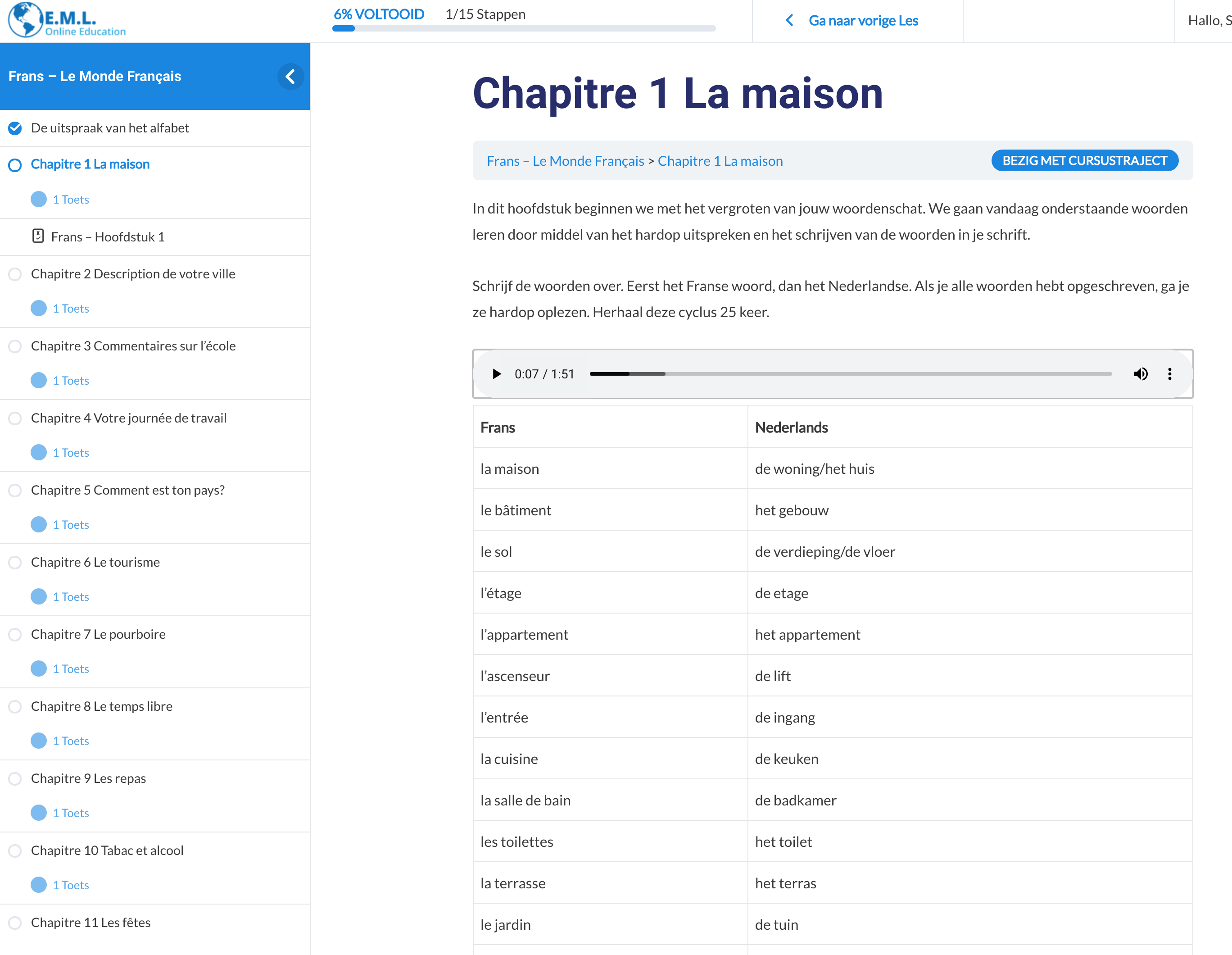
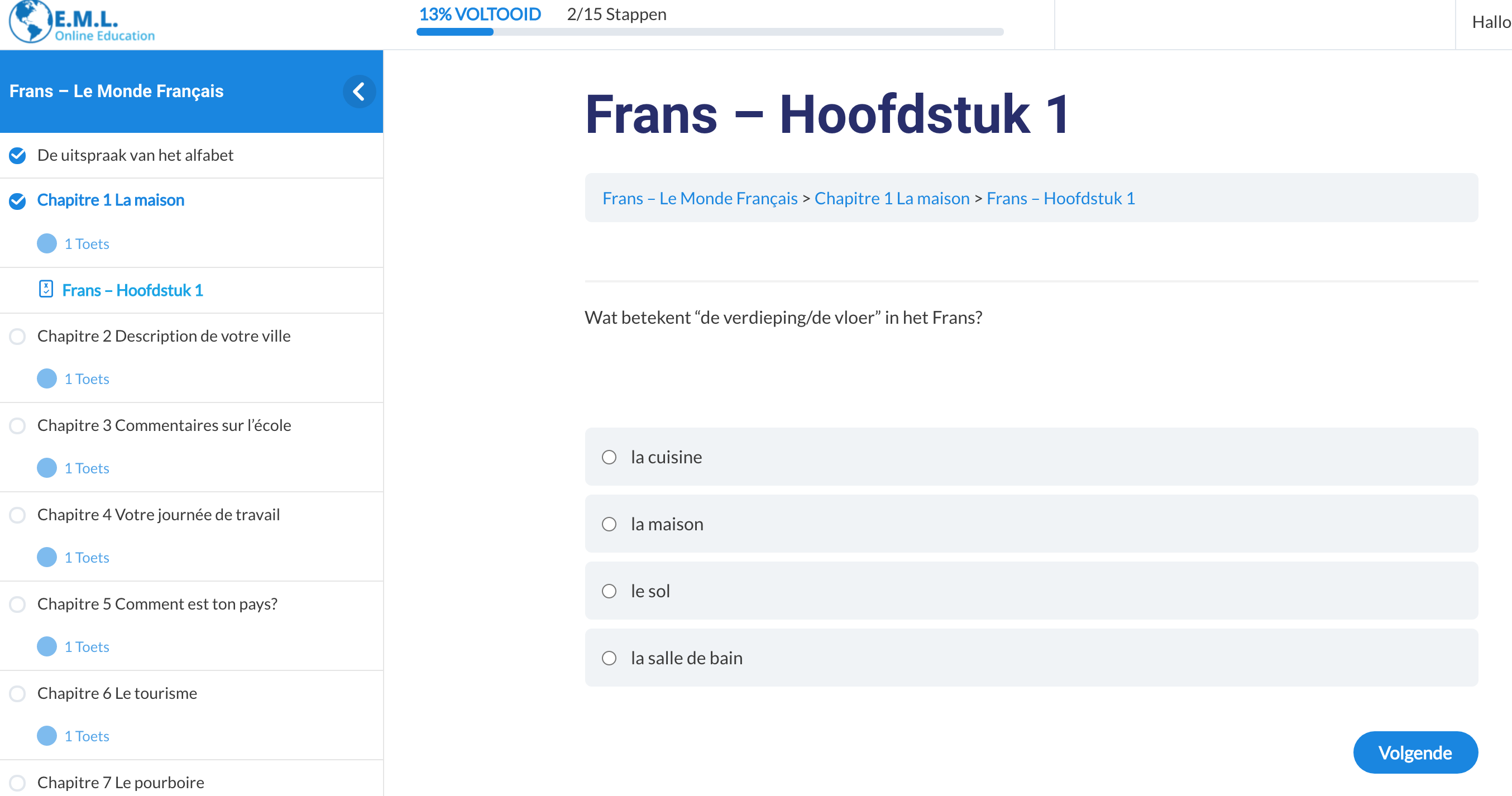
However, what awaited me in the second ‘lesson’ was far worse than any nightmare I might have anticipated. Here is a screenshot of the top of the page:

Words. After one scrolls dawn, more words. Sometimes a phrase (‘Comment tu t’appelles ?’, ‘Bonjour, agréable de vous rencontrer’ and a few similar basic phrases), but a vast majority simply words. Which would be fine at the beginning of a beginner’s course, except that we’re supposed to repeat them (as the Dutch command above the sound bar says) 25 times and perhaps remember them, which is useless in any case because, as language teachers, and probably students also, are already well aware, a word in itself is a lot more difficult to remember without a context than in a sentence, and it doesn’t do much to convey what we want to communicate anyway.

The worst of it, however, is the reading of the word list. The words on the left side are fired at the learner at an enormous pace, like from a machine gun, by an otherwise nice female reader. Natural pronunciation as far as individual words can be but when about a hundred words are pronounced within exactly 1 minute and 52 seconds, how much time do you have to repeat the words (phrases) after her and also pay attention to the meaning? And what is the value of saying something, albeit well and however many times, if you have next to no idea what you’re saying?

OK, so you want to pause the sound to have some time to have a look and understand. Fine. At least down to the 20th word. Then you need to scroll down. Ah, there’s the rub: the voice slider disappears under the heading of the page (the part with the ‘Hello’ in the top right corner, and everything to the left of it). And this was only the first 20 words. You can scroll back up to stop the sound for a second, then scroll back down to control yourself and the meaning, but how easy is that when you’re down in the second, third, fourth or fifth 20 words/phrases? What can be more embarrassing? And how much time does it take to scroll half a meter down and back up on a 15-20-cm screen at least 50 times, just to go through the whole list once? Let alone do the whole thing 25 times as suggested by the authors. And while the French single words appear on the left side, the phrases suddenly pop over to the right. But the most ridiculous thing about all this is that with a simple change in the programme, they could have allowed the sound bar on top so that you could at least pause it while you’re checking any of the 80 remaining items where you need to scroll up and down crazy now. While also changing sides.

And when – and if! – you’ve done that, and if you’re lucky, you’ll remember individual words. You won’t be able to say anything properly, mind you – this is still only a list of individual words (and a few greetings).

Afterwards, you’re only allowed to proceed to the next ‘lesson’ if you do a test. This is a multiple-choice test, where you have to find the meaning of a word in your language among four French options. Ten items altogether, like this one here.

And if you retake the test, the order of the items is always the same – which is a simply avoidable mistake from the dark ages of online courses, which other programmes, like Byki Deluxe or Google Tests, solved two decades ago. But, most importantly, remember: the list consisted of about 100 items. So what about the remaining 90? Do you remember them as well? Who cares – the authors definitely don’t.

That done, you’re through to the next ‘lesson’, which has fewer words in the second topic but the voice recording is also shorter. Unfortunately, however, it consists again of words and some simple phrases, without context. And let’s not forget, the check-back was to find the equivalent of the original word among 4 options in the target language – no check-back whether you could say anything on your own (i.e. without options offered), or whether you understand some snippet of French communication, or whether you could react to such at all.

I don’t think I’ll have enough patience to go very much further into later lessons but, to cut it short, at this point and period in time, I think this is the worst language teaching I’ve ever encountered. Perhaps barring one, when a colleague of mine was teaching geography terms in English to his low-intermediate students at the grammar school where I was teaching English: he simply used to read out the list of terms for the day, told the students to learn them at home and went on to check their knowledge of the previous lesson’s terms for the rest of the time in class. But at least it was reasonable check-back, plus he was not an English teacher. But this? Teaching? No, anything but. Learning? If you’re so clever and lucky…

So, in conclusion, if you ever see an ad by E.M.L. Online Education, offering you whatever bargain price for whatever language on their list, give it a very wide berth and don’t ever spill money into that abyss. Their courses hark back to the dark ages of language teaching. Although you’re spared the stick and it’s in the appropriate modern disguise, for the little price they ask, you’ll learn even less. Even less value than what you might have paid. There are much better courses out there, try those, not this one.

By P.S.

And the First Prize in Chinglish Goes to…

Tags

, , ,

… Carole!

Well, I’m a fan of English mistakes made by Chinese people. They’re amusing and, with some experience of teaching English in China, understandable. We can’t reverse the effects of our mother tongue just like that. What’s more, such features make the world not only funnier but also more interesting and varied.

Now, as my years as a translator have been accumulating, I sometimes have new contacts with Chinese companies, mostly in the Guangzhou area. Now another one has emerged from Zhejiang province, where I used to teach English. But said Carole is already a Project Manager, not a student. She’s supposed to write reasonably. So what message have I seen from her?

The elevation of the meaning of Chinglish to a new, shining height! She’s advertising for a Dutch<>English translator. The culprit is her requirement, “Preferred native language: English Middle (ca.1100-1500)”.

First, what does English Middle mean? If she means Middle English by the phrase, why reverse the word order?

Second, she seems to require somebody to speak Middle English. Really? As a native language? Looking for somebody whose mother should be dead for more than 500 years! Or much longer, perhaps since “ca. 1100”.

Congratulations for winning first place at the stupidity race among project managers! All, not only Chinese. Well done!

By P.S.


Statistical truth about problems caused by asylum seekers in the Netherlands

Tags

, , , , ,

Dear Reader,

Research has been done in the Netherlands over whether fears about lack of safety of a few years ago have been justified in some places. The article below was published this morning in the Volkskrant about the findings of a huge research done at the behest of the Dutch Research and Documentation Centre of the Department of Justice. The findings are presented in more detail in the Dutch House of Representatives Today.

My translation of the article can be read below. To my mind, it points towards “untruths” given to residents of most Middle-European people by propaganda reporting “neighbourhoods in the city of (you name it) in” Belgium, Sweden, France, Germany, Britain etc, where “locals do not dare to go out into the streets”, “which are ruled by hordes of migrants” and the like, even making bold statements about the Netherlands based on statements and opinions by Gerd Wilders, leader of the second most supported party in the country. Whoever can claim for sure that the Netherlands is an exception from these phenomena are absolved of the burden of reading about the situation there, but others are advised to read the article to learn about the truth. I think the Netherlands is just as representative of the problems as the other countries mentioned above, consequently, these findings may be indicative of the true size of the problems in other parts of Europe.

be542282-4fff-4d96-9c1f-3b813028e968.jpeg

” ‘Robuust’ research proves: Setting up a refugee centre does not lead to less safety in the neighbourhood

The WODC has examined statistical data from the CBS.

Safety in a neighbourhood does not decline after the arrival of a reception centre for asylum seekers. Local residents face no more risk of becoming victims of crime. This is the conclusion of the Research and Documentation Centre of the Department of Justice (WODC) after an analysis of statistical data from Statistics Netherlands (CBS). The results will be presented to the House on Thursday.

By: Marjon Bolwijn, 1 February 2018, 02:00

Fear of insecurity and rising crime three years ago was a major reason for strong protests from citizens in several municipalities where asylum seekers’ centres were planned. In 2014 and 2015 the number of asylum seekers, particularly from Syria and Eritrea, sharply rose. Sometimes citizens’ protests turned into riots and police intervention.

Meanwhile, the influx of asylum seekers has abated and the discussion has been silenced. The question remains whether opponents of a reception centre were right in saying that insecurity would increase. Therefore, the Ministry of Justice asked the WODC to investigate. Conclusion: the chance of becoming a victim of a criminal offence has not demonstrably risen with the arrival of a reception centre for asylum seekers. Researchers have found that there is a difference of 0.03 percent, which is statistically “insignificant”.

‘Rabble-rousing’

‘Robust research, no question’, says criminologist Jan van Dijk of Tilburg University. The results do not surprise him. ‘The vast majority of asylum seekers are keen to make something of their lives. They think ten times before they commit a crime,’ says Van Dijk. In his opinion, the conclusions of the WODC suggest that the protests were ‘a projection of fears’ and ‘rabble-rousing by a political party as the PVV’.

The WODC compared all the inhabitants of Dutch neighbourhoods with and without asylum seekers in 2015, 2010 and 2005. It was also examined whether registered crime in neighbourhoods was higher in years with than in years without asylum seekers in the period 2010-2015. In addition, the researchers compared offender profiles of asylum seekers with those of other population groups.

Safe countries

It is not that no asylum seekers commit offences. Earlier research already showed that mainly light property crimes, such as shoplifting, are involved. Because the safety in the neighbourhood does not demonstrably change after the arrival of an asylum centre, the researchers of the WODC suspect criminal offences committed in the reception centre itself or in a city centre in the wider area will presumably be committed. Two-thirds of the offenders are young men from safe countries in North Africa, for example, who do not have a chance to get a residence permit. ‘Adventurers who have nothing to lose,”says criminologist Jan van Dijk.

Compared to their counterparts of similar age, counterparts of the same gender, and people with low socio-economic status among the Dutch population, asylum seekers are somewhat under-represented in police statistics, also when it comes to sexual crimes. The majority of the offences are committed by young men. ‘If a few thousand people are added, it makes sense that crime will increase, but in absolute terms, we are talking about small numbers’, says Jan Wahideh of the WODC.

The greatest outrage over asylum seekers was felt in de Beverwaard, but there is nothing left of it there

The suffering from asylum seekers that residents of Rotterdam were afraid of at the coming of asylum seekers has not materialised. This is consistent with the findings of the WODC Research Institute. ‘We were stirred up,’ says a resident in the neighbourhood. (+)”

Full article with additional statistics: https://www.volkskrant.nl/4564736

I’ll soon translate the original into Hungarian for those of my former compatriots who do not comprehend the text in English.

by P.S.

In honour of the immigrant 2

Tags

, , , ,

As I promised in my previous post a few days ago, I’m posting the translation of the article of de Volkskrant published on 16th April, written by a guest columnist.

I publish the article in English in honour of my PhD friend working for CALTEC at the moment, who comes from Iraq originally and proves most points below. Being an Arab, a G.P., fluent in three languages, well-versed in European and world literature, a devotee of J.S.Bach, whose smaller piano pieces he began to learn at 28 years of age as his first ever piano pieces, he is a gifted and internationally quoted microbiologist with a bright career ahead of him.

I’d like to warn my readers, though, that, towards the end, the text could be seriously misunderstood or misinterpreted. Please do not construe the writer’s words as a threat to the existing society – the intention is to show the sheer effort, value and positive effect immigrants add to the existing society. The intended change the writer means is the change to inward-looking thinking some original natives of the country apply against those added values. It is to show that people should not consider immigrants as different in colour or culture, but as people who add their own talent and efforts to build a better future.

Here comes my translation.

“Guest column: an ode to the immigrant

GUEST COLUMN In spite of the barriers that the Dutch society erects, thanks to his own effort, the black-and sand-coloured Dutchman has made a historic success of his own part of the integration process, argues guest columnist Izz ad-Din Rahman.

Izz ad-Din Rahman 16 april 2017, 07:00

Often, a tragedy forms the basis for migration. No one voluntarily chooses to leave his homeland for good. Persecution. Hunger. War. Hopelessness. Forced by the colonizer and quartered in former Nazi camps. A tragedy that has left deep wounds, sometimes still noticeable to the fifth generation.


In spite of the visible and invisible barriers that the Dutch society erects, thanks to his own effort, the black-and sand-coloured Dutchman has made a historic success of his own part of the integration process. The pearl of the nation, who features determination, discipline and endurance.

People who often came to Netherlands with empty hands as guest workers or refugees are now directors, politicians, journalists, officers, judges, lawyers, tax advisors, entrepreneurs, surgeons, engineers and architects. The immigrant has taken over complete business sectors, or has revived them himself. From nothing, they have built vibrant communities, which now form the backbone of the economy of the Randstad. It is the black-and sand-coloured Dutchman who sustains the public and commercial life in the power centres.


Blood, sweat and tears

From his first steps in the sandpit, the black-and sand-coloured Dutchman has been fighting for his position in this country with blood, sweat and tears. The long way from the elementary school teacher and his framework advice at the technical school up to the professors who unsuccessfully try to bring down their thesis. Graduation with honours while his parents sometimes can’t even read.

From the harshest of conditions, he has shown what it means to be a fighter. The hopelessness of the concrete jungles and the uncertainty of the asylum procedures could not break the immigrant – on the contrary, it has armed him with unique experiences that bring out the best human qualities from the black-and sand-coloured Dutchman.

For many, that path has not been strewn with roses. For some, sheer agony. Of poverty. Of raids and round-ups. Of less, less and less. Of having to take too great responsibilities too early. The stabbings and shootings. The traffickers. The lonely abortion and the infants in the containers. Periods of despair and destitution. Losing everything and starting again. Going on despite setbacks or wrong choices. Not giving up, not losing sight of the objective. Soldier. A generation of lions make an act of presence.

This is a generation that does not allow you to tell them that they should be grateful. No, it is precisely the Netherlands that should be grateful to this generation for the energy they put into this reclaimed swamp. The success of the black- and sand-coloured Dutchman is purely the result of his own excellence. Of the courage to stand firm in a hostile climate that disclaimed him before he was born at all.

In particular, the immigrant who took his first steps in the conservative environment of predominantly white-populated offices. To have to be in a completely different world from nine to five and not speak about the stupid ideas that regularly circulate around the coffee machine is gruelling. It takes character to hold your ground in this mental torture chambers. Keep your head up. We support you.

No victimization

This is a generation that realizes that they can stand on their own feet. Which does not allow victimization by those who would rather see us fail because they need empirical evidence to support their sociological theories about perpetrators and victims. Or even worse: to make a PROFIT out of them. No, the black and sand-coloured Dutchman knows: a butterfly that is pulled out of its cocoon will be permanently maimed. This generation cannot be maimed by those whose degree of sympathy correlates with our level of subordination.

Glass ceiling? Even a ceiling of reinforced concrete will not stop us. We have the talent. We have the numbers. The hostile discourse in the media is just a last gasp of a social order that knows its days are numbered.

The stubborn black- and sand-coloured Dutchman ruthlessly deals with any obstacle that stands in the way of its emancipation and success. He does not need to be saved, helped, protected or being pulled ahead. He does not want to be the object of other people’s urge to have a clean conscience. Diamonds are formed under extreme pressure. All those elements that, according to the statisticians, make us fail at birth, created exactly the opposite: a whole generation of gemstones that shine far beyond the horizon.

It is this generation that paves the way for those who come after us. I am proud of my dark-eyed soldiers, the future of my country. A shout-out to all fighters: life can give me no greater honour than to be able to call you my contemporaries.

Shout-out majesty to the queen of Amsterdam-West.

Izz ad-Din Rahman is a publicist and a guest columnist of de Volkskrant this month.”

by P.S.


In honour of the immigrant 1

Tags

, , , , , ,

These are difficult times for people who have come to settle and find work and peace in countries other than their own countries of origin. Lots have been spoken and written about ‘migrants’ from various regions of the world, most notably in Europe and the USA. Although migration and ‘migrate’ have meanings mostly characterized by temporariness, looking for work and then relocating, they are now used heavily against people basically fleeing from hellish circumstances in their native lands.

The European Union has been wrestling with the influx of ‘migrants’ for quite a while. Germans seem to have forgotten that it was them who invited a couple of millions of Turkish workers for their own needs decades ago – and then forgot to teach them German), other big EU countries have large immigrant communities from their own former colonies, some others, like Sweden, have been supporting them well for decades (I have former classmates completely integrated there since the 1980’s), whereas a few others have borne the brunt of desperate people fleeing Africa and the Middle-East simply because they (Italy and Greece) are the closest to the danger zones. And then again, there are a few, like Hungary, who are neither very close, nor coveted target countries for those ‘migrating’ masses, but seem to be unable to understand that every coin has two sides – they only see the dark, threatening side of it, as if their own people were saints and had never endangered others themselves.

I don’t want to argue with anyone here, I just want to share an excellent article written by a ‘foreigner’, a ‘stranger’, an ‘outsider’ or an ‘immigrant’ in the Netherlands. The word in the title of the article, “allochtoon” means all these in Dutch and it’s very difficult to define more precisely how a Dutch person is using the word at a given moment so please don’t blame me for any of the English equivalents. However, being an “allochtoon” in the country myself, I’d like to remind people of the huge potential values that anybody settling abroad from outside can bring to any nation where they settle. I’d also like to allow the Netherlands to stand as an example before others as to how it is possible to welcome ‘strangers’ into a society and to appreciate them.

I dedicate quoting this article to my friend from Iraq as well. He arrived in the Netherlands nearly ten years ago as a trained young doctor with some English language knowledge. He learned Dutch within a few years, took a Masters in microbiology, then went on to receive a PhD with a thesis written in English, defended his thesis in fluent Dutch and received a scholarship to work at CALTEC. In the meantime, his thesis was awarded the prize for the best PhD thesis in his field over two years in the Netherlands, and this year he won over one hundred thousand Euros from the Rubicon foundation to follow his research wherever he intends to do so. I know that only very few of us are so gifted as him, but just think for a moment what an honour it would be to welcome such people in your country where local propaganda is fuelled by local fears about such people simply because they are ‘different’. I’d very much like to be so different sometimes.

The publication of the article you can read here and also supply below was timed for Easter Sunday, probably not without a reason. It is in Dutch, but for those who can’t understand it (although GoogleTranslate could provide a reasonable idea), I’ll translate it and publish the English version soon.

by P.S.
“Gastcolumn: een ode aan de allochtoon

GASTCOLUMN In weerwil van de barrières die de Nederlandse samenleving opwerpt, heeft de zwarte- en zandkleurige Nederlander op eigen kracht zíjn deel van het integratieproces tot een historisch succes gemaakt, betoogt gastcolumnist Izz ad-Din Ruhulessin.

Izz ad-Din Ruhulessin 16 april 2017, 07:00

Vaak ligt er een tragedie ten grondslag aan migratie. Niemand kiest er vrijwillig voor om zijn geboortegrond voorgoed te verlaten. Vervolging. Honger. Oorlog. Uitzichtloosheid. Gedwongen door de kolonisator en in voormalige Nazikampen ondergebracht. Een tragedie die diepe wonden achterlaat, soms voelbaar tot in de vijfde generatie.


In weerwil van de zichtbare en onzichtbare barrières die de Nederlandse samenleving voor ons opwerpt, heeft de zwarte- en zandkleurige Nederlander op eigen kracht zíjn deel van het integratieproces tot een historisch succes gemaakt. De parel der natie, die zich laat kenmerken door vastberadenheid, discipline en uithoudingsvermogen.

Mensen, die vaak met lege handen als gastarbeiders of vluchtelingen naar Nederland kwamen, zijn nu directeuren, politici, journalisten, officieren, rechters, juristen, fiscalisten, ondernemers, chirurgen, ingenieurs en architecten. De allochtoon nam complete bedrijfstakken over, of blies er zelf het leven in. Vanuit niets bouwde hij bruisende gemeenschappen op, die nu de ruggengraat vormen van de Randstedelijke economie. Het is de zwarte- en zandkleurige Nederlander die het publieke en commerciële leven in de machtscentra van ons land gaande houdt.


Bloed, zweet en tranen

Vanaf zijn eerste stappen in de zandbak heeft de zwarte- en zandkleurige Nederlander zijn positie in dit land met bloed, zweet en tranen bevochten. De lange weg van de basisschoolleraar en zijn VMBO-kaderadvies naar de professoren die tevergeefs het proefschrift proberen neer te sabelen. Cum laude afstuderen terwijl zijn ouders soms niet eens kunnen lezen.

Vanuit de meest barre omstandigheden toonde hij wat het betekent om een strijder te zijn. De uitzichtloosheid van de betonnen jungles en de onzekerheid van de asielprocedures hebben de allochtoon niet kunnen breken, integendeel, het heeft hem gewapend met unieke ervaringen, die in de zwarte- en zandkleurige Nederlander de meest deugdzame menselijke eigenschappen naar boven halen.

Voor velen ging dat pad niet over rozen. Voor sommigen een regelrechte lijdensweg. Van armoede. Van invallen en razzia’s. Van minder, minder, minder. Van te vroeg te grote verantwoordelijkheden moeten dragen. De steek- en schietpartijen. De mensenhandelaars. De eenzame abortus en de pasgeborenen in de containers. Perioden van wanhoop en rampspoed. Alles verliezen en opnieuw beginnen. Blijven doorgaan, ondanks tegenslagen of verkeerde keuzes. Niet opgeven en het doel voor ogen houden. Soldier. Een generatie van leeuwen maakt acte-de-presence.

Dit is een generatie die zich niet laat vertellen dat ze dankbaar moet zijn. Nee, het is juist Nederland dat deze generatie dankbaar moet zijn om de energie die zij in dit drooggemalen moeras steekt. Het succes van de zwarte- en zandkleurige Nederlander is zuiver het resultaat van zijn eigen excellentie. Van de moed om de rug recht te houden in een vijandig klimaat dat hem al afwees voordat hij überhaupt werd geboren.

In het bijzonder de allochtoon die als eerste stappen zette in het conservatieve milieu van de overwegend door witte mensen bevolkte kantoren. Van negen tot vijf in een totaal andere wereld moeten zijn is slopend, om maar niet te spreken over de stompzinnige opvattingen die daar dikwijls bij het koffiezetapparaat de ronde doen. Het vergt karakter om jezelf staande te houden in deze mentale martelkamers. Keep your head up. Wij staan achter je.

Geen slachtofferschap

Dit is een generatie die beseft dat zij op eigen benen kan staan. Die laat zich geen slachtofferschap aanpraten door degenen die ons liever zien falen omdat zij empirisch bewijs nodig hebben voor hun sociologische theorieën over daders en slachtoffers. Of erger nog: daar GELD aan verdienen. Nee, de zwarte- en zandkleurige Nederlander weet: een vlinder die uit zijn cocon wordt getrokken zal blijvend verminkt zijn. Deze generatie laat zich niet verminken door degenen wier mate van sympathie correleert met onze mate van ondergeschiktheid.

Glazen plafond? Zelfs een plafond van gewapend beton gaat ons niet tegenhouden. We hebben het talent. We hebben de aantallen. Het vijandige discours in de media is slechts een laatste stuiptrekking van een sociale orde die weet dat haar dagen zijn geteld.

De weerbarstige zwarte- en zandkleurige Nederlander rekent genadeloos af met elk obstakel dat zijn emancipatie en succes in de weg staat. Hij hoeft niet gered, geholpen, beschermd of voorgetrokken te worden. Hij wenst niet het object te zijn van andermans drang om een schoon geweten te hebben. Diamanten vormen zich onder extreme druk. Al de factoren die volgens de statistici ons geboren om te falen maken, produceerden juist het tegenovergestelde: een hele generatie van edelstenen die tot ver over de horizon schitteren.

Het is deze generatie die de weg plaveit voor degenen die na ons komen. Ik ben trots op mijn donkerogige soldiers, de toekomst van mijn land. Shoutout naar alle strijders; het leven kan mij geen grotere eer schenken dan jullie tot mijn generatiegenoten te mogen rekenen.

Shoutout-majestatis naar de Koningin van Amsterdam-West.”

Izz ad-Din Ruhulessin is publicist en deze maand gastcolumnist van de Volkskrant.


Can something, anything, be more stupid?

Tags

, , ,

My dear guest, this may not be for you if you don’t understand Dutch and have no interest in translation, but I just can’t avoid sharing this with anyone who does.

I’m translating a long big text with mostly broken sentences from Dutch into English with the help of a translation programme (otherwise, how could I translate more than 5000 words a day …). It is quite tedious and disheartening because it concerns mostly answers like “I want privacy”, “I love to be on my own” etc., but it’s somewhat understandable because it’s about holiday solutions. Anyway, here, one translatable original sentence says, “staat me niet aan”.

Well, the programme uses outside translation engines as well and as a first suggestion, it gives me the MateCat solution, which starts out, in this case, from an original that said, “Regelaar staat niet aan.” Fine, some similarity all right, could be used. The program says it has a 70% match as a solution – mind you, the match is supposed to be a match to my original sentence.

So, what do I get as a solution? Are you sitting? Well, it says, “Regelaar staat niet aan.” Yes, in Dutch. It is exactly the same as their original source sentence – 100%. In a translation into English. It is a 70% match, it says, right?

Being a translator instead of a teacher is nice and quiet. And sometimes very (VERY!) amusing. Have a nice day!

By P.S.

Intercultural life in the Netherlands

Tags

, , , , , ,

cl_043_ 001I’ve almost begun this post as most of my Chinese students back then in China began most of their (almost always very optimistic) papers: “In our highly developed, modern society …” But before I completely change my mind, let me begin by saying that in our societies in Europe, it’s more important than before that our children appreciate variety in the world, learn to understand and live alongside various other cultures than their own immediate background. When knives and guns are aimed from left and right at people that others think are ‘different’, meaning ‘strange’, ‘dangerous’, ‘threatening’ and this feeling is sometimes enhanced by the reality that others may actually be that, what can we do? When we think of ‘us’ v. ‘others’, let’s not forget that in such equations, we are ‘others’ to them just like that. And when we think that ‘others’ are dangerous, it means we are dangerous too and then how can we stay alive?

In today’s Europe this question is debated all over. What I was surprised to hear a few month back was that the largest country of the EU, which also has been having probably the largest imported work force, from Turkey, for that matter, has always forgotten about language teaching to those working for them. Thanks to improved understanding and policy, Germany may soon start teaching their language to those who have come and worked in Germany.

Great move. Hopefully not too late. But here in the Netherlands, such policies have long been in place and contributed to the peaceful living together of millions of people from all over the world, lots of whom are not only from former colonies, and lots of whom are muslims, or at least non-Christians.

P1120868I’ve already praised the language teaching system that allows immigrating adults to learn Dutch almost free of charge, or at least very cheaply and efficiently. Now I’ve just witnessed workings of a perhaps even more important ground for future peace: a primary school. The bigger kid of the Chinese partner to this post has already been going to school for a year. I’ve often seen kids coming or going to that school and already known that it lies in a ‘mixed nationality’ area of town. This means that probably all nationalities are represented at school, form Moroccans and Turks through Chinese, Indonesians, Thai, Surinamese and Syrians to Somalis and other black Africans. These can be very well seen in the area, but let’s add a probably huge number of Polish and some Hungarian people and we have a real cauldron.

So far I’ve found kids after school very interesting because most of them are so little that they have to be picked up by parents at the end of the day. Then I can see they talk their own languages to their parents but happily talk Dutch to all their friends to say good-bye. Nice. And of course the language of instruction inside is Dutch. The common denominator is important for understanding the society around us and to integrate into it.

P1120858Now, the school finds the original cultures of their kinds also important. We can’t deny that these exist: those parents (or their parents earlier) have come from somewhere else and it’s just natural that mother speaks her mother tongue to her children. The great thing is that the school understands the values embedded in such diversity. Instead of pointing at each others with grins, they are given the opportunity to first take everything around them at face value and accept it – no kid even realizes that some of them have very dark skins, others very white, yet again others different eyes or something – and then at the end of the school year, the school organizes a little festival to bring out the values inherent in the population of the school. This is what I’m going to show you parts below.

P1120861First, it was interesting to hear that the leader of the event found it important to wear a clothes and a piece of jewellery from Somalia. And to tell the kids about it too, and proudly at that.

As kids start going to school at age 4 in the Netherlands, no wonder the whole things was sometimes quite noisy, yet, it was apparently to all kids’ interests and they took part in chorus singing with obvious enthusiasm.

At the beginning there was Turkish dancing for everybody’s delight – even some teachers joined towards the end.

Most of the event contained singing and as parents were also invited not only to attend but also to take part, the co-writer of this blog decided to contribute as well.

The following are the recordings I took of her performing two Chinese songs. Her first performance started with inviting kids to help her play out the scene in the lullaby, thereby making the foreign text somewhat understandable to the very young audience. For those who find the Dutch introduction too long, the song starts at 5′ into the video. What I find important here is the children’s enthusiasm to join the ranks on the stage.

With the next song, teachers were asked to participate, again to great cheers. Children of all nationalities were chanting their favourite teacher’s names to make them join a song they knew they would not understand. Here the song starts rolling at 4′ into the recording.

There was also a very nice, colourful act with pairs of little ones parading clothes worn in their (or rather, their parents’) country of origin, again to great cheering from the audience.

The even practically closed with a Dutch song. The kids’ performance itself was not of the most outstanding quality but they had all volunteered in the first place, like the others, but what is here very important is that this is a Dutch song in front of a very multi-cultural audience, of which the most enthusiastic co-singers were ….

I hope my dear visitor also enjoyed the above and understands what I mean without me going on ranting about it. I just wish the world had a lot more similar institutions, events and joy about our differences and we can see more and proud wearers of such fabulous clothes and singers of such enchanting songs like on that day.

by Z.J.S. and P.S.

Good books to learn from

Tags

, , , ,

The chance visitor who honours my blog with his/her interest may wonder why I have written so little over the last couple of years. I have to apologize but the reason is that I changed course: I’ve been a full-time translator for more than 3 years now. Or sometimes not absolutely full-time: I’ve been having a student for several months now, who enjoys our lessons so much that she hopes to be able to come back after the summer. Before her, I also had a young man for a number of English lessons, who also enjoyed working with me and is now working over in the States on a contract.

These two experiences have drawn my attention again to the nature and state of English language teaching in the Netherlands, where a large majority of people profess to be able to speak very good English, although this often seems to be an exaggeration to me. With young people, there seems to be less of a problem because they are mobile, outgoing, and often decide to have time (and the means) to travel or live abroad extensively, and they pick up excellent English on the way, whatever teaching they were given at school before.

However, getting over that ‘intermediate plateau’ in English is a completely different problem for those older people who still have children to bring up and/or job commitments to fulfil. Often, it is precisely that job commitment that would make it imperative, or at least very advisable, for them to speak better English than what they remember from their school days. With the Netherlands being what it is, that is, a trading nation, most of such people are in professions and those professions are mostly in trade. A seemingly sweeping suggestion but I have no doubt they are a large part of learners on the market. Several people have approached me from my profile still present on the national “Marktplaats” web-site over the years and they always claimed having received little or too distant education at school.

Such people are, however, very particular in their (real or perceived) needs. They do not want to learn any English – they want to learn English that is useful for them in their profession, however limited in scope that may be. This poses the question of material to be used with them. And there is the rub, as I already pointed out much earlier in this blog: because schools find it easier to order students books en masse from publishers either from specialized Dutch publishers (at orbital prices, but who cares about that when they’re convinced they get the best stuff?) or from British (or, perhaps, from American) publishers.

Students only stand a chance of getting authentic material in the latter case, but from experience I know that even listening materials published in GB are lab-recorded and I’m sorry but I can’t consider that authentic in the sense that reading out a script can’t ever sound the same fluent language as that spoken in reality, in the street, shops, over the telephone talking to clients or talking to colleagues or bosses in the staff-room etc. A point in case is that when I and a few other colleagues had recorded several interviews of students and teachers in British schools in the late 1990’s for a group project with the BC, the publisher of the book later decided to script some of it, re-recorded the interviews in a lab and only published that version. They were scared to publish the originals, claiming they would not be marketable as they contained too much noise. The noise was actually the same anybody present at the recording would hear and which is a natural circumstance in all cases when one speaks to anyone anywhere. But to use it for teaching? Oh, no, that’s impossible, they said. Even though several of the group of teachers in the project did exactly that in their own classes, with success.

But back to the issue of specialised material. Older professional people here have to hear how it is spoken in their reality. And they insist that they learn what they need in their profession, not elsewhere and not what people speek while shopping, let alone in their kitchens. They don’t want to talk about music, or films, or politics, they want to talk about their own industry or trade and only or at least mostly use the vocabulary pertaining to their own area. They do not “have all the time in the world” for that, as young people tend to believe they do. But how can a teacher get such materials in the Netherlands?

Sadly, no market exists in the Netherlands for language learning materials because of the behaviour of schools. A teacher faced with such needy students have to find material abroad, taking a chance at buying perhaps unfamiliar material over the net or travel to GB if they want to sample the listening material for the book or peruse that one book that looks suitable for the needs of the student. I am fortunate: I only had to travel back to my home in Budapest and grab what I used to teach to professionals on various courses. I had bought them quite cheap back in the late 1980’s and the 1990’s, when the market really opened up in Hungary. Back then, numerous and various course books appeared in excellent quality and with reasonable listening material already on CD’s that are still useable. Unfortunately, cassettes are out of fashion by now so only the most staunch conservatives would still use cassette players, but I have to admit that I have the best listening material with the closest sound to authentic only on cassettes – this is no place for advertising, especially because my guess is that the material is already off the market, but I have to extend my thanks to the authors and publishers of the books called ‘Notions in English’ and especially ‘Functions in English’. I don’t mean it in the way you get it googled (in the best of cases you get to this page (for teachers), or to this page, or to this page, which, in its first group, actually lists those functions addressed and tackling of which students get to fluency in the easiest possible way), but the books so called and issued some time in the late 1970’s in GB by OUP, if I’m not mistaken. Well, these two books don’t appear on the net any more so I think when I retire, I’ll sell them on “Marktplaats” to somebody who can really teach. Or rather, in Hungary, where I’m sure young, enthusiastic teachers would be glad to acquire them and digitalize the cassette materials.

As to the professional materials (about business and trade) I’ve already brought over here, I’ll try to sell them to the only bookshop worth its mettle I know, one in Amsterdam, which seems to lay an emphasis on promoting books imported from abroad. But for the time being, I’ll still go on using them with this one student. The CD’s to go with them are good enough.

by P.S.

Teach Dutch to refugees

Tags

,

Lots of talk has been going on in all forums and media about the refugee crisis in Europe over the past months. A major problem for people who can actually have a relevant effect on events seems to be having to navigate between the Scylla of generous humanitarian help and the Charybdis of strict rejection.

As far as I know, the Netherlands is fairly quiet about the matter as the brunt of the problem seems to have to be borne by Southern- and Eastern-European countries, Austria, Germany and Sweden, but I know of situations where the “my home is my castle” notion has already come to work at a few places here where real refugees in actual neighbourhoods were planned to be lodged.

The Netherlands has been one of a few countries, in my view, which has a history of taking perhaps the singularly most important helpful action in the event of receiving refugees, the importance of which Germany has just been getting acquainted with: teaching the language of the host nation. When I was young, geography classes dealt with how many Turkish temporary workers were employed in Germany. Since we were informed that they actually remained in Germany for a long time and took over jobs that Germans themselves were loth to do, I’ve always thought they were integrated into the society. In the political turmoil of recent months, I’ve been proven wrong.

Well, I’m one of the beneficiaries of Dutch efficiency about teaching Dutch to foreigners as I’ve already described earlier. In line with that system, the other day I received an invitation to help teach Dutch to refugees in Gelderland here as I’m still registered with a number of intermediary organizations. Here is the text of the letter:

“U staat bij ons ingeschreven en momenteel zoeken we naar meerdere docenten NT2 voor diverse locaties en dagdelen. Het gaat om lessen NT2 aan vluchtelingen.
We zijn op zoek naar ZZP-ers, met een CRKBO erkenning (of in ieder geval BTW vrij factureren). Ik benader u nu via een algemene mailing, dus indien u geen ZZP-er bent dan alvast excuus dat ik u deze mail en vacature heb gestuurd.”

Being a language teacher to the core, a ZZP-er providing BTW invoices, and a sort of “economic refugee” myself, and having passed the NT2 exam, I jumped to the occasion. I can at last do something in return for what this system has done for me and a lot of my friends, one of whom, out of Iraq, has just received his PhD at Utrecht University as a microbiologist, so the investment into the language first and foremost may pay off wonderful dividends for those concerned.

Under the link provided in the e-mail, the important points concerning the jobs (needs!) are as follows (I’m not translating this text either – it doesn’t matter for those who don’t understand it, but those who may actually be interested in trying to take one of these positions have to understand it anyway):

“Voor onze opdrachtgever, met diverse locaties in het land, zjin we met spoed op zoek naar ervaren docenten NT2 voor minimaal 3 dagdelen per week. Het betreft een reguliere vacature.

Voor de vacature zoeken we docenten (ZZP-ers met een CRKBO erkenning) die ruime ervaring hebben met het geven van NT2 lessen en ervaring heeft met meerdere niveau’s in 1 groep.
Hieronder een overzicht van de locaties en de dagdelen:

  • Culemborg – exacte lesdagen en tijden nog niet bekend – Startdatum 18-01-2016;
  • Epe – lesdagen: woensdag en vrijdagochtend – Startdatum 20-01-2016;
  • Schijndel – lesdagen: maandag, dinsdag en donderdagochtend – startdatum 26-01-2016;
  • Ede – exacte lesdagen en tijden nog niet bekend – Startdatum 08-02-2016;
  • Wageningen – exacte lesdagen en tijden nog niet bekend – Startdatum 15-02-2016;
  • Zutphen – lesdagen: woensdag en vrijdagmiddag – Startdatum 24-02-2016;
  • Ede – exacte lesdagen en tijden nog niet bekend – Startdatum 14-03-2016, 2 groepen van 2 of 3 dagdelen

Heb je ruime ervaring met het verzorgen van NT2 aan vluchtelingen, ben je langere tijd beschikbaar voor een groep op de bovengenoemde locatie en dagdelen? Ben je ZZP-er die BTW vrij kan factureren? Dan ontvangen wij graag jouw motivatie en cv!

De docent die we zoeken:

  • beschikt over een Post HBO NT2, een certificaat NT2 of;
  • beschikt over een Bevoegdheid Basiseducatie of BVE
  • heeft ruime ervaring met het verzorgen van lessen NT2;
  • is ZZP-er en in bezit van VAR WUO of DGA
  • heeft een CRKBO erkenning en/of kan BTW vrij factureren;
  • is beschikbaar voor minimaal 3 dagdelen per week
  • heeft bij voorkeur ervaring met de methodes 7/43, Taalcompleet (Kleurrijker) , Op maat sprong en De Finale”

Here is the link to the site with this and more information, for example about fees offered.

If you consider applying, beware: you really have to fulfil ALL of the above conditions! Consider this: after being invited and having applied, I received no answer for a few days, but a repeat of the invitation (“Wellicht is deze mail aan uw aandacht ontsnapt, vandaar dat ik u nogmaals aanschrijf”). In answer to my second letter reinforcing my intent, I received a flat rejection saying that they are looking for people who fully comply with the requirements.

And here I see a sort of a problem with the system. They are intent on setting up courses, but a week before some of them (are planned to) start, they’re still short of teachers. I doubt again that there are a lot of teachers around who are actually free several mornings of the week and have nothing better to do in the middle of the academic year, and who, further, have not only the enthusiasm but also ‘a lot of experience teaching refugees’ with the particular materials and can provide invoices as ZZP-ers. Most teachers are not ZZP-ers. They teach at schools. They are the ones that taught me and my friends. Those who are ZZP-ers here teach English, not Dutch, and to all kinds of Dutch people at companies and businesses, not to refugees. And quite some of them (hope I’m wrong) actually do not agree with helping refugees in the first place. I mean they are probably British people with a certain degree of notoriety about rejecting foreigners settling down in their country.

So, despite the nice idea, who are going to teach a few hundred refugees in East Netherlands? Not me – I haven’t got the experience, and as a result, never will acquire it, however much I’d like to. Perhaps you? Don’t hesitate, apply if you’d like to do something for a better, still peaceful Europe.

by P.S. 

Arnhem’s cultural week and the famous Dutch railways

Tags

, , , , ,

This site tends to become more about Dutch culture than about working in the country. I can’t change that. I’ve abandoned the idea of working here and immersed myself in the life of the country. It is worth it, but beware, dear visitor.

DSC_3063I have to start this post from back a month ago. I was expecting my friend and co-author back into the Netherlands with her whole family, 2 toddlers included, on 15th August. I left Arnhem well before time, still, was almost late receiving them back from their flight from China. I had to negotiate a complicated route courtesy of the Nederlandse Spoorwegen (NS, Dutch Railways) due to works on the rails around Amsterdam. In the middle of the tourist season.

I tried to get to Den Haag early in September for official things to be settled. Again left early but could only make it late, courtesy of NS.

Now, a month after my difficulties, I’m expecting my friend from Amsterdam. I’m told that he can’t take a train from Amsterdam or Utrecht to Arnhem, courtesy of NS again. The détour costs an extra 1 or 2 hours.

DSC_3227Watch out, prospective visitors to Arnhem for the Cultural Weeks and the World Championships of Living Statues on 27th September. Checking the NS website is in order, but you have to be familiar with it, they don’t disclose info about problems just like that. You have to go to “Reisinformatie” and then “Storingen” to find out about the situation. It comes handy if you understand Dutch if you’re from abroad, advice from over-worked NS staff at Utrecht is difficult to get. You’d better set out early in the morning of the 27th to make it to the beginning at 13:00 in Arnhem. From Amsterdam, you’d probably have to travel through ‘s Hertogenbosch (Den Bosch) after changing in Utrecht to make it.

Good luck!

by P.S.

Hilarious Hungarian-English mistranslation

Tags

Translators may produce mistakes, they are human, too, after all. However, as I’ve shown in my earlier posts about mistranslations from China and the Netherlands, some are so outrageous that they do not only border on stupidity. For the sake of balance, and for those of you who understand some Hungarian, I must post this example from Hungary that I’ve just found on a Hungarian news portal.

This example sucks big time not only because of being as bad as it can be but also because it can be found at a place around Lake Balaton, one of the most exposed holiday area in the country. The original article can be seen here.

Enjoy and have a fabulous day.

by P.S.

Send Dutch applicants … no. 2

Tags

, ,

I’ve just received a very derogatory message to my earlier post which may or may not be right. However, this coincided with a few calls I also received these days from a few job agencies and schools enquiring about my availability, although I stopped applying or advertising myself as a teacher of English more than a year ago. I’ve amassed perhaps 250 refusals over the six years I’ve been living here, how could I go on living on teaching without teaching? Yet, this remark bills my earlier post as judgemental, probably meaning biassed, and based on stereotypes.

As to judging the Dutch education system as a whole, I can’t have anything to say. I have no overall picture. It seems to work and do its job. As to working for me as a teacher, it clearly is judgemental, i.e., biassed against anyone not yet having experience working in it. I have worked in it once for a small project. However, when I told the job agency person that my experience was with a military facility, she clearly changed her mind and didn’t come back to me about the open post she may have had for me. That wouldn’t count for a school job was the meaning.

So, after teaching English in two other countries for 30 years counts nothing in this country. If it doesn’t, if being a top professional means nothing in the Netherlands, I can only say the system is biassed against everybody from outside here. They say, “Have you experience in the Dutch education system? No? Then you won’t ever have it. Bye-bye!”

It’s not my stereotype, not my judgement. If the Chinese can accept that an expert teacher may not be from an English-speaking country, but this country can’t, that’s a judgement against foreigners, based on the stereotype: only English people can teach English! Right? Then which English people? A poor under-educated chap from Detroit? Or Glasgow? Someone who couldn’t even get his or her GCSE? So: wrong!

The other part of my criticism in the above-mentioned post was to claim that if this is the opinion of the system about foreign experts, then they should not advise anyone to employ Dutch people abroad. How dare they? They aren’t willing to employ anyone here without Dutch experience, so how could Dutch work abroad without having any experience working abroad? It’s simply the other side of the same coin. Nonsense. Their practice is against EU laws about free movement of workers claiming a possible exemption in educational matters. They should be exempted in the same way when trying to get employed outside. They should let others with experience there work there. Or even those without it. Or allow others to work here as they are meant to instead of wasting the talent they have to offer them.

by P. S.

Eastern-European views on the Netherlands

Tags

, , , ,

When I registered myself and moved to this country, it was a personal matter. But after I had lived in China for three years, I definitely felt it may be a lot better option than staying in Hungary. At the time, Hungary had a Socialist government whose prime minister admitted to lying all the time to their people, but he didn’t resign. After a few years, Hungary got into the grips of a leftist government who built up a two-thirds majority from 53% of the votes of 53% of the voting-age population, which they managed to strengthen with changes to the constituencies. Now they have a two-thirds majority with 44.8% of the votes of about 52% of voters (detailed results in Hungarian here).

Since then, the country has been receiving a lot of criticism from the EU and the US for actions and declarations from mostly the Prime Minister about building a non-liberal democracy. The government seems to have changed not only the constituencies to its advantage, but has changed almost all institutions of importance, like the central bank, the media, courts of justice, the national tax office and its supervising agency, has syphoned the billions of pension reserves of future pensioners and is replicating the action with the last remaining reserves of those who were not involved in the first round, has been driving public education and the health system almost into the ground with fully taking their administration into the (rather inexpert) hands of the government. Now, after a lot of negative experience with my original country, it’s time to take stock of where my choice of leaving Hungary has led me to, and whether a similar action of fellow Hungarians would be worth it.

Emigration has been escalating ever since former members of the Warsaw Pact have been admitted to the EU and the area of the Schengen Agreement. The main targets of movements have been Germany and the UK, but besides Austria, a lot of other Hungarians have moved to the Netherlands as well, so it’s important to look at the situation and chances in this country for East-Europeans.

Most of my friends here have pointed it out as a fact that circumstances in the Netherlands have been deteriorating for about 15 to 20 years. Younger people have been complaining about too many rules, but to my mind, they should look at Hungary with its ever-changing regulations for solace. The most important factor is then security. Regulations don’t keep changing, people are more-or-less reliable with a number of them to be certain to let you down without a word if you’re not chosen for a position, but life in general is just as secure here as anywhere in the developed world (or in China, for that matter). Institutions take care of you, most matters can be securely and quickly handled, or at least registered for handing, over the internet, there’s not much waiting time for almost anything. Systems work well, charges and prices are on a level which are not above reasonable limits.

Prices are nowadays just as high (of low, if you like) as in Hungary, except for housing prices. You have to be aware that by selling a property in Hungary, you get nowhere here, but renting is reasonable – while there’s a 1-to-5 ratio for buying a flat, renting one may not cost you a lot more than in Budapest. There is a system of help for poorer people too. You can get help for the compulsory and comparably very high rate of health security insurance, like for renting. However, you have to avoid a trap here. Possibilities are that you can get a part of your renting fees and health insurance fees covered by the government/national tax office.

However, they reckon you are a member of the family where you rent a room if your address is the same. All of this year, I’ve been demanded to repay the amount I was paid in 2011, and although I’ve pointed out that I, as a 56-year-old Hungarian man, didn’t marry a 64-year-old Dutchman a year after his wife had died of cancer, such things, as I’ve found out, do not matter: one is considered to be living together with another if the address is the same, and one hasn’t got access to a separate kitchen and bathroom. I did, still, my case is still pending and I can’t be sure I can avoid paying back nearly a thousand Euros I was given three years ago.

Thankfully, no such problems with health insurance, which is about 60% covered by the health subsidy if your earnings are low. Just be aware that insurance costs and the amount you have to pay before you get paid by the insurer (your own risk) keeps climbing, your subsidy decreases as you earn more, but all these are expected and not dramatic changes like in Hungary. If you have a profession, you may or may not get a job, circumstances depending. As you can get informed from my earlier posts here, a teacher with a foreign degree has next to no chance, except if he has a British degree. If you have good expertise and documents about it in a special area of industry, you can get a job for a year or two, but, like Polish people, you may come in for a lot of criticism and problems. Some leaders in industry may even directly cheat you.

The situation hasn’t been helped by a large number of Romanians who had come here to take up the support and then disappeared. I could have done that if I had moved back to Hungary one or two years after I had taken the support. As a large number of temporary workers come into the industrial sector from Poland, I have to add a few words about them too. A couple of years ago statistics indicated that they had already become the largest minority group in the Netherlands. As a result, the xenophobic, anti-Islam, anti-foreigner right-wing Freedom party made a lot of noise and came in for a lot of criticism after they tried to temper with the situation over the internet and over working rights. This weakened their position in the Parliament at the elections in 2012, so since then, politics has been looking relatively quiet here. As it is, Polish people do not stay in the country, rather, they help the industry a lot by offering cheap work that locals couldn’t or wouldn’t do, stay for a year in shacks and then take the remains of their wages back home. They aren’t a burden for the security system so they are a lot more useful than some of the other foreigners who stay, scarcely get work and live on subsidies.

On the streets, the huge variety of people you can see seems like a security against anti-foreigner sentiments, but while security is very good, crime rates are low, your bicycle may still be stolen or damaged, small miscalculations in the supermarket could happen and groups of youngsters may shout at you in the street on the way home from school. But when you get into trouble in the street, even young guys will help you instantly.

If one stays here for good, one has to live on something. If you have incomes not exceeding ten thousand Euros per year, you don’t have to register anywhere other than with the local government and get a bank account, then you get your social security number and can fill in your tax return on-line. To perform many kinds of economic activities, you have to ask for a “VAR”, which is a declaration to perform your activities as an individual normally under licenses asked of a company. Above that sum, you have to register yourself as a small company, or a “ZZP’er”, and with that you’re asked to register for VAT (“BTW” in Dutch). This VAT is only slightly less than in Hungary, it stands at 21% now, so don’t underestimate it. Business charges burdened on businesses here is not a real reason for anyone to escape the Hungarian system.

Accountability and help from the system is. If you have any questions, you can make an appointment with relevant institutions within a few days, and if they can’t answer you well enough (probably because your question is outside their competency), they will still refer you to information or organizations that can. If you don’t have high skills, or can’t use them, or just want to try something new on the job market, the most usual way to do it is walk into a temporary job agency, or “uitzendbureau”, and you may get a small job for minimum wages at a factory, store, or the post office centre. In such a case, all administration, security deductions etc. are done by the agency and you can do your tax return the following year copying stuff from their year-end declaration.

What you can’t avoid for long is payment for health security, which is high and rates keep crawling upwards. You can try to use the European Health Insurance Card, but it’s intended for travellers, not for people settled at an address within the EU, so you have to get insured by the compulsory local system. Sooner or later, you’ll be demanded to do so anyway as all systems are linked together. Even your bank has to declare your basic data to the tax system once a year, only the details are secret. But one can live with this small matter.

On the whole, the Netherlands, with all its cultural void compared to Hungary, with all its quiet and efficiency and relative coldness of the population, is a good choice for those who want to start again on a calculable basis.

by P.S.

Everywhere …

Tags

, , , ,

I know you already have at least an inkling that wherever you are, independent of the country, things are bound to go wrong even after they look like going well. In this post, I only want to add to that roster of experience about the fickleness of life in various countries. I’ll start with the country that may be my favourite. Actually, I don’t have much to add after the Chinese Language Blog of Transparent Language has posted a discussion of bad things, and also of good things about China.

This is the correct attitude, but these post are general, whereas my examples are concrete, something that could happen to anyone on floor level. Although I could obviously add items to the negative list like there’s no real nature in China, all parks are fake, trees are mishandled, environmental pollution is rampant and growing faster than economic development, I’d like to tell you about an issue that a local leader I worked for experienced.

He was the Department Leader at the Economics Department of the university where I worked back in those days. He decided that at the rate of 16 hours of teaching a week, the ‘foreign experts’ cannot do enough preparation and provide enough quality for the students that he required, so he hired one more foreign teacher and unofficially reduced the number of hours allocated for each of us.

Actually, his plan worked well for me as I felt obliged to satisfy my students’ need and request for some extra activities, so we enjoyed watching and discussing several films over several weeks.

However, the Dean of the university found out about it in the middle of the second half-year, reprimanded the department head, and radically reduced the number of foreign teachers the following year. It didn’t have much impact on me as I was moving on, but it impacted the following year’s students substantially. Quality-wise, which is difficult to assess of course. I wholly enjoyed my following year at another branch of the same uni, but this case left a warning impression on me. Besides the lack of internet freedom.

In the Netherlands, I’ve been enjoying my life quite freely. A quiet country (if you forget about the rampage they go on on Queen’s (now King’s) Day, or at a football match, or about the sense of proprietorship concerning their own property even without fences), they smile at you a lot in the street except in Amsterdam, where people behave just like everywhere else on fashionable territory, well-organized, people behave, offices work efficiently, provide social security benefits for the needy … Fine, ain’t it?

It took some time for me to discover, through a friend, that I’m entitled for help for the money I pay for my rent and social security costs. I applied, got it and was happy. Ever after, right?

Not exactly. At the beginning of this year (2014), I was informed that I had to repay almost a thousand euros (the whole amount) that I was given for 2011, because I had lived at the same address as some other people: the person whose room I was renting back then, and his adult daughter, and another person who also rented a room there. So the office reckoned we were all the same happy family, our incomes were put together and, as a result, I had had no right for housing allowance. I should pay back. For those not really aware of the weight of money, this is an amount to the value of a teacher’s three months’ net monthly salary in Hungary.

This is insane enough, since I’ve been renting another room for more than two years now, I’m a man of Hungarian origin with my own son back in Budapest, not with a Dutch daughter of 22, who is from the owner’s deceased wife who had died a year before. Not to mention that I had no income during the period in question due to severe illness. And not to mention the fact that I never married that man after his wife had died …

But no data had been checked except the address. I was allowed to apply for redress. We had to explain the whole situation with a lot of documents about the family situation and the situation of the house. On top of this, although they wrote to me that, until the case is decided, I don’t have to pay, I haven’t received a decision until now – instead, I received another order to pay up two weeks ago. No reply yet to my second protest.

If this is not enough, my last case involves Hungary. Nobody may be surprised that when I had graduated and then applied to be trained as a Geologist, I was told I should be happy to have been educated enough at the cost of the working people and now I should be happy with it and work myself. No further education in the socialist system for me.

What did I have to do? I did what I had room for and became a teacher trainer, and a project member with the British Council, with a lot of excellent students in my schools along the way, quite a number of whom became English teachers themselves a couple of decades ago.

After three decades, however, the appeal I used to have for my students, and also the interests of students, have changed dramatically, and I have ended up with the same work I started to do more than two decades ago: I became a translator. I can’t complain about it, but I still don’t have the education about it, no degree, only experience, but with very little feedback, which I had very much rather get.

So I entered a university course in Budapest this autumn. I began the course, but before that, I had talked to the department head in July, who encouraged me to apply for an individual course of studies, practically doing the course over the internet. I live in the Netherlands, and I would like to stay here among my best friends instead of paying for my room and health insurance while living elsewhere. I was told to collect the signatures of my teachers allowing me to do it over the net, so I reckoned I should first go to lessons, then ask them to sign.

At that point, the head told me I should ask for a form to be filled in from the Students’ Office, where, however, I was informed that the application deadline had expired – at the end of the first week! I am still flabbergasted! At the best university of Hungary, one is expected to apply, as an unknown person to them, for special treatment by unknown teachers, who may even be absent in the first week, thus unavailable (one was in fact absent for two weeks).

Now it is my fault not to have checked upon the deadlines, but when you go to buy a chair at IKEA, do you check if they had packed all the screws and screwdrivers in the package right after you’ve bought it? I had been told by the department head that it’s alright, go for it, and when the deadline had passed, she told me I should just go ahead, she would help me with my application with the university leaders, I can quietly leave. Case closed with success.

After all this, she went to the deputy dean for students’ affairs and wrote a letter to all my teachers to scrap me from the roster because I “hadn’t even paid the fee”. Which I had paid two weeks before her letter. When she talked to the deputy dean, she didn’t even check whether I had paid my dues. I may even not get back the fee I had paid, let alone successfully finish my studies. I’ve been in limbo and in a lot of doubts ever since.

Up to this point, I didn’t have time to think about my application for writing my thesis. The rule is that this must be submitted before half-time of the last-but-one semester when the thesis is to be submitted, in our case, one-and-a-half months after we started the one-year course. Then I realize now that with the same sweep of her mind, thinking I hadn’t paid, the department head refused to sign my application earlier this week, so by now, I have also missed this deadline. Even if the dean consents to my request to carry on with my studies after all, it does not seem feasible for me to finish it on time.

This is not a system geared to work badly – this is only a system of formalities, keeping to deadlines no matter what. I can only personally re-claim the fee that I don’t need any more, and only a part of it. I’ve been told to behave like an adult by a clerk in the Students’ Affairs department, whereas it is the Department Head who has behaved like a child to me. I’ve been acting in good faith and am looking to loose almost as much as by the Dutch department for housing allowances. If only the department head had the guts to go ahead with what she told everyone, her teachers included, to do.

All in all, it’s usually not the system, but the participants in the system who make it feel …

by P.S.
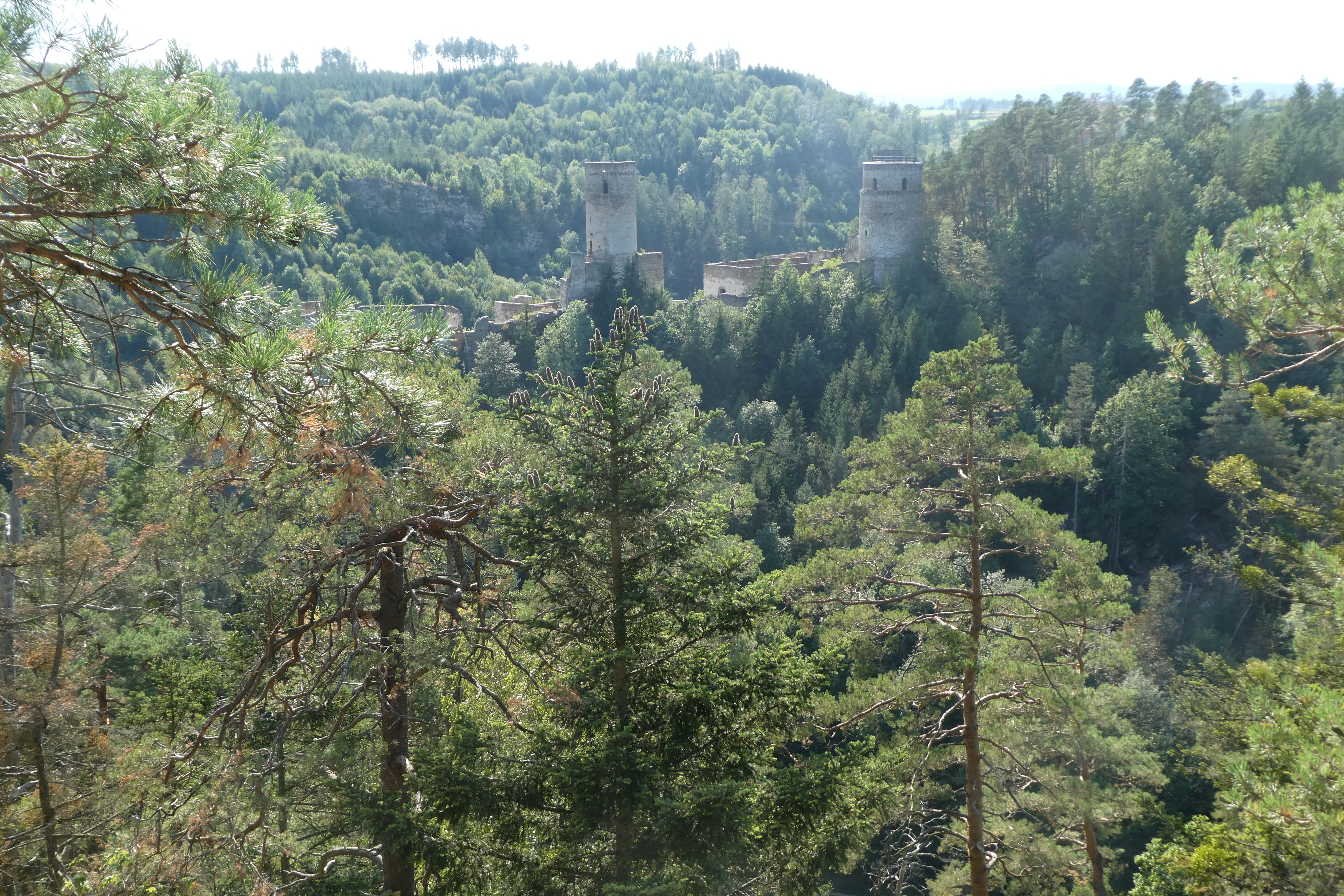
Chinglish, or Dunglish?

Tags

, , , , ,

Various places on the web and elsewhere expose the terrible mauling of the English language in China, one of the latest editions coming on the Chinese language blog here. Although this last one is called ‘tasty Chinglish’ on account of the fact that the examples come from food names in restaurants, this whole development of the ‘fan-club’ is beginning to become rather tasteless to me. After a visit to Madame Tussauds in Amsterdam, I thought, why not start looking at other ‘…lishes’?

‘Dunglish’ seems to be quite over the top, but let’s consider the distances, geographically, historically and linguistically, between English and those two countries. China used to be one of the doormats on the way to riches the imperialist mighty cleaned their feet on a hundred years ago. China got into such a terrible state of affairs as a result partly of this that they chose to follow the Chairman, who, alongside guiding the country out of the deepest doldrums and almost led it into just another one, kept grounding salt into the already bleeding wounds. He also cut the Chinese away from any foreign influence, umpteenth time in the country’s history. This also meant that practically no English-speaking people got into contact with any ordinary Chinese between 1949 and 1976.

This was easily a full generation, if not more, who were not only unable to learn languages but who also grew up loathing any foreigner. Coupled with long and repeated historical maltreatment before, no wonder a ‘foreigner’ is still mostly called a ‘laowei’ (老为), meaning ‘foreign devil’ by Chinese people in the street. Add the distance of kind between this Asian type of language and Germanic English, and the thousands of miles to English-speaking countries, hardly balanced by a few thousand native English people, or highly qualified non-native teachers teaching English as a first foreign language to an ocean of 1.3 billion natives, and you’ll see the enormity of the task. The enthusiasm leading up to the Beijing Olympics helped several thousands to master English, but the ratio is still tiny. And to critics from the West, may I ask which of you learned writing the Chinese sign system besides the Latin ABC? They do both en masse.

Considering that Dutch is a young Germanic language, in close proximity of kind to English and to the Islands themselves geographically, what extent of mistakes, if any, would be allowed for Dutch texts? Obviously, there aren’t enough English speakers to translate or correct all public signs and restaurant menus in Beijing, let alone around China. On the other hand, the Dutch are one of the nations that stand out in foreign language skills in Europe. Whereas there is one English-speaking television channel in China, whose text is locally made, English-speaking channels are easily available for and popular among youth in the Netherlands. The historical opposition between the two countries hundreds of years ago long forgotten, the linguistic kinship also adds to the expectation that here in the Netherlands all public texts in English are excellent. The testing methods in schools that I exposed earlier in this blog somewhat dampens this, still, what I’ve recently found in one of the most widely visited museums in Amsterdam, in Madame Tussauds, is nearing the level of shamefulness.

P1090694

As I see it, it can hardly be argued that the third sentence explaining Stuyvesant’s importance is a quote from the man himself. He probably didn’t speak English, the ultimate foe for his country then. This is the work of a Dutch translator who translated this text from the original Dutch for the sake of English visitors. Still, he failed to change the sentence structure from Dutch into English.

This was perhaps the greatest blunder I found, but there are number of other, smaller ones that should be improved by the museum. This one, for example, is a close contender.

P1090695

Not only do we not address him ‘in’ as we prefer, he was also not crowned ‘as’ king (see the example here, he was still a prince when he was crowned king of the Netherlands, although “Today, only the British Monarchy continues this tradition as the sole remaining anointed and crowned monarch, 

though many monarchies retain a crown as a national symbol in heraldry” according to this source. However, it is simply hilarious to believe that his ‘mother officially abdicated … and was then crowned’. This would mean that his mother is still the sovereign following an anointment for the second time after her abdication. The writer simply forgot to include ‘he’ to signal a change of the subject. 

In the following example of manhandling English, ‘june’ spelt with a small letter, like ‘april’ in the one above, is a minor issue following the Dutch vernacular.

P1090713

Unfortunately, “The” following a “:” should not be capitalized, but the ‘sentence’ afterwards is meaningless simply because the “Artist, also known as TAFKAP and, was christened Prince Rogers Nelson after his father’s jazz band” is not a sentence. It’s not the senseless inclusion of a comma before ‘was’, but the inclusion of “and” that makes it so, making the following into a clause that would need another subject, or an object, before going on with the predicate. Then, “Besides the more than thirty albums he released, Prince is the charismatic owner …” is also not exactly the paragon of the correct subject co-ordination, making Prince another version of, or name for, the thirty albums he released. A little bit massed up, for my taste.

Then let’s consider another nice one, which also misses the capital on “may 5”.

P1090716

A couple of blunders here. The smallest of them is that it’s a normal text, so “Debut album” badly needs an article in front of it, on account of ‘album’ being a countable singular noun. Further, in a text in the past tense, we suddenly encounter “leads” and “breaks”. Yes, historic present, but then what about the rest of the text? All of it should either be in this historic present, or the writer should have kept the past, where he returns in the third part after all. But funniest of all the mistakes here is in the first and second line – “and that friend out her song …”. Fried out, friended out, ousted? That friend outed? What’s going on here? Would ‘published’ or ‘brought out’ have been so difficult? “amoungst” in the last part is only the icing on the cake here.

Perhaps we could only find the usual non-capitalized name of a month and the inconsistent use of the comma in the following …

P1090717

but this also allows one to see that the writer can’t differentiate between defining- and non-defining clauses, making it seem as if there had been at least two “Idols 2” competitions. Besides, “recordcompany” is a non-existent word, the idea must have been either a recording company, or a record label, or perhaps a record-company like here. I also suspect that they actually have a recording deal, not a record deal, which would perhaps mean a record amount of money for the deal; however, this seems far exaggerated, without real international fame for the said duo. I can simply accept the missing question mark after “Do you know what I mean’ … it may have been missing from the original as well.

P1090727

The usual ‘july’ and ‘october’ aside, I have a certain measure of doubt as to whether Rembrandt could have painted anything not “in his life”, but I’m certain that even he could not paint etchings and drawings, not even with his outstanding talent, and not in the hundreds and thousands. Further, if the writer knew that the Saxon genitive could be used in the case of “Amsterdam’s “Rijksmuseum””, how could he have not known it with “Rembrandts work”? Or did he get enlightened between the two sentences? The missing commas in the last sentence are a completely minor issue after this.

P1090731

In this last example of Dunglish, the second question is a fine piece. Not only because, in English, the what he received comes before the where from, but also because, sadly, oevreprice is not English. Oeuvre is the legitimate word in English for the work of an artist over his lifetime, but a prize for this work is called a ‘life achievement award‘, or ‘lifetime achievement award‘. It’s a small matter that, by the third question, the writer forgot that he had started to list questions after the original “Did you know that …” piece, otherwise he wouldn’t have started the third dependent question with a capitalized “He”. But he certainly never forgot to write all names of months without the English capital, so why so forgetful otherwise?

P1090720Well, I know a writer/translator can’t be perfect. That’s why translations are proof-read afterwards, before the texts are handed out, as done and dusted, to be presented to the original client. Obviously, at this very exposed museum, somebody forgot to care about this, and nobody else cared to notice. I hope that somebody does after this. But I have become a bit uncertain as to the seriousness of mistakes on English-language signs and texts in China. In which country of these two are mistakes relatively more serious? Besides the need for Mme Tussauds Amsterdam to check and exchange their notices, perhaps the image of the Dutch being excellent about their English also needs a revision. And berating the Chinese for their public English texts could also be done a bit more kindly. To ease the stern expression on Mme’s face.

by P. S.
English testing issue in Hungary

Tags

, , , , ,

Last week, students sitting for the school-leaving exams in Hungary were up against the English test on the higher level. This test is something the results of which count towards university entrance exams, so naturally, perceived or real trouble about it counts a lot more than that on the normal level tests. Internet news about the issue with the listening part can be read in Hungarian here. I hope that my interpretation of the situation may be useful for English teachers in other countries as well and may help students understand some features of the situation.

In short, of the 9809 exam takers, in one day, more than 2500 joined a facebook group (though this could be misleading, seeing that parents also joined the group) and submitted a petition to the relevant government agency against the quality of the listening material as they thought the material couldn’t be heard properly because of distortions of sound in classrooms. Some actually claimed the original sound already had echos. We can also listen to it in the middle section of the article, right next to the link to the pdf of the task sheet involved. As my listening to the published material reveals no distortion problems to me on my computer, the story reveals a lot of problems in the Hungarian education system.

Admitting that the inclusion of several French and Spanish words was not exactly fair, I still wonder if that may have disturbed takers. Not only in my teaching practice but also in all teaching materials, there are lots of names from other languages recurring all the time. How can one learn a language without mentioning outstanding people from history, science, the arts etc.? English doesn’t distort foreign names like Chinese does, so this can’t really have been a problem for trained examinees. Trained, I’m saying, and I’m returning to this a bit later.

Another problem claimed was the extreme distortion. The article claims many schools use ancient portable tape-recorders to play … what exactly? The listening material was issued to schools in two copies of the relevant CDs, so no tape-recorders could have been involved. Such a distortion is, to my mind, indicative of the quality of … the Hungarian media. Other than that, CD players may have been of dubious quality, in bad repair, I had already met a number of such equipment 10 years ago. However, if a CD player doesn’t work, it is taken away to be repaired or thrown away and is exchanged to a better one. Some people actually claimed that they didn’t hear the sound sitting in the second row and they have good listening abilities. To my mind, it is doubtful that the teacher administering the test purposefully brought in a bad player with bad loudspeakers to disturb her/his own students. Claiming that the loudspeaker had to be turned up too strongly in the big rooms is also strange: the same students had been sitting in the same rooms for four years listening to the same players at similar intensity. What may have been new, pray?

However, this point only in itself brings the technical background for schools in Hungary in the limelight, and probably deservedly. This in turn underlines the poor financials of the same for extended years. While in my study years we only had really ancient big tape-recorders to listen to the one set of intermittent pre-recorded (that is, unnatural, carefully read-out) listening material, the 21st century makes it necessary to expose students to realistic listening in countries, like Hungary, where English-language TV-programs are practically unavailable and dubbed films prevail in the cinemas. This practice is also in need of changing, but the poor general financial situation makes it very difficult for any broadcaster to buy the rights of contemporary TV programs and air them as they are. And what would be their incentive? That change nowhere to be seen in the pipeline, it is the schools’ duty to provide ample practice for listening. If they can. But that is only one side of the equation.

And that brings me up to my next point. As I said, it is up to schools. But schools consist of not only teachers, there are, in the majority, students as well. Meaning, the vast majority of people in a classroom are the students. Have you ever stood in front of a large group of people who resist all your efforts to bring them together and make them quietly learn something instead of their own will? It’s a lot easier for a party leader to speak to a huge crowd from their own party – they want to hear what he wants to say. Try doing it in front of the opposition. And that is still only speaking, not making them practice performing skills. My experience shows that during the last 15 years the willingness of most students in Hungarian schools to learn has been nose-diving. You can lead a horse to water but you can’t make him drink, as the proverb goes. More and more students do not want to drink from the fountain of knowledge, so to speak, but weep and wail each time listening is brought in – I faced this reluctance increasingly myself.

I’m not saying it happens everywhere, but that it has been increasing dangerously. Now, if the teacher doesn’t want to antagonize her/his students all the time, she/he yields and there goes the listening practice. This may turn into a general tendency because it is easy to neglect something once again what we’ve already neglected a couple of times and yes, listening is not easy and also not easy to teach. With a decrease of quality students, teachers’ average levels of quality and professionalism may also decline, and in a culture growing towards accommodating the perceived ‘needs’ of the customer (the students), teachers get used to catering to what students ‘want’. And that can be dangerously close to very little. This based on the majority will. And the majority is always right, right? At least before Copernicus …

That said, I’m not saying those students hadn’t practiced listening – I’m saying, what they had done was far from satisfactory, far from enough.

Learning a language has nothing near to the logic of developing mathematical or historical knowledge. It is not even only knowledge, it is rather a huge set of skills. It is a lot more complex than other subjects except for learning a musical instrument, and contrary to beliefs, but due to the complexity as well, there are very big differences in learning abilities, especially if we consider the time constraints. Hence the complaints in the complaining group on facebook, demanding logical, rational answers. No, there may not be logical, rational answers. No, the way we learn languages is next to impossible to follow with logic. Yes, intelligence may have a limited part in it. Yes, it may also be due to psychological barriers, individual learning styles, short- and long-term memory differences, methodological differences on the part of the teacher as well as on the students, to name a few problems. And listening is an area where a lot of those factors converge for many as there is no possibility for individual speed, time to stop to consider and the like. It is thus very tiring and also difficult to really assess. I am next to stating that teaching a language is an instinctive art, with an instinct not easy to develop. So many colleagues in the classroom may give up on trying and practicing listening. It is easier to resort to a dry, seemingly logical structure of what happens easily each time: turn to page … read and answer the questions. Choose … fill in … let me see … correct … incorrect because … (grammar explanation following). Satisfaction – duties have been fulfilled.

Of course, students wanting to take the higher-level test are the cream of the classes. Why couldn’t they perform at the test without problems? Well, it’s because they are a minority of the communities they had been brought up in to be the best. To be the best among a general decline may mean very different from what it meant for us 40 years ago, or for my first groups 30-or-so years ago. Those communities are the real initiators of this protest and the real cause of the problem. They may be the reason why the best may think they are good listeners. Among whom?

Parents seem to subscribe to the general mood of protest. I have seen and felt this too. Parents have become more and more defensive of their children based on the perception that they know their kids better. Parents’ perceptions have been shifting towards seeing, if not the school, then at least the ‘problem’ teacher as the enemy instead of the ally in improving their children’s capabilities and thus future chances. Unfortunately, this perception has been spreading among the student community as well. And this has been happening in a country and culture where parents are more and more inundated with their own work. Before I forget, there is also the other side, the group of parents who can provide their kids with everything they wish for. As one student explained to me a few years ago, “I don’t need to speak English, I’ll have my father’s business and I’ll employ interpreters.” Well, yes, that seems easy for some. If that’s the image they make fashionable, what are the chances for the meek not to follow in laziness? However, that’s already a social problem that I can’t address here. But that’s another reason for the students to consider the teacher the enemy – she/he, the ‘loser’, seems to be powerless against the ‘mighty’ parents, so what do they want? Reminiscent of the situation in Chinese private schools. Does it also remind you of “another brick in the wall”?

I see one positive. And that is that the tasks are still given in English at an English test, something that may often not be the case in the Netherlands, or Italy, or China, for example. I can feel, however, that this may also change as so many other things have changed in the course of the last couple of years in the Hungarian education system. It is always easy to take the easier path. But that is going to be the subject of another article next time.

A few days after I posted this article, on 14th May, what do I see on Dutch TV? Mass protests on the net by Dutch takers of their respective school-leaving exams against the time constraints they thought was too short … while in Nigeria, where more than 270 girls were earlier kidnapped to prevent them from going to school and punish them, people are still hoping that there may still be a future for girls’ getting a profession.

by P. S.

Effect of Grammar Teaching on Learners and Translators

Tags

, , , ,

I have been relatively new to translators’ sites, but on a discussion forum, I’ve already come across a lot of very professional explanations of problems in English. Translators are language experts after all.

However, I’ve recently seen a question that, surprisingly, at first sight, veiled the sight of professionals as well. The question was about how to translate the following part of a test into another language:

“Q X. The School of Art is
a. moving to a new site in the near future
b. lifting to a new site in the near future
c. sending to a new site in the near future”

The asker (somewhat grammatically incorrectly) said “I think that answers B and C are not grammatically corrects” but asked for other people’s opinion.

My feeling is that the foreign language teaching which we all underwent at a young age left an indelible mark on us to an extent that most of the best language professionals still think in terms of grammar when faced with wrong language items. They clearly identify what is wrong language, but when the question referred to wrong grammar, they left it at that and were mostly busy discussing how strange the idea is to translate a language test into another language. That is also a very valid question, but at the same time, of the 5 or 6 people involved in the discussion, only one pointed out that it is not the grammar which is wrong, but “it’s a problem of vocabulary — simply the incorrect choice of verb”. And this amazed me.

I suspect that language teaching that focuses on grammar leads to a tunnel vision of languages with most of us, and we accept all, or most, language mistakes to be those of grammar, the rest being allowed for spelling and punctuation, but which are almost never pointed out to fellow professionals for fear of being called impolite.

In this particular case, what was really important was indeed the incorrect two choices. But, though asked about grammar, some people may have also been afraid to correct the conceptual mistake. Yes, grammar is usually to blame. To a language teacher, this indicates that treating vocabulary, or lexis, as increasingly referred to at least since Michael Lewis’ ‘lexical approach’ appeared in ELT, is still the basic concept we deal with about language. His work has apparently not gained enough kudos to counteract the good old reference to ‘grammar’, whatever is understood under this umbrella term.

Besides, one other very valid point was also raised, namely, to what extent wrong language can be called incorrect. It often happens in language classes that teachers (or native voluntary helpers here in the Netherlands) jump on any mistake learners make. Besides possibly intimidating most learners, this also overshadows the fact that language is for communicating ideas even through mistakes. Haven’t we all, as babies, started out making millions of mistakes, and yet, our families understood us the way we intended? There was correction, too, but it was not only patient, it also accepted the extent the faulty language was still communicative enough.

Besides, it was all done without reference to ‘grammar’. I increasingly suspect that the concept itself is to blame for the mere question. If it is enough for language professionals, and indeed all native and high, or even mid-level speakers of the language to identify a mistake as wrong, is it necessary to call it a name and thereby fall back on falsely trained concepts? If we have to teach along lines of concepts at all, then teachers and learners should learn to call a spade a spade and call a wrong word a mistake of lexis, and not grammar. Or abandon ‘grammar’ almost completely.

It is also time to point out to language learners that when they make lexical mistakes, they may be grammatically correct, but most lexical mistakes are completely wrong because of the meaning, and often simply because of general usage. In schools, the stress is on grammar, whereas the most urgently necessary material to be learned is vocabulary, and in the proper usage. Without lexis, grammar is dead, but proper words have a meaning even when ungrammatically used. “Papa, rug pein?” with good intonation is completely understandable from the toddler, although an applicant at a Dutch language exam would fail. “Kici, nagyi?” is completely wrong Hungarian even on pronunciation level, yet all Hungarians in Chinese take-aways understand this in Budapest and react without problems. This importance of lexis is perhaps most apparent using Chinese, a language rather void of grammar, when, for example, politely asking someone to “Qing zuo ba” would become wrong if we changed the declining voice pattern on ‘zuò’ to ‘zuǒ’ (as in 坐 v. 左). Of course, the context helps, and in the case of Chinese, due to the characteristics of the language, phrases with wrong tones are still understood. But a mistake is a mistake, but it is almost never one of grammar, especially in writing.

This all shows as well how mistaken language testing itself could be, and that language tests should not be translated. Language tests are to measure the level of use of language of learners based on the characteristics of the given language, not of another one. Also, tests do not provide context, even for grammatical correctness. Thus teachers and then tests end up having to transcribe active sentences to passive “equivalents”, which, in the vast majority of cases, cannot sensibly be done. What would be the active version of “The last member of the family could not be rescued from the burning house”? An accusation against whom? The normal British press item “Our government has failed to realize the threat involved in allowing hedge funds to ….” would be completely unheard-of if translated into Hungarian without using an impersonalized kind of language reminiscent of passive voice, but such a Hungarian item would lose all its usual critical edge translated into English in the passive, as a result of the fact that no acting party would be mentioned as subject. Languages have their internal characteristics besides and above mere ‘grammar’. But when the question turns to ‘correct grammar’, even a native language professional suggests, however tentatively, that in sentence C above, the passive would be more correct. Except for the meaning involved.

by P. S.

Neurobiologist on the brain development of children – part 3

Tags

, ,

This is the third, last part of the interview I’ve translated from Hungarian about children’s development and the role of the media that was made with Gerald Hüther and published in Hungarian here. This part is mainly about what parents should notice, how they could help their children grow up healthily and what long-term changes are to be expected.

“From what signs are parents able to recognize that the virtual world has sucked their children in? And how can they protect their children from the threatening deprivation?”

Hüther,Gerald_08.jpg.5154300“If a child prefers sitting in front of the computer instead of running about outside and playing with others, that is, if he/she does not satisfy his/her natural needs, then the situation is worrying, parents already have to respond to this. But not by formulating prohibitions. Instead, they would have to try to present their children with challenges that correspond to the real world, and which can also be met. With adventures, unexpected incidents, surprising, or even dangerous situations that the child can overcome, so that then he become hardened through these.

Therefore, beside the wide computer highways, parents should plant something else in the heads of their descendants. Lots of parent enter their offspring for Asian fighting sports, holidays with camping out, or ask them to look after smaller children.

Some of them may be helped if they can teach old people how to use the computer and the internet. These children will later be able to talk to others and solve problems together. This is because they are provided with a broad spectrum of the real, empirical world by their parents during the years decisive for the maturing of the brain.

On the other hand, children who get immersed in computer worlds will learn too soon that for everything there, all it takes is to press the correct button. They no longer tolerate any mistake, no longer bear frustration, and are not able to maintain control over their impulses. They are no longer able to navigate in the real world.

P1000416If, on the other hand, your children are parts of a living community, and they experience adventures like the boy scouts, they will be lured under the spell of virtual worlds much more rarely: they will play with the computer a lot less often and watch far less television. During their subsequent lives they will experience far less disturbance from anxiety, and will not become so uncertain. They will grow into really healthy personalities.

“Let us suppose that such a personality has emerged. As all youngsters, this child will still try out computer games and the Internet. Similarly to others, he will also want to create a chat profile. What dangers arise from this?”

“No child is born computer-dependent. And it is never the strong, lively, open-minded, curious and creative children with good interpersonal skills who are charmed by the electronic media. I can’t see threats for them. They will consider the computer to be what it sould be considered: an excellent tool to serve the efficient use of the brain. They will discover the internet as a gigantic source of knowledge for themselves, which allows them to answer questions about the real life.

“But what happens in the mind of a child of ten when he/she accidentally hits upon a page with pornographic or horrifying content? Does not he/she get too great a shock?”

“Not necessarily. It depends on what the family environment is like, and what role the media play at home. Some content that for us adults appears to be signs of horrible brutality, for a lot of kids appears as one of many possible forms of approaching each other. A child whose mind has already been blunted by passive consuming of the media will not be able to form an opinion on what he can see there. Experience has taught him/her that everything can happen on the screen.

One minute he/she can see that the fox is chasing the bunny, in another that people are laughing when Donald Duck and Pluto are flattening each other, and then, as if nothing had happened, they rise again. Muscle-headed wrestlers smash each other’s skulls on the screen before a yelling crowd, and then the child can see that two people are making love, or, for example, cut off each other’s heads.

The parents have weaned them off the natural feeling of being horrified. The child has already found out that it is pointless to ponder all this. He has learned that he/she is not necessarily able to understand what is happening on the screen.

“But what happens to children who have hardly gained experience yet with the passive media?”

“The child’s brain will be trying to fit this new image, no matter how disturbing, to that already existing, so that he/she can understand it. His/Her impression will be stored as one of the forms of communication among people. It is very important that the parents then clearly explain that this is not a desirable form of co-existence with others. If someone did this to you in the real world, it would be terribly painful for you.

“Children, therefore, need not only tasks which help their development, but also people who give them direction.”

“Yes, they urgently need role models who help them avoid doubtful communities and questionable tasks. Things always go wrong if the children are not able to fully expand their skills.

For this, adults are needed again. The computer industry only satisfies the demand. And as long as there are enough parents who do not understand that children have needs which are best met in the real world, the supply in digital media will increase. And if children grow up among such circumstances, they will seek tasks necessary for their development there.

It is worth stopping to contemplate what may become of a society whose children take leave of the real world. The result of which is a brain that has perfectly adapted to a virtual world of the Internet and to PC games.

“Can you justify this idea neurologically?”

JJ_published“We already have studies which demonstrate that nowhere else can a man learn better hand skills, or, more precisely, better finger technique than when practicing on a keyboard or writing an SMS (my remark: this is true except in comparison with playing musical instruments, which gives really complete finger control together with aesthetic satisfaction in the long run).This leaves its mark on the brain. Thus, during the last ten years, the region in young people’s brain that directs the thumbs has grown considerably larger.

There have developed finer and finer, denser and denser networks, which allows them to make amazingly fast thumb movements. Young people develop their brains so as to optimally adapt to these requirements. Now the only remaining question is if it is going to be important in the society of the future that man can move his thumb as quickly as possible. Children cannot answer this question yet – it is up to adults to anwer it.

by P. S.

Neurobiologist on the brain development of children – part 2

Tags

, , , ,

This is the second part of the interview I’ve translated from Hungarian about children’s development and the role of the media that was made with Gerald Hüther and published in Hungarian here (unfortunately, this site can no longer be accessed). This part is mainly directly about the effect of the media on the brain.

“So do you think children need tasks?”

For the brain the real challenges and adventures are of decisive importance. Going fishing with uncle, building a house into a tree, or climbing a mountain. The adventures have made us all strong. Nerve scientists can now prove the connection: children have to overcome as many challenges as possible during their lives so that the most important networks can be created. Therefore, children need a world in which interactivity plays a very large role. And that not in the context of virtuality, but of real life.

“Can children later develop this neuronal network in their brains?”

“If the critical period is over and the networks important for the regulation of the body are sparsely developed, the child does not have a good feeling about his/her body. However, the brain remains malleable throughout our whole life. An 8-, or 10-year-old child shall also benefit later from all the experience of his/her body that he/she acquires nowadays. However, the child will be differently motivated to train his/her body. The learning process no longer takes place intuitively and automatically. Children are ashamed of themselves, they are mocked at – and they learn with fear, which is not a good basis.

“Provided that at age 6 the important neuronal networks in the brain have already been established, are children protected by this time against all danger from the media?”

“Not necessarily, because many children are in the danger that they will get lost in the virtual worlds.”

“Are you referring to computer games?”

“Yes, among others. It is because it becomes dangerous if children use the digital media to meet their essential needs. Each person has two of those.

One is to belong somewhere. The other is to want to perform. The first need is expressed in the need for bonding, the second in the desire for freedom. Kids suffer in our society first of all from the fact that they only rarely have the opportunity to achieve something. They find no real tasks which may strengthen them in their development. That is because those would precisely be the tools to be used to build up children’s self-image, their identity.

It is obvious that a lot of parents have already forgotten what such a task would be like, the kind helping the development of a child. The child himself has to find this task nowadays, and it should indeed be challenging and long.

At the end of it, we will feel like when climbing a mountain: we only sit up there, and simply feel happy. This is a sign that the child has solved a real task, that in this case, there is no need for outside praise, he is happy with it on his own.

Today, primarily the boys find it to be their task to develop their proficiency to absolute perfection in computer games. In such competitions, they can show others how good they are. But those tasks are not suitable to assist them to find their way in real life.

“What kind of children are especially vulnerable?”

“Precisely 40% of German schoolchildren go to school feeling stressed. In particular, the boys are those who sit down in front of the computers immediately after school. They need at least one hour’s shooting games. The computer is, for them, a means of getting rid of their frustration. By doing a great job holding their ground among the adventures of the virtual worlds, butchering monsters and becoming victorious, they find a way out of their powerlessness and the mounting agression. They reduce their frustration with a peculiar achievement.

“So then, again, the system of rewards comes in action.”

“Exactly. As if the children had come by a wonderful life experience. This experience, however, applies to a world which does not exist in reality. Neurobiologically speaking, this is fatal: the child trains his mind for situations that only occur on screen. What is more, computers create the illusion of controllability too. When a child plays with another one, his experience is that, in reality, not everything can be controlled. Another person is not always doing what we want.

Besides, a lot of kids can no longer sense their bodies during a game. They no longer need sleep, they do not respond to signals of hunger or thirst. In South-Eastern Asia, the first cases have already appeared where computer-dependent youngsters starved to death or dried out sitting in front of the computer.

“You are talking about boys basically. But what do girls do with the computer?”

“They chat. Girls feel more need to belong somewhere and to build up relationships. And then, if this is not really successful, chatting can become a compensating substitute to some extent for the missing proximity and bonding. I do not have to prattle every five minutes with a friend in whom I can trust. That girls talk so much is rather a sign that they have in fact become uncertain, and they cannot trust the durability and strength of the connection. It is like when chicks call their mother.

“And do the real social relations wither away?”

“This must necessarily happen so. They can only keep real relationships with another if they are really together. All else is only virtual connections. Because in the virtual spaces, people are not present in their full reality. They have no fragrance, no smell, their movement and other manifestations are not life-like. In virtuality, features of encounters prevalent to life do not occur. While chatting, they only communicate in writing.

To be continued soon …

by P. S.

Neurobiologist on the brain development of children

Tags

, , ,

My dear reader, I read a fascinating article (in Hungarian) a few weeks ago (which was accessible here in Hungarian but since the publication of this text, is has become unavailable – sorry for the inconvenience) that I found so interesting that I’d like to make it accessible for a different community here in my English translation as well.

Hüther,Gerald_08.jpg.5154300It is an interview with leading German neuropsychologist Gerald Hüther (some more information and another interview with him in English here). The original interview may have been in German, so apologies for perhaps deviating from the original meanings at points. It is also long, so I’m going to deliver it in three parts over the next couple of weeks. I’m going to insert my own ideas at places where I find it appropriate as I’m not only interested in, but also involved with young children’s development, especially as regards their language, social and creative development, being closely involved in my co-author’s children’s lives.

What goes on in children’s brains when they are watching television?

In the latest edition of GEOkompakt, devoted to child-development psychology, professor Gerald Hüther, one of the best-known German brain researchers and neuropsychologists explains what goes on in the minds of children who watch television or play with the computer very much.

“Professor, as a neurobiologist, you research how the media affect human brain development. Could you recommend to us a good TV program or a computer game for Children?

“No, and such recommendations would not help us any further. This is because in that way we would only get mired in a superficial conversation about the content quality of the supply; however, it is better to avoid that. On the other hand, you do not need to look for very long: you can quickly find five studies which show you how good watching television is for children, allegedly.

In contrast to this, however, another five studies will prove that TV is bad. This discussion is completely useless for parents. I do not talk about content, I approach the question from much further away.

A few years ago, we neurobiologists still thought that the genetic programs automatically set up all connections in the brain. Therefore, the complex neuronal networks, which direct the ways we think, feel, act, were thought to be genetically programmed. It is now known, however, that in the long run, only those relationships are created in the child’s mind which are regularly activated in real life. What is not used, withers away. (me: And so it is with adults too.) The genetic programs ensure that at first large surpluses of neuron-links get created.

For the creation of the most important neuronal circuits in the brain, children need to experience their own bodies first of all. And this is not acquired sitting before the screen independently of what goes on on TV.

“Why are bodily experiences so definitive?”

“Only those can fully develop their cognitive abilities in whom the appropriate feelings of their own bodies mature. There already exist studies which prove that those young children who are good at mathematics are especially capable of balancing too. One obtains the capabilities necessary for three-dimensional and abstract thinking and for mathematics that he learns to keep his body in balance. As a child is sitting in front of the TV, he no longer feels his body. He does not climb, does not jump, does not balance, or does not climb a tree, i.e. he does not pass the time by learning his body.

“So children should keep moving as much as possible?”

“Yes, but they do not necessarily have to climb mountains. Singing is one of the most extraordinary practices to learn our bodies. In doing this, in fact, the child’s mind has to direct  his vocal chords in such a virtuosic manner as to bring out the very exactly appropriate sound. This is the best fine motorneuoronic practice and, at the same time, this is the condition of all future, very differentiated  manners of thinking.

On top of this, we can speak of a very complex creative performance with singing. This is because the child has to bear in his mind the whole song so as to be able to hit the correct sound at the correct time. Besides, he also learns to adapt to the others in the chorus, which is one of the conditions of social competence.

Without fear

Without fear

Moreover, children also experience something wonderful, namely that we are not able to be afraid when we are singing. Neurobiologists now know that during free singing, the brain is not able to mobilise the feeling of fear. This is why, going down to the cellar, man has been singing for thousands of years  and not because he wants to scare the mice away.

“Where do such experiences condense, where are the neuronal circuits formed?”

Trying to find out how it works/1

Trying to find out how it works/1

“In the most complicated part of our brains, in the so-called pre-frontal lobe. It is located right behind the forehead. That is where our idea of ourselves evolves. And at the same time, this is also where the urge to turn to the world also evolves, the urge to plan actions, to control impulses and to bear frustration.

This has to be formed in early childhood, until around the age of 6. The networks in the frontal lobe responsible for all this, however, will only evolve if the child acquires this experience. Such experience, in its turn, results primarily from dealing with things that he can make sense of and is able to manipulate. This, however, is more and more difficult today.

“What is the cause of this?”

Trying to find out how it works/2

Trying to find out how it works/2

“The children’s world has changed just as much as that of adults. We are not able to understand any more how our household articles actually work. Formerly this was otherwise. Each object was understandable, the bicycle, the steam engine, even the car. A child could take the clock to pieces, he could study the cogwheels on the inside, and in this way he could uncover the mechanism behind it. Today, in the days of the information society, things may be so complex that very often we fint it hard, or impossible, to understand the cause and the effect.

“How does it all affect the child’s mind?”

“Our brain always adapts to what we do enthusiastically. In the previous century, people felt enthusiastic about machines, and that was what they identified themselves with. In fact, they even applied this machine-like way of thinking to themselves. This then affects the language: we call our hearts pumps, and we talk about run-down joints, which we then replace.

But now suddenly there is this new era. It will be more and more difficult to comprehend the causes and the effects. For example, why the arrow on the screen moves to the right when the mouse is moved. The lack of this mental connection will lead to children not being interested in causality any more. This is the simple result of human brain development. They seem to learn that they have to accept things without capturing the inherent sense behind them.

It is not only that lots of digital media are not understandable, but in addition, there are very few possibilities for us to get involved in current events actively. A very simple example for this is that we cannot change anything else about a television than choose the program. The first time we put a young child in front of the telly, they even talk to the set. They tell the bunny where the fox is lurking. This means they try to participate actively in the events.

This has been taught to them by their experience so far, without virtual media. After a few weeks of watching TV, however, most kids resign to the fact that they cannot actively get involved in the development of things on-screen and give up, that is, they query a part of their own efficacy.

“This is, however, an important element in the development of a child.”

The strength of our inside urge - a toddler choses his own activity against looking at the TV

The strength of our inside urge – a toddler choses his own activity against looking at the TV

“Yes, and this only develops by its own experience in the frontal lobe – as a very complex neuronal network. To expand their knowledge horizon, children have to place their new experiences in a mental context. This is because our brain is only able to learn something if the new impressions are linked to an existing pattern which originate in previous experience. This is an exceptionally creative process.

Therefore, the child will try to suit the new to the existing, older patterns. But to do this, he/she will first start looking for things in his/her mind, so to speak. A stage of productive anxiety emerges, until the pattern of stimuli falls in place. And then the chaos is converted into harmony in the brain. This is that particular ‘I see’ experience.

In the meantime, the bonus system is activated. Nerve cells emit “hormones of happiness”. All little experience of our own achievement causes happiness comparable to taking a little cocain and heroin at the same time. In contrast, it is terribly difficult to be actively, creatively involved in watching films. Therefore, it would be preferable if kids did not get into contact with the television or the computer before schooling.

“But we also receive the action in a book ready-made. Reading is also a passive activity.”

“When a child reads, a lot of things go on in the meantime in the brain technically. It puts the letters together into words. The words and sentences are converted into worlds of phantasy. What the child’s brain has read appears before his mind’s eye.

Little Red Riding Hood is walking in the forest. No child sees the letters here. This is an incredible achievement of the brain: to create a picture from black and white. In contrast, a Harry Potter movie is worth nothing. Before you can turn on your imagination, the following image is already there. In fact you are only developed by what you have worked for yourself.”

(me: A proof of this can be considered in the fact that most people watch films to relax, to get out of their own reality, to stop worrying. We may laugh or cry over a film, but we do that because we copy, we are moved at best, not because we take their happiness or sorrows on ourselves. The rare film which is so good that we feel involved is not only rare, but soon becomes obsolete – people get fed up with them; just watch Lars von Trier, or Mike Leigh films – most of them exceptionally good and disturbing films, but never successes at the box office.)

To be followed soon …

by P.S.