• Privacy policy
  • Translator – ProZ.com Pro member
  • About

Learning and teaching languages in the Netherlands – and taking photos in the process

~ A fine WordPress.com site

Learning and teaching languages in the Netherlands – and taking photos in the process

Category Archives: education

Learning Languages with Duolingo

21 Sunday Apr 2024

Posted by ZJShen-PSimon in education, foreign language teaching, language learning, language teaching

≈ Leave a comment

Tags

Érdemes a Duolingoval nyelvet tanulni?, duolingo, Изучение языков с помощью Duolingo, Стоит ли учить языки с помощью Duolingo?, Is learning languages with Duolingo worth it?, Ist Duolingo wertvol?, Language, language learning, Learning, Lohnt es sich mit Duolingo sprachen zu lernen, on-line-language-learning, travel, Waarde von Duolingo

Or Duolingo, the really helpful language teacher, which offers courses on beginner, intermediate and advanced levels

Or, the meaning of “The largest language learning community in the world”

Or, “Did you know that you can learn a language by learning 15 minutes a day?” (But we won’t tell you how many years it will take.)

I’ve met a lot of such slogans, countless many times, from the beginning since I started studying on Duolingo more than two and a half years ago, then starting with German based on English.

During that time I added several other courses I was interested in, depending also on availability, but my original doubts about those slogans and the usefulness of their system and methods have grown to considerable disappointment in spite of my considerable progress and achievements. Below I’m going to discuss why.

For the sake of those who don’t know me from these, much earlier posts, I better introduce myself before delving into the below, rather critical, essay.

I’m a native Hungarian English teacher and teacher trainer with CELTA/B, with teaching experience of more than 30 years, mostly done in Hungarian secondary schools and tertiary institutions and 3 years of work experience in a school and at a university in China. Afterwards, I moved to the Netherlands and, after odd jobs and learning Dutch fairly properly, I became a translator with a degree exam from the University of Budapest and an ATA certificate. I’ve been translating loads of texts among the three languages mentioned above, translated two Hungarian books into English and wrote and published a book about classical singing in the USA, as you can see in another part of my site(s).

Despite the above, I’m not a talented language learner. I’m average at best, sometimes even lousy. With the somewhat solid theoretical basis and the expansive experience, and despite the fact that I had tried learning eleven languages through my years, I only speak English well, which I started at 14 like most people around that time and on which I worked hard and much to build a career on. We all had to start Russian at around 10 as part of the friendship package back then. I was good at it for some years but at secondary school it faded and by the time I had to take my closing exam halfway dawn the university, I had practically forgotten everything. But I passed the exam owing to my excellent translation at the written part.

Afterwards, I studied some other languages on and off, either for a year or for a few months before I went on one trip or another abroad and thought I needed them, tried Chinese in China with only very basic success, enough only for travelling around and getting by at the market and shops, otherwise nothing. But I was above 45 at the time, and 55 by the time I started Dutch, with which I got success at the high-level state exam after two years of very intensive learning. Yet, to this very day, understanding fluent native speech often beats me.

These above led me to start learning what I considered a missed must, German, with Duolingo, and a feeling of missed opportunities to start revising some I’d learned – and forgotten – many years before. Starting Arabic along those proved to be a failed experiment.

Now, having established as a fact that I know how to teach – and probably learn – languages but that I’m very far from being a gifted learner, over to the matter of this language learning platform that advertises and promotes itself with the slogans more-or-less quoted as subtitles above. I believe my insight and opinion will be validated by my background and will be useful for lots of people out there.

As to the choice of languages, perhaps this platform truly offers the largest selection of language courses available nowadays. Especially if one doesn’t look too hard around the world.

However, there are limitations: as a Hungarian native, I rue the fact that there is only English and German offered for native speakers of this language. I know for a fact that there are still hundreds, if not thousands, of Russian teachers who could and perhaps would gladly do a course for this self-anointed champion under the right circumstances. Something similar may go for teachers of French, and if no teacher of either language were willing, there are thousands of capable students, at least, who could do it after being acquainted with the general content requirements of other language pairs.

Add to this how soon some courses are cut short: that Hungarian-Germain course is just a few dozens of sets long, and I know for a fact that some of my earlier students who studied German at secondary school and wanted to brush up and develop their German 15 or 20 years after graduation soon left Duolingo, as they said because it’s so predictable and stops at such a low level, it doesn’t help them any further. Of course, to me, as a beginner, it was useful as long as it went but the German courses based on my other languages are for more extensive and useful.

The EN-Dutch course is hardly longer – these two courses should at least be twice as long and deep for a reasonable level of grammar and vocabulary to be reached. The comparison is there with other German courses, for example, or the rather fast Russian course, where one reaches the level of using participles for abbreviated clauses within a few months of intensive work, whereas I can’t even get near that in Dutch, were I learned several times more in a year in the Netherlands a few years ago. Which base language should I use to learn Dutch nearly half properly if English is not good a basis enough? I’ve browsed all source languages: no other source language offers Dutch, not even Bahasa Indonesia – and the EN-Dutch source is very weak, to say the least. Nothing, if you ask me. Perhaps if, as one rather good in Dutch, I’d chose English as a target language, I could delve into a lot more Dutch but I would be bored to death apparently learning English, my professional language for over 50 years. Unfortunately, the Dutch-German course is also not very long or deep: it is cut short at the end of Section 4 while the EN-German course is, thankfully, nowhere near the middle in Section 6. So much about teaching – and thus learning – languages on all levels.

Now, a few weeks after I first wrote this article, however, I have to add that my EN-German course suddenly – and very-very strangely – is cut off at the end of Section 5 Unit 44. What I supposed to be going on in Section 6 doesn’t exist – it has transformed itself into a daily practice circle, to which I could come back if I didn’t want “to get rusty”, as they write. They write, “Don’t get rusty — come back each day to refresh your skills!” – and I’m given practically the same sentences to solve every day I come back. How can one avoid getting rusty by repeating or solving the same 40 or 50 sentences for weeks on end?? And where is the course forward?? The same story with Russian: at the end of Section 3, Unit 39, it’s suddenly stopped, with those practice circles left. Those helpful guys behind that “totally helpful” Duolingo simply cut my studies short. And I pay for smoother progress! Not for very much longer, I’m sure.

Another problem is the painfully wanting grammar range offered, mostly on the English side of courses. Not only are the present continuous and past continuous sadly almost completely missing or used at surprising places in most courses I’ve been doing (“My grandkids are studying at the University of Vienna now”, as if they were to switch universities any time soon), so does Present Perfect seem to be unknown for the authors even when using the famous prepositions since and for.  Never have I seen a sentence begging for the Present Perfect but doing without it having a time adverb added when used in the Simple Past, like in “Guest workers worked in Germany” – always? in the 12th century or when? How can one properly learn the real meaning of the German past tense, which says, “Gastarbeiter haben in Deutschland gearbeitet”, which seem vague enough but is the German and the English tense system parallel? I very much doubt it.

I have to admit that in the EN-Russian pair, the Pres. Perf. and Pres. Progressive Tenses, unlike in the other pairs, often appear properly but I’ve never had the opportunity to see a single use of the Pres. Perf. Continuous Tense anywhere. Similarly, the Past Perfect is also missing although, for ex., as a translation of “Die Römer in Trier sind aus Rom gekommen”, it seems more proper than the use of the Simple “came”, everything having taken place in the distant-enough past. Even so, all these courses abound in sentences like these taken from the Russian course, “Unfortunately, this phenomenon is not studied enough” or “The substance is not studied yet” while in another example with the Pres. Perfect T., if I enter the logical “yet”, the programme throws it back as a mistake because the original sentence doesn’t contain ещё. Although the authors of the Russian course seem to speak the best English among the authors of my pairs, they still mostly insist on word-for-word translations and forget that even though the RU sentence doesn’t use ещё, the translation should be in the Pres. Perf. and, therefore, the use of “yet” should be considered absolutely normal and acceptable.

The above grammar appears to be non-existent in America but please, is every author of these courses completely ignorant of British EN usage and the Cambridge or Oxford Intermediate EN exams, or the Advanced Level or Proficiency levels thereof, or are they? Otherwise, they wouldn’t have made other, though not completely prevalent mistakes for which they’d be failed in any of them.

As a result, where the Pres. Progressive is used, for example, it is used in the wrong sentences, like in the German course it says, “The number of problems is growing with the city”, or, in the French course, “You aren’t sleeping enough”, apparently in answer to questions regarding somebody’s reason for being tired. This kind of, sadly and totally wrong, use of the temporary is prevalent when a general tendency is described and vice versa.

Another glaring example of blatant mistakes is the type of basic sentences like “There is a tree.” Just like that. These kinds of stupid “sentences” (begging the question, are the trees in my garden non-existent?) mostly appear in the French courses, whether from Dutch or English.

Other glaringly stupid shortcomings abound in most courses, like several examples of the type “Can you pronounce this word slower?” or, on the EN-Russian course, the translations of “такой же”, which is translated as “the same” without fail in sentences like “Я хочу такой же велосипед” or “Я хочу такой же пуловер”, which is absurd if somebody else already has that one.Are they promoting stealing? Or simply forget about the fact that “такой же” doesn’t only mean “the same” but also expresses the notion of “(a) similar” or “such as/like”? As yet, this stupidity is culminating in the translation “We have the same sweaters!” Two owners of the same wearables at the same time and place? Joint ownership of sweaters? That would usually be expressed a bit differently, wouldn’t it?

Just one more example from the middle of the EN-German course. When I’m asked to translate this, “Wenn sie nich verheiratet sind, dann sind sie ledig”, my solution from the offered pieces as “If you’re not married, you’re single” is deemed wrong for the omission of “then”. The writer must be a Hungarian or something like that without proper EN education because in English, contrary to Hungarian, no second connector is necessary after a conditional, and its use is at least strongly contra-indicated. They should have at least allowed for the usual correct solution instead of punishing it.

Above these problems, add the fact that sometimes a certain word is accepted on one German course but not on another. Examples are unfortunately numerous. All told, I guess these facts slowly undermine the learner’s confidence not only in the capabilities of the writers in English but, by extension through this inconsistency, in German – or any other target language, for that matter.

I must also mention the lack of context of meaning in all this, except in the conversations, which are only a small addition to the bulk of it all. The basis of learning on this platform consists overwhelmingly of single sentences. The learner is rendered helpless as to what the field of meaning most of the basic words belong to. Only one glaring example from the Hungarian-German course: one is supposed to translate “Van még egy menet?” into German. Well, this word has around a dozen meanings in Hungarian. Try looking them up and choose the correct (? no, the required!) ‘equivalent’. Guess which of them fits, according to the authors? No, none of them! Their choice is ‘Tour’. How come?? For the sake of those who don’t understand Hungarian but perhaps they do Dutch, here is the sentence “Na het eindexamen wil ik in België studeren” to be translated into German. Fine, but which ‘eindexamen’? The kind after secondary or tertiary education? No clue. And, of course, if you guess wrong, your answer is not accepted even though, through a large part of the courses, synonyms or optional sentence structures are accepted.

Some positives now, with some more problems following afterwards.

The courses are mostly well-structured, and a bit similar in this regard. The target language courses have similar build-ups so they will be familiar from other languages if one does another target. On the other hand, target languages from different source languages are reasonably different so one can not only reinforce from the second course what one has already learned from the first one but can also get new insights. Especially useful for French, where EN as a source offers a whole lot more than Dutch.

Learning some of the target languages involve good cultural background. I have found the treatment of famous tales and references to the Grimm brothers refreshing on the German courses – one mentioned Der Froschkönig, another one the tale of Rotkäppchen (Little Red Riding Hood). I’m still wondering how much learning about them in German will add to my German conversational abilities but they are still interesting. Sure, the EN-German course amply discusses the former existence and then the fall of the Berliner Mauer (the Berlin wall), which is certainly useful, while, on the other hand, no valuable cultural references appear on the HU-German course, which is also strangely cut very short, without going into the depth of the language. Similarly very short and shallow is the EN-Dutch course, which stops short somewhere at the lower intermediate level, offers little grammar, a very limited vocabulary but a lot of useless references to Belgian matters.

A detailed discussion of the old city of Trier and references to Bayern München can also be interesting for some people, just like some (Belgian?) Dutch or Chinese food specialities, not even avoiding Hong Kong food. However, I must also mention that I’ve never met most of those foods (except for the dumplings, or “jiao zi”) while living in China or since I’ve moved to the Netherlands, where there is a huge Chinese culinary presence. To me, the other words mean nothing, and I wonder if I will ever meet them, thereby doubting the value of their presence on the language courses.

The Chinese course otherwise mostly lacks cultural content, except if one finds such example sentences as “My mom threw away my game” as typically Chinese culture – I find it so since I know a few Chinese parents who, sadly, often react in such aggressive manner to their kids’ actions. Later on, the course suddenly jumps on features like Otaku, a Japanese word meaning “people with consuming interests, particularly in anime, manga, video games, or computers” (Wikipedia) or Weibo, Chinese for a microblogging website. Unfortunately, these are completely out of scope for most non-Chinese learners or those without an interest in such things, or those simply older than game-besotted young teenagers. Again, this is very similar to the food on the Dutch course, where we would be supposed to learn or remember meaningless things we have no idea about. Add to theses problems the hilariously wrong English that the Chinese course actually demands.

At a later stage of the course, in Unit 10 of Section 3, where they suddenly delve into investing and business risks, supposing perhaps that the learner has learnt everything before, beside such sentences to be translated as “No need for the honorable, my last name is Wang” or “Excuse me, what is your honorable last name?” where, obviously, no native or highly educated learner would ever use hono(u)rable, there are really disturbing translations demanded, from or into, “What is your honourable’s business/company/investment etc.” on account of the fact that, in such situations, polite Chinese does use 贵 (guÌ) a lot, and the word “honourable” does exist in English. But is not used in this way! I can’t even understand what the authors had in mind there. Compared to the strangeness and folly of such sentences, it matters really little that the pup-up meanings of Chinese words, even the new ones, are so often wrong throughout that the English speaker is usually left scratching their head as to what to do with the translations.

As far as the Russian course is concerned, it lacks culture other than, in parts of the course, containing sentences that, to me at least, harks back to the times of the party state and the questions a KGB agent might have asked people. Otherwise, this is the only course that deals extensively, to my mind a bit too much, with spacecraft, space research or the size of the cosmos and contains references to the world wars. How much that is due to Russian culture is a matter to ponder but the German courses also contain some references to cities or structures destroyed in the wars. No wonder. Then, towards the end of Section 3, after not very deep into daily language, the course plunges into deep science, experiments with elements and such, becoming completely irrelevant to the average language learner’s needs. And then the whole course is suddenly cut short.

The whole system features cartoon characters on the side representing various speakers all through all the courses I’ve seen. They make various movements probably intended to be funny. But these cartoons do not help learning itself except in the EN-French course, where they are sometimes used as background to what happens in the example sentences. Otherwise, some characters are outright exasperating, especially when one of them, Eddy, needs at least five seconds to pronounce some things like “Natürlich, Junior! Es ist dein Geburtstag!”, like this, “Natürlich… Junior! … Es ist… dein… … Geburtstag” on the Dutch-German course, or when, having finished a pronunciation practice session, Duo the owl begins to dance, apparently happy and in wait for the programme to provide you with your points so that you can go on to the next task but he goes on dancing and dancing for a minute, two minutes,… who knows how long the programme can get stuck – at such points you have to stop it altogether and start another practice task. A lot of time wasted.

Cartoon characters used for good mood is fine (for some…) but a further important element is the collection of points, which ranks people from beginners, and it all allows learners to move up from the lowest tiers called precious metals and stones like ruby up to the highest one called the Diamond League. Utilising people’s urge to compete, urged by silly figures, is one thing, however, and creating an unlevel field to do so is completely different: there are big differences as to the provision of opportunities to collect points among various languages, which I find quite disturbing.

Several language pairs, I guess mostly involving the large western languages, contain conversations along the courses to practice and collect points by. Additionally, they offer revision opportunities. Completing such sections of 10 sentences, which could be revision batches, listening or speaking sets, awards the user 20 points instead of the maximum 15 points for successfully going through a normal set of 17 or 18 learning examples of fill-in or choice questions or sentences. This is a bit lop-sided, but when one considers that some courses have no stories to listen to on the course, or even worse, no speaking practice sets at all, like the EN-Chinese course, which, in itself, is a lot more difficult than most other courses, given the fact that one has to master characters, the gap among the possibilities offered by different languages can be considered outrageously huge. And I can’t even start to explore these features with the Arabic course, given the almost insurmountable obstacle of learning the special writing system. I’ve spent a good amount of time on Arabic but did not get anywhere further than the first few characters without remembering anything solidly so gave up.

The Chinese course has a lot to be wished for even on its own. I’m quite sure that one can’t learn those characters simply by pairing them up with what one hears pronounced and other very simple methods while no meaning to the characters is provided whatsoever. Except in Chinese primary and secondary schools, where the little ones are tortured hours on end per week for over a decade to memorise those characters – but they have an advantage: they already speak their mother tongue, so when they hear how a character is pronounced, they have a meaning to it, helping the memory. Still, even university students don’t always perform well enough on their Chinese final exams. Here, the character is pronounced, we have to match it to the one where it is written in Pinyin (the Latinised writing can be used for the sake of foreign learners to recognise at least the pronunciation) with the intonation provided, then it is done vice versa once, which can be done except if one has no hearing at all, and then that’s it – no meaning to anything at all, just recognise it! Then go on and learn it. So, one is supposed to remember meaningless scratches on the screen, basically, based on a pronunciation system totally new for speakers of European languages. Shall I say, well done!?

Fortunately, after months of trudging through the material – if you haven’t already given up and thrown your gadget in the corner –, you do have a chance to scrape, from parts of various words or sentences here-and-there, a couple of characters the meanings of which suddenly light up the darkness in your head. Otherwise, you can trust yourself to remember and sooner pair up the Chinese words based on the EN meaning and their Pinyin than remember the meaning of any character simply based on the sound. Or you can turn off the Pinyin, but then, how do non-Chinese learners recognise the differences among so many characters and remember them for good?? And again, in 15 minutes a day? Crazy if you ask me!

Added to this is the problem that there are no pronunciation practice sections at all, which is not only a difficulty if the learner wants to collect points but also given the fact that Chinese syllables can have four different tones, and each tone provides a distinctive character to the syllable, which is a basic problem to speakers of any Western languages used to sentence intonation, not to this syllabic kind. So, adding pronunciation practice would help a lot. Its lack doesn’t mean it is impossible to learn Chinese or similarly character-based languages like Japanese or Korean, or Vietnamese, which is reputed to have seven, not only four intonation variations, but understanding what one is trying to learn and practicing it as it is spoken would probably speed up the speed of learning somewhat – or considerably, which would suit the self-proclaimed best learning method in the world.

Speaking of pronunciation practice, which – probably – most other languages offer, there you may encounter some strange problems. Normally, the speech recognition system can correctly identify your sentence as correct, sometimes otherwise when it’s incorrect, but not very rarely, it simply cannot hear and accept correct sentences. In such cases, the learner can repeat the sentences twice more. You will often find that where for the first time it says something was not correct, it instantly accepts the same pronunciation for the second time. Sometimes only for the third time. Sometimes even then it does not, and in such instances you are allowed to go on to the end of the ten-sentence set where it will face you with the one that you – or the system – missed earlier. Strangely, it sometimes happens that your sentence is accepted at last. Or it will not be. Never. This forever-impossible obstacles are mostly numbers or ones associated with them, like kilometre. This can happen on any course in a way that, if the larger part of a sentence, mostly the short ones, consists of numbers, you will never manage to be accepted. In such cases you receive the message, Hm… that doesn’t sound right, then, That still doesn’t sound right, meaning the system is not geared to its acceptance.

Sometimes other bits are also impossible but, and this is interesting, if you start experimenting with various sounds instead of the correct ones, you may hit upon a sequence that makes it possible for you to be accepted. However, especially on the Russian course, even this is mostly impossible and such sentences like “Мария пробежала пять километров за двадцать минут” will prove forever impossible to pronounce, simply on account of the words kilometres and twenty even though you’ve said everything correctly. On the Dutch-French course (and probably on other French courses as well), sentences containing “Qu’est-ce qu’elle” or “Qu’est-ce qu’il” are difficult but there are sentences on the normal course material that only add one short word to these forever (like in “Qu’est-ce qu’elle fait?)” and then you’re stuck in the middle of Section 2 – there’s no way you finish that set of tasks and reach the next one if you don’t click on “Kan nu niet praten” (I can’t speak now), which is ridiculous and time-consuming. I suggested to their helpdesk to try and let the system listen to the original speaker to prove me right but, of course, I never received an answer and these problematic sentences go on and on being problematic.

Compared to the general difficulty of the language and considering the missing pronunciation practice, Chinese sorely misses advice about the characteristics and usage of the language in what they call “language tips” in their Guidebooks to sections of material. Seeing that what Western languages consider grammar hardly exists in Chinese, perhaps not much is needed but quite often word-order help would go a long way because that’s where the difficulties of such a domino-like language lie.

Unfortunately, about two years ago Duolingo scraped almost all the grammar explanation sections then still existing. As they had already been there, and because the site sometimes mentions that it is mostly for adult learners, they provided important help to learners, who are admittedly at least older teenagers or young adults if not elderly, to whom a considerable amount of the material is also geared. Such learners need a lot more grammar than toddlers learning their mother tongues.

Grammar help is especially sorely missed on the Russian course, which is relatively the most difficult language I’ve met, with its various forms conforming gender, case, number etc., which are not practiced enough at all. As even with the same gender, case or number, etc., different nouns and especially verbs conform to several patterns of their own, a lot more discussion of those and exceptions, and a lot more practice would be necessary. It is sadly missed. But this is a huge shortcoming of all the courses as they are now as a handful of example sentences is hardly an equivalent of meaningful grammar explanations

Sometimes courses of a certain language with different source languages differ considerably as to the treatment of grammar and the expansiveness of practice. In this regard, the French course for English learners offers a lot more than the one for Dutch learners so, with the extra benefit of more practice, a second course on the same language sometimes yields a lot more than more practice: more language help.

On top of all things discussed above, although one can send complaints to a couple of Duo helpdesk e-mail addresses, they never answer you, stating in their response mail acknowledging receipt of your mail that you may not receive an answer. You should not take it at face value: they never ever answer. It may happen sometimes that you receive mail about an adjustment to the accepted translations based on your suggestion but not to complaints about grammar or the pronunciation sets. “Duolingo ist tatsachlich hilfreich”, “Duolingo is inderdaad nuttig”, i.e., Duolingo is really helpful, an oft-recurring, audaciously self-promoting sentence advertises the platform to users on the German courses again and again – except that Duolingo is not helpful at all with our problems – staff don’t even deign to respond!

It is true that even without thinking (much), one can sooner or later be able to remember words, expressions or sentences of a foreign language. But to speak it, like in having a conversation with a – native? – speaker of that language, as in the English meaning of “Do you speak …?”, not in the meaning of some other languages where people ask “Do you know (German/French/Chinese etc.)”, well, that’s in a totally different league. If that can be achieved, we can be certain that the person understands the spoken and written language and can respond meaningfully in speech or writing – in the meaning of the four basic skills. Strange facts (surprises??): one can only learn to speak if one speaks, can only understand speech if one listens, one can only understand what’s written if one reads and one can only achieve a reasonable level in writing if one writes. But what in the world of Duolingo one has to do is mostly translate, which is a totally separate skill! True, during the course, one has to read and write some, but mostly one has to write what a word or sentence in the known language means in the target language, sometimes vice versa – which means one has to translate. As long as our brain needs to translate, the person can’t speak freely, that is, can’t speak the language fluently but has to decode that language in both directions first.

How does one learn to understand and respond to another’s spoken or written language fluently by translating what is artificially – and without context – put in front of him/her remains to be seen. Remember my Russian exam?

The only positive of the courses is that there’s an almost infinite possibility to repeat or translate sentences or phrases, which may (or may not), sooner or later, stick in the mind and the learner will slowly – very slowly – have enough neural connections to utilise in real-life circumstances. Once, in an earlier film, a character played by Antonio Banderas, who was captured and held captive by the Moors in a respectful manner, suddenly, after a few years, started to join the conversation of the Moors, who were taken aback and asked, Can you speak our language? The Banderas-character responded, I’ve had a lot of time listening to your discussions so I learned it.

It would be ideal if this fib could befall to real people. I am honestly afraid that there were people who believed him. In reality, this is impossible above the age of the babies and very small children. Above that age, the human brain needs more and explicit information and a lot more practice than those of babies. Here on Duolingo, we get a lot, we can repeat words and sentences endlessly but, mostly lacking grammar explanation and without conversational practice, the learner is in a very difficult situation. True, as it happened to me with German, the – almost – total ignorance of a target language can disappear as a result of the lot of spoken (recorded) input and the lot of repetitions in various forms of the target structures. But after two and a half years of relentless work of about 20 or more hours a week I have so far only been able to say a couple of sentences when necessary in Germany or Austria. Not much, not very confident, especially if I compare it to the progress of some of my – or my colleagues’ – English classes of yore, where students were able to conduct meaningful, though short and limited, conversations after a year or two of three hours of English classes a week.

So, to what extent can the learner accept and appreciate that insight Duo put up there suggesting that we can learn a language in 15 minutes a day? Given the circumstances on these courses, my informed guess is, almost zero within the framework of an average adult’s life span. One can collect “friends” in the system but can’t converse with them so, without that and without grammar explanations, I’m sure I’m right. The only viable feature is the fact that you can hammer the thousands of sentences into your brain as much as you wish – and endure. ”Repetitio est mater studiorum” may have been the only motto the devisers of Duolingo relied on. That was the way people of my father’s generation studied Latin (and German as well), short of any other method, in the 20’s and 30’s of the previous century in Hungary. As a result, my father could sometimes quote a famous Latin philosopher but neither of them ever spoke a foreign language.

The only question remains, to what extent we can believe that we may be able to converse in a target language in the distant future using Duolingo. How many hours a day do we need over how many years to be conversational? In some languages, like in Dutch, or without English as the basis, the easy answer is never, as some of the courses are very (-very) short. With other languages, if you’re young enough and find frequent opportunities to talk to native speakers often enough, there’s a chance. But without that, and if you’re a bit (or more than a bit) older than young, I’m quite afraid you won’t ever speak, or at least understand spoken language, fluently. This is simply not the way to achieve that. Better go back to school or take a private course instead of, or at least besides, Duolingo.

by P.S.

Intercultural life in the Netherlands

06 Monday Jun 2016

Posted by ZJShen-PSimon in child development, Dutch culture, education, immigration, intercultural learning, Netherlands

≈ 2 Comments

Tags

appreciation of variety, cultural variety, education, education in the netherlands, intercultural festival, Netherlands, primary school

cl_043_ 001I’ve almost begun this post as most of my Chinese students back then in China began most of their (almost always very optimistic) papers: “In our highly developed, modern society …” But before I completely change my mind, let me begin by saying that in our societies in Europe, it’s more important than before that our children appreciate variety in the world, learn to understand and live alongside various other cultures than their own immediate background. When knives and guns are aimed from left and right at people that others think are ‘different’, meaning ‘strange’, ‘dangerous’, ‘threatening’ and this feeling is sometimes enhanced by the reality that others may actually be that, what can we do? When we think of ‘us’ v. ‘others’, let’s not forget that in such equations, we are ‘others’ to them just like that. And when we think that ‘others’ are dangerous, it means we are dangerous too and then how can we stay alive?

In today’s Europe this question is debated all over. What I was surprised to hear a few month back was that the largest country of the EU, which also has been having probably the largest imported work force, from Turkey, for that matter, has always forgotten about language teaching to those working for them. Thanks to improved understanding and policy, Germany may soon start teaching their language to those who have come and worked in Germany.

Great move. Hopefully not too late. But here in the Netherlands, such policies have long been in place and contributed to the peaceful living together of millions of people from all over the world, lots of whom are not only from former colonies, and lots of whom are muslims, or at least non-Christians.

P1120868I’ve already praised the language teaching system that allows immigrating adults to learn Dutch almost free of charge, or at least very cheaply and efficiently. Now I’ve just witnessed workings of a perhaps even more important ground for future peace: a primary school. The bigger kid of the Chinese partner to this post has already been going to school for a year. I’ve often seen kids coming or going to that school and already known that it lies in a ‘mixed nationality’ area of town. This means that probably all nationalities are represented at school, form Moroccans and Turks through Chinese, Indonesians, Thai, Surinamese and Syrians to Somalis and other black Africans. These can be very well seen in the area, but let’s add a probably huge number of Polish and some Hungarian people and we have a real cauldron.

So far I’ve found kids after school very interesting because most of them are so little that they have to be picked up by parents at the end of the day. Then I can see they talk their own languages to their parents but happily talk Dutch to all their friends to say good-bye. Nice. And of course the language of instruction inside is Dutch. The common denominator is important for understanding the society around us and to integrate into it.

P1120858Now, the school finds the original cultures of their kinds also important. We can’t deny that these exist: those parents (or their parents earlier) have come from somewhere else and it’s just natural that mother speaks her mother tongue to her children. The great thing is that the school understands the values embedded in such diversity. Instead of pointing at each others with grins, they are given the opportunity to first take everything around them at face value and accept it – no kid even realizes that some of them have very dark skins, others very white, yet again others different eyes or something – and then at the end of the school year, the school organizes a little festival to bring out the values inherent in the population of the school. This is what I’m going to show you parts below.
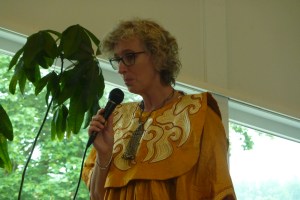
P1120861First, it was interesting to hear that the leader of the event found it important to wear a clothes and a piece of jewellery from Somalia. And to tell the kids about it too, and proudly at that.

As kids start going to school at age 4 in the Netherlands, no wonder the whole things was sometimes quite noisy, yet, it was apparently to all kids’ interests and they took part in chorus singing with obvious enthusiasm.

At the beginning there was Turkish dancing for everybody’s delight – even some teachers joined towards the end.

Most of the event contained singing and as parents were also invited not only to attend but also to take part, the co-writer of this blog decided to contribute as well.

The following are the recordings I took of her performing two Chinese songs. Her first performance started with inviting kids to help her play out the scene in the lullaby, thereby making the foreign text somewhat understandable to the very young audience. For those who find the Dutch introduction too long, the song starts at 5′ into the video. What I find important here is the children’s enthusiasm to join the ranks on the stage.

With the next song, teachers were asked to participate, again to great cheers. Children of all nationalities were chanting their favourite teacher’s names to make them join a song they knew they would not understand. Here the song starts rolling at 4′ into the recording.

There was also a very nice, colourful act with pairs of little ones parading clothes worn in their (or rather, their parents’) country of origin, again to great cheering from the audience.

The even practically closed with a Dutch song. The kids’ performance itself was not of the most outstanding quality but they had all volunteered in the first place, like the others, but what is here very important is that this is a Dutch song in front of a very multi-cultural audience, of which the most enthusiastic co-singers were ….

I hope my dear visitor also enjoyed the above and understands what I mean without me going on ranting about it. I just wish the world had a lot more similar institutions, events and joy about our differences and we can see more and proud wearers of such fabulous clothes and singers of such enchanting songs like on that day.

by Z.J.S. and P.S.

Good books to learn from

22 Sunday May 2016

Posted by ZJShen-PSimon in education, English teaching, foreign language teaching, language learning, language teaching

≈ Leave a comment

Tags

authentic listening material, English as a foreign or second language, learning to communicate, students books, Teaching English as a foreign language

The chance visitor who honours my blog with his/her interest may wonder why I have written so little over the last couple of years. I have to apologize but the reason is that I changed course: I’ve been a full-time translator for more than 3 years now. Or sometimes not absolutely full-time: I’ve been having a student for several months now, who enjoys our lessons so much that she hopes to be able to come back after the summer. Before her, I also had a young man for a number of English lessons, who also enjoyed working with me and is now working over in the States on a contract.

These two experiences have drawn my attention again to the nature and state of English language teaching in the Netherlands, where a large majority of people profess to be able to speak very good English, although this often seems to be an exaggeration to me. With young people, there seems to be less of a problem because they are mobile, outgoing, and often decide to have time (and the means) to travel or live abroad extensively, and they pick up excellent English on the way, whatever teaching they were given at school before.

However, getting over that ‘intermediate plateau’ in English is a completely different problem for those older people who still have children to bring up and/or job commitments to fulfil. Often, it is precisely that job commitment that would make it imperative, or at least very advisable, for them to speak better English than what they remember from their school days. With the Netherlands being what it is, that is, a trading nation, most of such people are in professions and those professions are mostly in trade. A seemingly sweeping suggestion but I have no doubt they are a large part of learners on the market. Several people have approached me from my profile still present on the national “Marktplaats” web-site over the years and they always claimed having received little or too distant education at school.

Such people are, however, very particular in their (real or perceived) needs. They do not want to learn any English – they want to learn English that is useful for them in their profession, however limited in scope that may be. This poses the question of material to be used with them. And there is the rub, as I already pointed out much earlier in this blog: because schools find it easier to order students books en masse from publishers either from specialized Dutch publishers (at orbital prices, but who cares about that when they’re convinced they get the best stuff?) or from British (or, perhaps, from American) publishers.

Students only stand a chance of getting authentic material in the latter case, but from experience I know that even listening materials published in GB are lab-recorded and I’m sorry but I can’t consider that authentic in the sense that reading out a script can’t ever sound the same fluent language as that spoken in reality, in the street, shops, over the telephone talking to clients or talking to colleagues or bosses in the staff-room etc. A point in case is that when I and a few other colleagues had recorded several interviews of students and teachers in British schools in the late 1990’s for a group project with the BC, the publisher of the book later decided to script some of it, re-recorded the interviews in a lab and only published that version. They were scared to publish the originals, claiming they would not be marketable as they contained too much noise. The noise was actually the same anybody present at the recording would hear and which is a natural circumstance in all cases when one speaks to anyone anywhere. But to use it for teaching? Oh, no, that’s impossible, they said. Even though several of the group of teachers in the project did exactly that in their own classes, with success.

But back to the issue of specialised material. Older professional people here have to hear how it is spoken in their reality. And they insist that they learn what they need in their profession, not elsewhere and not what people speek while shopping, let alone in their kitchens. They don’t want to talk about music, or films, or politics, they want to talk about their own industry or trade and only or at least mostly use the vocabulary pertaining to their own area. They do not “have all the time in the world” for that, as young people tend to believe they do. But how can a teacher get such materials in the Netherlands?

Sadly, no market exists in the Netherlands for language learning materials because of the behaviour of schools. A teacher faced with such needy students have to find material abroad, taking a chance at buying perhaps unfamiliar material over the net or travel to GB if they want to sample the listening material for the book or peruse that one book that looks suitable for the needs of the student. I am fortunate: I only had to travel back to my home in Budapest and grab what I used to teach to professionals on various courses. I had bought them quite cheap back in the late 1980’s and the 1990’s, when the market really opened up in Hungary. Back then, numerous and various course books appeared in excellent quality and with reasonable listening material already on CD’s that are still useable. Unfortunately, cassettes are out of fashion by now so only the most staunch conservatives would still use cassette players, but I have to admit that I have the best listening material with the closest sound to authentic only on cassettes – this is no place for advertising, especially because my guess is that the material is already off the market, but I have to extend my thanks to the authors and publishers of the books called ‘Notions in English’ and especially ‘Functions in English’. I don’t mean it in the way you get it googled (in the best of cases you get to this page (for teachers), or to this page, or to this page, which, in its first group, actually lists those functions addressed and tackling of which students get to fluency in the easiest possible way), but the books so called and issued some time in the late 1970’s in GB by OUP, if I’m not mistaken. Well, these two books don’t appear on the net any more so I think when I retire, I’ll sell them on “Marktplaats” to somebody who can really teach. Or rather, in Hungary, where I’m sure young, enthusiastic teachers would be glad to acquire them and digitalize the cassette materials.

As to the professional materials (about business and trade) I’ve already brought over here, I’ll try to sell them to the only bookshop worth its mettle I know, one in Amsterdam, which seems to lay an emphasis on promoting books imported from abroad. But for the time being, I’ll still go on using them with this one student. The CD’s to go with them are good enough.

by P.S.

Teach Dutch to refugees

17 Sunday Jan 2016

Posted by ZJShen-PSimon in applying for a job in the Netherlands, Dutch culture, education, European Union, foreign language teaching, immigration, learning Dutch, refugees in Europe

≈ Leave a comment

Tags

Dutch, Netherlands

Lots of talk has been going on in all forums and media about the refugee crisis in Europe over the past months. A major problem for people who can actually have a relevant effect on events seems to be having to navigate between the Scylla of generous humanitarian help and the Charybdis of strict rejection.

As far as I know, the Netherlands is fairly quiet about the matter as the brunt of the problem seems to have to be borne by Southern- and Eastern-European countries, Austria, Germany and Sweden, but I know of situations where the “my home is my castle” notion has already come to work at a few places here where real refugees in actual neighbourhoods were planned to be lodged.

The Netherlands has been one of a few countries, in my view, which has a history of taking perhaps the singularly most important helpful action in the event of receiving refugees, the importance of which Germany has just been getting acquainted with: teaching the language of the host nation. When I was young, geography classes dealt with how many Turkish temporary workers were employed in Germany. Since we were informed that they actually remained in Germany for a long time and took over jobs that Germans themselves were loth to do, I’ve always thought they were integrated into the society. In the political turmoil of recent months, I’ve been proven wrong.

Well, I’m one of the beneficiaries of Dutch efficiency about teaching Dutch to foreigners as I’ve already described earlier. In line with that system, the other day I received an invitation to help teach Dutch to refugees in Gelderland here as I’m still registered with a number of intermediary organizations. Here is the text of the letter:

“U staat bij ons ingeschreven en momenteel zoeken we naar meerdere docenten NT2 voor diverse locaties en dagdelen. Het gaat om lessen NT2 aan vluchtelingen.
We zijn op zoek naar ZZP-ers, met een CRKBO erkenning (of in ieder geval BTW vrij factureren). Ik benader u nu via een algemene mailing, dus indien u geen ZZP-er bent dan alvast excuus dat ik u deze mail en vacature heb gestuurd.”

Being a language teacher to the core, a ZZP-er providing BTW invoices, and a sort of “economic refugee” myself, and having passed the NT2 exam, I jumped to the occasion. I can at last do something in return for what this system has done for me and a lot of my friends, one of whom, out of Iraq, has just received his PhD at Utrecht University as a microbiologist, so the investment into the language first and foremost may pay off wonderful dividends for those concerned.

Under the link provided in the e-mail, the important points concerning the jobs (needs!) are as follows (I’m not translating this text either – it doesn’t matter for those who don’t understand it, but those who may actually be interested in trying to take one of these positions have to understand it anyway):

“Voor onze opdrachtgever, met diverse locaties in het land, zjin we met spoed op zoek naar ervaren docenten NT2 voor minimaal 3 dagdelen per week. Het betreft een reguliere vacature.

Voor de vacature zoeken we docenten (ZZP-ers met een CRKBO erkenning) die ruime ervaring hebben met het geven van NT2 lessen en ervaring heeft met meerdere niveau’s in 1 groep.
Hieronder een overzicht van de locaties en de dagdelen:

  • Culemborg – exacte lesdagen en tijden nog niet bekend – Startdatum 18-01-2016;
  • Epe – lesdagen: woensdag en vrijdagochtend – Startdatum 20-01-2016;
  • Schijndel – lesdagen: maandag, dinsdag en donderdagochtend – startdatum 26-01-2016;
  • Ede – exacte lesdagen en tijden nog niet bekend – Startdatum 08-02-2016;
  • Wageningen – exacte lesdagen en tijden nog niet bekend – Startdatum 15-02-2016;
  • Zutphen – lesdagen: woensdag en vrijdagmiddag – Startdatum 24-02-2016;
  • Ede – exacte lesdagen en tijden nog niet bekend – Startdatum 14-03-2016, 2 groepen van 2 of 3 dagdelen

Heb je ruime ervaring met het verzorgen van NT2 aan vluchtelingen, ben je langere tijd beschikbaar voor een groep op de bovengenoemde locatie en dagdelen? Ben je ZZP-er die BTW vrij kan factureren? Dan ontvangen wij graag jouw motivatie en cv!

…

De docent die we zoeken:

  • beschikt over een Post HBO NT2, een certificaat NT2 of;
  • beschikt over een Bevoegdheid Basiseducatie of BVE
  • heeft ruime ervaring met het verzorgen van lessen NT2;
  • is ZZP-er en in bezit van VAR WUO of DGA
  • heeft een CRKBO erkenning en/of kan BTW vrij factureren;
  • is beschikbaar voor minimaal 3 dagdelen per week
  • heeft bij voorkeur ervaring met de methodes 7/43, Taalcompleet (Kleurrijker) , Op maat sprong en De Finale”

Here is the link to the site with this and more information, for example about fees offered.

If you consider applying, beware: you really have to fulfil ALL of the above conditions! Consider this: after being invited and having applied, I received no answer for a few days, but a repeat of the invitation (“Wellicht is deze mail aan uw aandacht ontsnapt, vandaar dat ik u nogmaals aanschrijf”). In answer to my second letter reinforcing my intent, I received a flat rejection saying that they are looking for people who fully comply with the requirements.

And here I see a sort of a problem with the system. They are intent on setting up courses, but a week before some of them (are planned to) start, they’re still short of teachers. I doubt again that there are a lot of teachers around who are actually free several mornings of the week and have nothing better to do in the middle of the academic year, and who, further, have not only the enthusiasm but also ‘a lot of experience teaching refugees’ with the particular materials and can provide invoices as ZZP-ers. Most teachers are not ZZP-ers. They teach at schools. They are the ones that taught me and my friends. Those who are ZZP-ers here teach English, not Dutch, and to all kinds of Dutch people at companies and businesses, not to refugees. And quite some of them (hope I’m wrong) actually do not agree with helping refugees in the first place. I mean they are probably British people with a certain degree of notoriety about rejecting foreigners settling down in their country.

So, despite the nice idea, who are going to teach a few hundred refugees in East Netherlands? Not me – I haven’t got the experience, and as a result, never will acquire it, however much I’d like to. Perhaps you? Don’t hesitate, apply if you’d like to do something for a better, still peaceful Europe.

by P.S. 

Send Dutch applicants … no. 2

13 Friday Mar 2015

Posted by ZJShen-PSimon in education, foreign language teaching, Netherlands, work in Dutch education

≈ Leave a comment

Tags

education in the netherlands, European Union, Teaching English as a foreign language

I’ve just received a very derogatory message to my earlier post which may or may not be right. However, this coincided with a few calls I also received these days from a few job agencies and schools enquiring about my availability, although I stopped applying or advertising myself as a teacher of English more than a year ago. I’ve amassed perhaps 250 refusals over the six years I’ve been living here, how could I go on living on teaching without teaching? Yet, this remark bills my earlier post as judgemental, probably meaning biassed, and based on stereotypes.

As to judging the Dutch education system as a whole, I can’t have anything to say. I have no overall picture. It seems to work and do its job. As to working for me as a teacher, it clearly is judgemental, i.e., biassed against anyone not yet having experience working in it. I have worked in it once for a small project. However, when I told the job agency person that my experience was with a military facility, she clearly changed her mind and didn’t come back to me about the open post she may have had for me. That wouldn’t count for a school job was the meaning.

So, after teaching English in two other countries for 30 years counts nothing in this country. If it doesn’t, if being a top professional means nothing in the Netherlands, I can only say the system is biassed against everybody from outside here. They say, “Have you experience in the Dutch education system? No? Then you won’t ever have it. Bye-bye!”

It’s not my stereotype, not my judgement. If the Chinese can accept that an expert teacher may not be from an English-speaking country, but this country can’t, that’s a judgement against foreigners, based on the stereotype: only English people can teach English! Right? Then which English people? A poor under-educated chap from Detroit? Or Glasgow? Someone who couldn’t even get his or her GCSE? So: wrong!

The other part of my criticism in the above-mentioned post was to claim that if this is the opinion of the system about foreign experts, then they should not advise anyone to employ Dutch people abroad. How dare they? They aren’t willing to employ anyone here without Dutch experience, so how could Dutch work abroad without having any experience working abroad? It’s simply the other side of the same coin. Nonsense. Their practice is against EU laws about free movement of workers claiming a possible exemption in educational matters. They should be exempted in the same way when trying to get employed outside. They should let others with experience there work there. Or even those without it. Or allow others to work here as they are meant to instead of wasting the talent they have to offer them.

by P. S.

Everywhere …

16 Thursday Oct 2014

Posted by ZJShen-PSimon in education, Hungary, translation, university education

≈ Leave a comment

Tags

China, education, Hungary, Netherlands, people's behaviour

I know you already have at least an inkling that wherever you are, independent of the country, things are bound to go wrong even after they look like going well. In this post, I only want to add to that roster of experience about the fickleness of life in various countries. I’ll start with the country that may be my favourite. Actually, I don’t have much to add after the Chinese Language Blog of Transparent Language has posted a discussion of bad things, and also of good things about China.

This is the correct attitude, but these post are general, whereas my examples are concrete, something that could happen to anyone on floor level. Although I could obviously add items to the negative list like there’s no real nature in China, all parks are fake, trees are mishandled, environmental pollution is rampant and growing faster than economic development, I’d like to tell you about an issue that a local leader I worked for experienced.

He was the Department Leader at the Economics Department of the university where I worked back in those days. He decided that at the rate of 16 hours of teaching a week, the ‘foreign experts’ cannot do enough preparation and provide enough quality for the students that he required, so he hired one more foreign teacher and unofficially reduced the number of hours allocated for each of us.

Actually, his plan worked well for me as I felt obliged to satisfy my students’ need and request for some extra activities, so we enjoyed watching and discussing several films over several weeks.

However, the Dean of the university found out about it in the middle of the second half-year, reprimanded the department head, and radically reduced the number of foreign teachers the following year. It didn’t have much impact on me as I was moving on, but it impacted the following year’s students substantially. Quality-wise, which is difficult to assess of course. I wholly enjoyed my following year at another branch of the same uni, but this case left a warning impression on me. Besides the lack of internet freedom.

In the Netherlands, I’ve been enjoying my life quite freely. A quiet country (if you forget about the rampage they go on on Queen’s (now King’s) Day, or at a football match, or about the sense of proprietorship concerning their own property even without fences), they smile at you a lot in the street except in Amsterdam, where people behave just like everywhere else on fashionable territory, well-organized, people behave, offices work efficiently, provide social security benefits for the needy … Fine, ain’t it?

It took some time for me to discover, through a friend, that I’m entitled for help for the money I pay for my rent and social security costs. I applied, got it and was happy. Ever after, right?

Not exactly. At the beginning of this year (2014), I was informed that I had to repay almost a thousand euros (the whole amount) that I was given for 2011, because I had lived at the same address as some other people: the person whose room I was renting back then, and his adult daughter, and another person who also rented a room there. So the office reckoned we were all the same happy family, our incomes were put together and, as a result, I had had no right for housing allowance. I should pay back. For those not really aware of the weight of money, this is an amount to the value of a teacher’s three months’ net monthly salary in Hungary.

This is insane enough, since I’ve been renting another room for more than two years now, I’m a man of Hungarian origin with my own son back in Budapest, not with a Dutch daughter of 22, who is from the owner’s deceased wife who had died a year before. Not to mention that I had no income during the period in question due to severe illness. And not to mention the fact that I never married that man after his wife had died …

But no data had been checked except the address. I was allowed to apply for redress. We had to explain the whole situation with a lot of documents about the family situation and the situation of the house. On top of this, although they wrote to me that, until the case is decided, I don’t have to pay, I haven’t received a decision until now – instead, I received another order to pay up two weeks ago. No reply yet to my second protest.

If this is not enough, my last case involves Hungary. Nobody may be surprised that when I had graduated and then applied to be trained as a Geologist, I was told I should be happy to have been educated enough at the cost of the working people and now I should be happy with it and work myself. No further education in the socialist system for me.

What did I have to do? I did what I had room for and became a teacher trainer, and a project member with the British Council, with a lot of excellent students in my schools along the way, quite a number of whom became English teachers themselves a couple of decades ago.

After three decades, however, the appeal I used to have for my students, and also the interests of students, have changed dramatically, and I have ended up with the same work I started to do more than two decades ago: I became a translator. I can’t complain about it, but I still don’t have the education about it, no degree, only experience, but with very little feedback, which I had very much rather get.

So I entered a university course in Budapest this autumn. I began the course, but before that, I had talked to the department head in July, who encouraged me to apply for an individual course of studies, practically doing the course over the internet. I live in the Netherlands, and I would like to stay here among my best friends instead of paying for my room and health insurance while living elsewhere. I was told to collect the signatures of my teachers allowing me to do it over the net, so I reckoned I should first go to lessons, then ask them to sign.

At that point, the head told me I should ask for a form to be filled in from the Students’ Office, where, however, I was informed that the application deadline had expired – at the end of the first week! I am still flabbergasted! At the best university of Hungary, one is expected to apply, as an unknown person to them, for special treatment by unknown teachers, who may even be absent in the first week, thus unavailable (one was in fact absent for two weeks).

Now it is my fault not to have checked upon the deadlines, but when you go to buy a chair at IKEA, do you check if they had packed all the screws and screwdrivers in the package right after you’ve bought it? I had been told by the department head that it’s alright, go for it, and when the deadline had passed, she told me I should just go ahead, she would help me with my application with the university leaders, I can quietly leave. Case closed with success.

After all this, she went to the deputy dean for students’ affairs and wrote a letter to all my teachers to scrap me from the roster because I “hadn’t even paid the fee”. Which I had paid two weeks before her letter. When she talked to the deputy dean, she didn’t even check whether I had paid my dues. I may even not get back the fee I had paid, let alone successfully finish my studies. I’ve been in limbo and in a lot of doubts ever since.

Up to this point, I didn’t have time to think about my application for writing my thesis. The rule is that this must be submitted before half-time of the last-but-one semester when the thesis is to be submitted, in our case, one-and-a-half months after we started the one-year course. Then I realize now that with the same sweep of her mind, thinking I hadn’t paid, the department head refused to sign my application earlier this week, so by now, I have also missed this deadline. Even if the dean consents to my request to carry on with my studies after all, it does not seem feasible for me to finish it on time.

This is not a system geared to work badly – this is only a system of formalities, keeping to deadlines no matter what. I can only personally re-claim the fee that I don’t need any more, and only a part of it. I’ve been told to behave like an adult by a clerk in the Students’ Affairs department, whereas it is the Department Head who has behaved like a child to me. I’ve been acting in good faith and am looking to loose almost as much as by the Dutch department for housing allowances. If only the department head had the guts to go ahead with what she told everyone, her teachers included, to do.

All in all, it’s usually not the system, but the participants in the system who make it feel …

by P.S.

English testing issue in Hungary

13 Tuesday May 2014

Posted by ZJShen-PSimon in education, English teaching, foreign language teaching, Hungary, language learning, language teaching, language testing, teacher training

≈ 4 Comments

Tags

English as a foreign or second language, Hungary, Language education, limits in class, Secondary education, teaching foreign languages

Last week, students sitting for the school-leaving exams in Hungary were up against the English test on the higher level. This test is something the results of which count towards university entrance exams, so naturally, perceived or real trouble about it counts a lot more than that on the normal level tests. Internet news about the issue with the listening part can be read in Hungarian here. I hope that my interpretation of the situation may be useful for English teachers in other countries as well and may help students understand some features of the situation.

In short, of the 9809 exam takers, in one day, more than 2500 joined a facebook group (though this could be misleading, seeing that parents also joined the group) and submitted a petition to the relevant government agency against the quality of the listening material as they thought the material couldn’t be heard properly because of distortions of sound in classrooms. Some actually claimed the original sound already had echos. We can also listen to it in the middle section of the article, right next to the link to the pdf of the task sheet involved. As my listening to the published material reveals no distortion problems to me on my computer, the story reveals a lot of problems in the Hungarian education system.

Admitting that the inclusion of several French and Spanish words was not exactly fair, I still wonder if that may have disturbed takers. Not only in my teaching practice but also in all teaching materials, there are lots of names from other languages recurring all the time. How can one learn a language without mentioning outstanding people from history, science, the arts etc.? English doesn’t distort foreign names like Chinese does, so this can’t really have been a problem for trained examinees. Trained, I’m saying, and I’m returning to this a bit later.

Another problem claimed was the extreme distortion. The article claims many schools use ancient portable tape-recorders to play … what exactly? The listening material was issued to schools in two copies of the relevant CDs, so no tape-recorders could have been involved. Such a distortion is, to my mind, indicative of the quality of … the Hungarian media. Other than that, CD players may have been of dubious quality, in bad repair, I had already met a number of such equipment 10 years ago. However, if a CD player doesn’t work, it is taken away to be repaired or thrown away and is exchanged to a better one. Some people actually claimed that they didn’t hear the sound sitting in the second row and they have good listening abilities. To my mind, it is doubtful that the teacher administering the test purposefully brought in a bad player with bad loudspeakers to disturb her/his own students. Claiming that the loudspeaker had to be turned up too strongly in the big rooms is also strange: the same students had been sitting in the same rooms for four years listening to the same players at similar intensity. What may have been new, pray?

However, this point only in itself brings the technical background for schools in Hungary in the limelight, and probably deservedly. This in turn underlines the poor financials of the same for extended years. While in my study years we only had really ancient big tape-recorders to listen to the one set of intermittent pre-recorded (that is, unnatural, carefully read-out) listening material, the 21st century makes it necessary to expose students to realistic listening in countries, like Hungary, where English-language TV-programs are practically unavailable and dubbed films prevail in the cinemas. This practice is also in need of changing, but the poor general financial situation makes it very difficult for any broadcaster to buy the rights of contemporary TV programs and air them as they are. And what would be their incentive? That change nowhere to be seen in the pipeline, it is the schools’ duty to provide ample practice for listening. If they can. But that is only one side of the equation.

And that brings me up to my next point. As I said, it is up to schools. But schools consist of not only teachers, there are, in the majority, students as well. Meaning, the vast majority of people in a classroom are the students. Have you ever stood in front of a large group of people who resist all your efforts to bring them together and make them quietly learn something instead of their own will? It’s a lot easier for a party leader to speak to a huge crowd from their own party – they want to hear what he wants to say. Try doing it in front of the opposition. And that is still only speaking, not making them practice performing skills. My experience shows that during the last 15 years the willingness of most students in Hungarian schools to learn has been nose-diving. You can lead a horse to water but you can’t make him drink, as the proverb goes. More and more students do not want to drink from the fountain of knowledge, so to speak, but weep and wail each time listening is brought in – I faced this reluctance increasingly myself.

I’m not saying it happens everywhere, but that it has been increasing dangerously. Now, if the teacher doesn’t want to antagonize her/his students all the time, she/he yields and there goes the listening practice. This may turn into a general tendency because it is easy to neglect something once again what we’ve already neglected a couple of times and yes, listening is not easy and also not easy to teach. With a decrease of quality students, teachers’ average levels of quality and professionalism may also decline, and in a culture growing towards accommodating the perceived ‘needs’ of the customer (the students), teachers get used to catering to what students ‘want’. And that can be dangerously close to very little. This based on the majority will. And the majority is always right, right? At least before Copernicus …

That said, I’m not saying those students hadn’t practiced listening – I’m saying, what they had done was far from satisfactory, far from enough.

Learning a language has nothing near to the logic of developing mathematical or historical knowledge. It is not even only knowledge, it is rather a huge set of skills. It is a lot more complex than other subjects except for learning a musical instrument, and contrary to beliefs, but due to the complexity as well, there are very big differences in learning abilities, especially if we consider the time constraints. Hence the complaints in the complaining group on facebook, demanding logical, rational answers. No, there may not be logical, rational answers. No, the way we learn languages is next to impossible to follow with logic. Yes, intelligence may have a limited part in it. Yes, it may also be due to psychological barriers, individual learning styles, short- and long-term memory differences, methodological differences on the part of the teacher as well as on the students, to name a few problems. And listening is an area where a lot of those factors converge for many as there is no possibility for individual speed, time to stop to consider and the like. It is thus very tiring and also difficult to really assess. I am next to stating that teaching a language is an instinctive art, with an instinct not easy to develop. So many colleagues in the classroom may give up on trying and practicing listening. It is easier to resort to a dry, seemingly logical structure of what happens easily each time: turn to page … read and answer the questions. Choose … fill in … let me see … correct … incorrect because … (grammar explanation following). Satisfaction – duties have been fulfilled.

Of course, students wanting to take the higher-level test are the cream of the classes. Why couldn’t they perform at the test without problems? Well, it’s because they are a minority of the communities they had been brought up in to be the best. To be the best among a general decline may mean very different from what it meant for us 40 years ago, or for my first groups 30-or-so years ago. Those communities are the real initiators of this protest and the real cause of the problem. They may be the reason why the best may think they are good listeners. Among whom?

Parents seem to subscribe to the general mood of protest. I have seen and felt this too. Parents have become more and more defensive of their children based on the perception that they know their kids better. Parents’ perceptions have been shifting towards seeing, if not the school, then at least the ‘problem’ teacher as the enemy instead of the ally in improving their children’s capabilities and thus future chances. Unfortunately, this perception has been spreading among the student community as well. And this has been happening in a country and culture where parents are more and more inundated with their own work. Before I forget, there is also the other side, the group of parents who can provide their kids with everything they wish for. As one student explained to me a few years ago, “I don’t need to speak English, I’ll have my father’s business and I’ll employ interpreters.” Well, yes, that seems easy for some. If that’s the image they make fashionable, what are the chances for the meek not to follow in laziness? However, that’s already a social problem that I can’t address here. But that’s another reason for the students to consider the teacher the enemy – she/he, the ‘loser’, seems to be powerless against the ‘mighty’ parents, so what do they want? Reminiscent of the situation in Chinese private schools. Does it also remind you of “another brick in the wall”?

I see one positive. And that is that the tasks are still given in English at an English test, something that may often not be the case in the Netherlands, or Italy, or China, for example. I can feel, however, that this may also change as so many other things have changed in the course of the last couple of years in the Hungarian education system. It is always easy to take the easier path. But that is going to be the subject of another article next time.

A few days after I posted this article, on 14th May, what do I see on Dutch TV? Mass protests on the net by Dutch takers of their respective school-leaving exams against the time constraints they thought was too short … while in Nigeria, where more than 270 girls were earlier kidnapped to prevent them from going to school and punish them, people are still hoping that there may still be a future for girls’ getting a profession.

by P. S.

Effect of Grammar Teaching on Learners and Translators

04 Friday Apr 2014

Posted by ZJShen-PSimon in education, foreign language teaching, language learning, language teaching, language testing, translation

≈ Leave a comment

Tags

Grammar translation, grammar-translation method, language correction approaches, tests, Translation

I have been relatively new to translators’ sites, but on a discussion forum, I’ve already come across a lot of very professional explanations of problems in English. Translators are language experts after all.

However, I’ve recently seen a question that, surprisingly, at first sight, veiled the sight of professionals as well. The question was about how to translate the following part of a test into another language:

“Q X. The School of Art is
a. moving to a new site in the near future
b. lifting to a new site in the near future
c. sending to a new site in the near future”

The asker (somewhat grammatically incorrectly) said “I think that answers B and C are not grammatically corrects” but asked for other people’s opinion.

My feeling is that the foreign language teaching which we all underwent at a young age left an indelible mark on us to an extent that most of the best language professionals still think in terms of grammar when faced with wrong language items. They clearly identify what is wrong language, but when the question referred to wrong grammar, they left it at that and were mostly busy discussing how strange the idea is to translate a language test into another language. That is also a very valid question, but at the same time, of the 5 or 6 people involved in the discussion, only one pointed out that it is not the grammar which is wrong, but “it’s a problem of vocabulary — simply the incorrect choice of verb”. And this amazed me.

I suspect that language teaching that focuses on grammar leads to a tunnel vision of languages with most of us, and we accept all, or most, language mistakes to be those of grammar, the rest being allowed for spelling and punctuation, but which are almost never pointed out to fellow professionals for fear of being called impolite.

In this particular case, what was really important was indeed the incorrect two choices. But, though asked about grammar, some people may have also been afraid to correct the conceptual mistake. Yes, grammar is usually to blame. To a language teacher, this indicates that treating vocabulary, or lexis, as increasingly referred to at least since Michael Lewis’ ‘lexical approach’ appeared in ELT, is still the basic concept we deal with about language. His work has apparently not gained enough kudos to counteract the good old reference to ‘grammar’, whatever is understood under this umbrella term.

Besides, one other very valid point was also raised, namely, to what extent wrong language can be called incorrect. It often happens in language classes that teachers (or native voluntary helpers here in the Netherlands) jump on any mistake learners make. Besides possibly intimidating most learners, this also overshadows the fact that language is for communicating ideas even through mistakes. Haven’t we all, as babies, started out making millions of mistakes, and yet, our families understood us the way we intended? There was correction, too, but it was not only patient, it also accepted the extent the faulty language was still communicative enough.

Besides, it was all done without reference to ‘grammar’. I increasingly suspect that the concept itself is to blame for the mere question. If it is enough for language professionals, and indeed all native and high, or even mid-level speakers of the language to identify a mistake as wrong, is it necessary to call it a name and thereby fall back on falsely trained concepts? If we have to teach along lines of concepts at all, then teachers and learners should learn to call a spade a spade and call a wrong word a mistake of lexis, and not grammar. Or abandon ‘grammar’ almost completely.

It is also time to point out to language learners that when they make lexical mistakes, they may be grammatically correct, but most lexical mistakes are completely wrong because of the meaning, and often simply because of general usage. In schools, the stress is on grammar, whereas the most urgently necessary material to be learned is vocabulary, and in the proper usage. Without lexis, grammar is dead, but proper words have a meaning even when ungrammatically used. “Papa, rug pein?” with good intonation is completely understandable from the toddler, although an applicant at a Dutch language exam would fail. “Kici, nagyi?” is completely wrong Hungarian even on pronunciation level, yet all Hungarians in Chinese take-aways understand this in Budapest and react without problems. This importance of lexis is perhaps most apparent using Chinese, a language rather void of grammar, when, for example, politely asking someone to “Qing zuo ba” would become wrong if we changed the declining voice pattern on ‘zuò’ to ‘zuǒ’ (as in 坐 v. 左). Of course, the context helps, and in the case of Chinese, due to the characteristics of the language, phrases with wrong tones are still understood. But a mistake is a mistake, but it is almost never one of grammar, especially in writing.

This all shows as well how mistaken language testing itself could be, and that language tests should not be translated. Language tests are to measure the level of use of language of learners based on the characteristics of the given language, not of another one. Also, tests do not provide context, even for grammatical correctness. Thus teachers and then tests end up having to transcribe active sentences to passive “equivalents”, which, in the vast majority of cases, cannot sensibly be done. What would be the active version of “The last member of the family could not be rescued from the burning house”? An accusation against whom? The normal British press item “Our government has failed to realize the threat involved in allowing hedge funds to ….” would be completely unheard-of if translated into Hungarian without using an impersonalized kind of language reminiscent of passive voice, but such a Hungarian item would lose all its usual critical edge translated into English in the passive, as a result of the fact that no acting party would be mentioned as subject. Languages have their internal characteristics besides and above mere ‘grammar’. But when the question turns to ‘correct grammar’, even a native language professional suggests, however tentatively, that in sentence C above, the passive would be more correct. Except for the meaning involved.

by P. S.

Neurobiologist on the brain development of children – part 3

28 Friday Mar 2014

Posted by ZJShen-PSimon in child development, child rearing, education

≈ Leave a comment

Tags

cognitive science, education, learning to communicate

This is the third, last part of the interview I’ve translated from Hungarian about children’s development and the role of the media that was made with Gerald Hüther and published in Hungarian here. This part is mainly about what parents should notice, how they could help their children grow up healthily and what long-term changes are to be expected.

“From what signs are parents able to recognize that the virtual world has sucked their children in? And how can they protect their children from the threatening deprivation?”

Hüther,Gerald_08.jpg.5154300“If a child prefers sitting in front of the computer instead of running about outside and playing with others, that is, if he/she does not satisfy his/her natural needs, then the situation is worrying, parents already have to respond to this. But not by formulating prohibitions. Instead, they would have to try to present their children with challenges that correspond to the real world, and which can also be met. With adventures, unexpected incidents, surprising, or even dangerous situations that the child can overcome, so that then he become hardened through these.

Therefore, beside the wide computer highways, parents should plant something else in the heads of their descendants. Lots of parent enter their offspring for Asian fighting sports, holidays with camping out, or ask them to look after smaller children.

Some of them may be helped if they can teach old people how to use the computer and the internet. These children will later be able to talk to others and solve problems together. This is because they are provided with a broad spectrum of the real, empirical world by their parents during the years decisive for the maturing of the brain.

On the other hand, children who get immersed in computer worlds will learn too soon that for everything there, all it takes is to press the correct button. They no longer tolerate any mistake, no longer bear frustration, and are not able to maintain control over their impulses. They are no longer able to navigate in the real world.

P1000416If, on the other hand, your children are parts of a living community, and they experience adventures like the boy scouts, they will be lured under the spell of virtual worlds much more rarely: they will play with the computer a lot less often and watch far less television. During their subsequent lives they will experience far less disturbance from anxiety, and will not become so uncertain. They will grow into really healthy personalities.

“Let us suppose that such a personality has emerged. As all youngsters, this child will still try out computer games and the Internet. Similarly to others, he will also want to create a chat profile. What dangers arise from this?”

“No child is born computer-dependent. And it is never the strong, lively, open-minded, curious and creative children with good interpersonal skills who are charmed by the electronic media. I can’t see threats for them. They will consider the computer to be what it sould be considered: an excellent tool to serve the efficient use of the brain. They will discover the internet as a gigantic source of knowledge for themselves, which allows them to answer questions about the real life.

“But what happens in the mind of a child of ten when he/she accidentally hits upon a page with pornographic or horrifying content? Does not he/she get too great a shock?”

“Not necessarily. It depends on what the family environment is like, and what role the media play at home. Some content that for us adults appears to be signs of horrible brutality, for a lot of kids appears as one of many possible forms of approaching each other. A child whose mind has already been blunted by passive consuming of the media will not be able to form an opinion on what he can see there. Experience has taught him/her that everything can happen on the screen.

One minute he/she can see that the fox is chasing the bunny, in another that people are laughing when Donald Duck and Pluto are flattening each other, and then, as if nothing had happened, they rise again. Muscle-headed wrestlers smash each other’s skulls on the screen before a yelling crowd, and then the child can see that two people are making love, or, for example, cut off each other’s heads.

The parents have weaned them off the natural feeling of being horrified. The child has already found out that it is pointless to ponder all this. He has learned that he/she is not necessarily able to understand what is happening on the screen.

“But what happens to children who have hardly gained experience yet with the passive media?”

“The child’s brain will be trying to fit this new image, no matter how disturbing, to that already existing, so that he/she can understand it. His/Her impression will be stored as one of the forms of communication among people. It is very important that the parents then clearly explain that this is not a desirable form of co-existence with others. If someone did this to you in the real world, it would be terribly painful for you.

“Children, therefore, need not only tasks which help their development, but also people who give them direction.”

“Yes, they urgently need role models who help them avoid doubtful communities and questionable tasks. Things always go wrong if the children are not able to fully expand their skills.

For this, adults are needed again. The computer industry only satisfies the demand. And as long as there are enough parents who do not understand that children have needs which are best met in the real world, the supply in digital media will increase. And if children grow up among such circumstances, they will seek tasks necessary for their development there.

It is worth stopping to contemplate what may become of a society whose children take leave of the real world. The result of which is a brain that has perfectly adapted to a virtual world of the Internet and to PC games.

“Can you justify this idea neurologically?”

JJ_published“We already have studies which demonstrate that nowhere else can a man learn better hand skills, or, more precisely, better finger technique than when practicing on a keyboard or writing an SMS (my remark: this is true except in comparison with playing musical instruments, which gives really complete finger control together with aesthetic satisfaction in the long run).This leaves its mark on the brain. Thus, during the last ten years, the region in young people’s brain that directs the thumbs has grown considerably larger.

There have developed finer and finer, denser and denser networks, which allows them to make amazingly fast thumb movements. Young people develop their brains so as to optimally adapt to these requirements. Now the only remaining question is if it is going to be important in the society of the future that man can move his thumb as quickly as possible. Children cannot answer this question yet – it is up to adults to anwer it.

by P. S.

Neurobiologist on the brain development of children – part 2

26 Wednesday Mar 2014

Posted by ZJShen-PSimon in child development, child rearing, education

≈ Leave a comment

Tags

cognitive science, education, Language acquisition, Learning, learning to communicate

This is the second part of the interview I’ve translated from Hungarian about children’s development and the role of the media that was made with Gerald Hüther and published in Hungarian here (unfortunately, this site can no longer be accessed). This part is mainly directly about the effect of the media on the brain.

“So do you think children need tasks?”

For the brain the real challenges and adventures are of decisive importance. Going fishing with uncle, building a house into a tree, or climbing a mountain. The adventures have made us all strong. Nerve scientists can now prove the connection: children have to overcome as many challenges as possible during their lives so that the most important networks can be created. Therefore, children need a world in which interactivity plays a very large role. And that not in the context of virtuality, but of real life.

“Can children later develop this neuronal network in their brains?”

“If the critical period is over and the networks important for the regulation of the body are sparsely developed, the child does not have a good feeling about his/her body. However, the brain remains malleable throughout our whole life. An 8-, or 10-year-old child shall also benefit later from all the experience of his/her body that he/she acquires nowadays. However, the child will be differently motivated to train his/her body. The learning process no longer takes place intuitively and automatically. Children are ashamed of themselves, they are mocked at – and they learn with fear, which is not a good basis.

“Provided that at age 6 the important neuronal networks in the brain have already been established, are children protected by this time against all danger from the media?”

“Not necessarily, because many children are in the danger that they will get lost in the virtual worlds.”

“Are you referring to computer games?”

“Yes, among others. It is because it becomes dangerous if children use the digital media to meet their essential needs. Each person has two of those.

One is to belong somewhere. The other is to want to perform. The first need is expressed in the need for bonding, the second in the desire for freedom. Kids suffer in our society first of all from the fact that they only rarely have the opportunity to achieve something. They find no real tasks which may strengthen them in their development. That is because those would precisely be the tools to be used to build up children’s self-image, their identity.

It is obvious that a lot of parents have already forgotten what such a task would be like, the kind helping the development of a child. The child himself has to find this task nowadays, and it should indeed be challenging and long.

At the end of it, we will feel like when climbing a mountain: we only sit up there, and simply feel happy. This is a sign that the child has solved a real task, that in this case, there is no need for outside praise, he is happy with it on his own.

Today, primarily the boys find it to be their task to develop their proficiency to absolute perfection in computer games. In such competitions, they can show others how good they are. But those tasks are not suitable to assist them to find their way in real life.

“What kind of children are especially vulnerable?”

“Precisely 40% of German schoolchildren go to school feeling stressed. In particular, the boys are those who sit down in front of the computers immediately after school. They need at least one hour’s shooting games. The computer is, for them, a means of getting rid of their frustration. By doing a great job holding their ground among the adventures of the virtual worlds, butchering monsters and becoming victorious, they find a way out of their powerlessness and the mounting agression. They reduce their frustration with a peculiar achievement.

“So then, again, the system of rewards comes in action.”

“Exactly. As if the children had come by a wonderful life experience. This experience, however, applies to a world which does not exist in reality. Neurobiologically speaking, this is fatal: the child trains his mind for situations that only occur on screen. What is more, computers create the illusion of controllability too. When a child plays with another one, his experience is that, in reality, not everything can be controlled. Another person is not always doing what we want.

Besides, a lot of kids can no longer sense their bodies during a game. They no longer need sleep, they do not respond to signals of hunger or thirst. In South-Eastern Asia, the first cases have already appeared where computer-dependent youngsters starved to death or dried out sitting in front of the computer.

“You are talking about boys basically. But what do girls do with the computer?”

“They chat. Girls feel more need to belong somewhere and to build up relationships. And then, if this is not really successful, chatting can become a compensating substitute to some extent for the missing proximity and bonding. I do not have to prattle every five minutes with a friend in whom I can trust. That girls talk so much is rather a sign that they have in fact become uncertain, and they cannot trust the durability and strength of the connection. It is like when chicks call their mother.

“And do the real social relations wither away?”

“This must necessarily happen so. They can only keep real relationships with another if they are really together. All else is only virtual connections. Because in the virtual spaces, people are not present in their full reality. They have no fragrance, no smell, their movement and other manifestations are not life-like. In virtuality, features of encounters prevalent to life do not occur. While chatting, they only communicate in writing.

To be continued soon …

by P. S.

Neurobiologist on the brain development of children

25 Tuesday Mar 2014

Posted by ZJShen-PSimon in child development, child rearing, education, language learning

≈ Leave a comment

Tags

cognitive science, Language acquisition, Learning, learning to communicate

My dear reader, I read a fascinating article (in Hungarian) a few weeks ago (which was accessible here in Hungarian but since the publication of this text, is has become unavailable – sorry for the inconvenience) that I found so interesting that I’d like to make it accessible for a different community here in my English translation as well.

Hüther,Gerald_08.jpg.5154300It is an interview with leading German neuropsychologist Gerald Hüther (some more information and another interview with him in English here). The original interview may have been in German, so apologies for perhaps deviating from the original meanings at points. It is also long, so I’m going to deliver it in three parts over the next couple of weeks. I’m going to insert my own ideas at places where I find it appropriate as I’m not only interested in, but also involved with young children’s development, especially as regards their language, social and creative development, being closely involved in my co-author’s children’s lives.

What goes on in children’s brains when they are watching television?

In the latest edition of GEOkompakt, devoted to child-development psychology, professor Gerald Hüther, one of the best-known German brain researchers and neuropsychologists explains what goes on in the minds of children who watch television or play with the computer very much.

“Professor, as a neurobiologist, you research how the media affect human brain development. Could you recommend to us a good TV program or a computer game for Children?

“No, and such recommendations would not help us any further. This is because in that way we would only get mired in a superficial conversation about the content quality of the supply; however, it is better to avoid that. On the other hand, you do not need to look for very long: you can quickly find five studies which show you how good watching television is for children, allegedly.

In contrast to this, however, another five studies will prove that TV is bad. This discussion is completely useless for parents. I do not talk about content, I approach the question from much further away.

A few years ago, we neurobiologists still thought that the genetic programs automatically set up all connections in the brain. Therefore, the complex neuronal networks, which direct the ways we think, feel, act, were thought to be genetically programmed. It is now known, however, that in the long run, only those relationships are created in the child’s mind which are regularly activated in real life. What is not used, withers away. (me: And so it is with adults too.) The genetic programs ensure that at first large surpluses of neuron-links get created.

For the creation of the most important neuronal circuits in the brain, children need to experience their own bodies first of all. And this is not acquired sitting before the screen independently of what goes on on TV.

“Why are bodily experiences so definitive?”

“Only those can fully develop their cognitive abilities in whom the appropriate feelings of their own bodies mature. There already exist studies which prove that those young children who are good at mathematics are especially capable of balancing too. One obtains the capabilities necessary for three-dimensional and abstract thinking and for mathematics that he learns to keep his body in balance. As a child is sitting in front of the TV, he no longer feels his body. He does not climb, does not jump, does not balance, or does not climb a tree, i.e. he does not pass the time by learning his body.

“So children should keep moving as much as possible?”

“Yes, but they do not necessarily have to climb mountains. Singing is one of the most extraordinary practices to learn our bodies. In doing this, in fact, the child’s mind has to direct  his vocal chords in such a virtuosic manner as to bring out the very exactly appropriate sound. This is the best fine motorneuoronic practice and, at the same time, this is the condition of all future, very differentiated  manners of thinking.

On top of this, we can speak of a very complex creative performance with singing. This is because the child has to bear in his mind the whole song so as to be able to hit the correct sound at the correct time. Besides, he also learns to adapt to the others in the chorus, which is one of the conditions of social competence.

Without fear

Without fear

Moreover, children also experience something wonderful, namely that we are not able to be afraid when we are singing. Neurobiologists now know that during free singing, the brain is not able to mobilise the feeling of fear. This is why, going down to the cellar, man has been singing for thousands of years  and not because he wants to scare the mice away.

“Where do such experiences condense, where are the neuronal circuits formed?”

Trying to find out how it works/1

Trying to find out how it works/1

“In the most complicated part of our brains, in the so-called pre-frontal lobe. It is located right behind the forehead. That is where our idea of ourselves evolves. And at the same time, this is also where the urge to turn to the world also evolves, the urge to plan actions, to control impulses and to bear frustration.

This has to be formed in early childhood, until around the age of 6. The networks in the frontal lobe responsible for all this, however, will only evolve if the child acquires this experience. Such experience, in its turn, results primarily from dealing with things that he can make sense of and is able to manipulate. This, however, is more and more difficult today.

“What is the cause of this?”

Trying to find out how it works/2

Trying to find out how it works/2

“The children’s world has changed just as much as that of adults. We are not able to understand any more how our household articles actually work. Formerly this was otherwise. Each object was understandable, the bicycle, the steam engine, even the car. A child could take the clock to pieces, he could study the cogwheels on the inside, and in this way he could uncover the mechanism behind it. Today, in the days of the information society, things may be so complex that very often we fint it hard, or impossible, to understand the cause and the effect.

“How does it all affect the child’s mind?”

“Our brain always adapts to what we do enthusiastically. In the previous century, people felt enthusiastic about machines, and that was what they identified themselves with. In fact, they even applied this machine-like way of thinking to themselves. This then affects the language: we call our hearts pumps, and we talk about run-down joints, which we then replace.

But now suddenly there is this new era. It will be more and more difficult to comprehend the causes and the effects. For example, why the arrow on the screen moves to the right when the mouse is moved. The lack of this mental connection will lead to children not being interested in causality any more. This is the simple result of human brain development. They seem to learn that they have to accept things without capturing the inherent sense behind them.

It is not only that lots of digital media are not understandable, but in addition, there are very few possibilities for us to get involved in current events actively. A very simple example for this is that we cannot change anything else about a television than choose the program. The first time we put a young child in front of the telly, they even talk to the set. They tell the bunny where the fox is lurking. This means they try to participate actively in the events.

This has been taught to them by their experience so far, without virtual media. After a few weeks of watching TV, however, most kids resign to the fact that they cannot actively get involved in the development of things on-screen and give up, that is, they query a part of their own efficacy.

“This is, however, an important element in the development of a child.”

The strength of our inside urge - a toddler choses his own activity against looking at the TV

The strength of our inside urge – a toddler choses his own activity against looking at the TV

“Yes, and this only develops by its own experience in the frontal lobe – as a very complex neuronal network. To expand their knowledge horizon, children have to place their new experiences in a mental context. This is because our brain is only able to learn something if the new impressions are linked to an existing pattern which originate in previous experience. This is an exceptionally creative process.

Therefore, the child will try to suit the new to the existing, older patterns. But to do this, he/she will first start looking for things in his/her mind, so to speak. A stage of productive anxiety emerges, until the pattern of stimuli falls in place. And then the chaos is converted into harmony in the brain. This is that particular ‘I see’ experience.

In the meantime, the bonus system is activated. Nerve cells emit “hormones of happiness”. All little experience of our own achievement causes happiness comparable to taking a little cocain and heroin at the same time. In contrast, it is terribly difficult to be actively, creatively involved in watching films. Therefore, it would be preferable if kids did not get into contact with the television or the computer before schooling.

“But we also receive the action in a book ready-made. Reading is also a passive activity.”

“When a child reads, a lot of things go on in the meantime in the brain technically. It puts the letters together into words. The words and sentences are converted into worlds of phantasy. What the child’s brain has read appears before his mind’s eye.

Little Red Riding Hood is walking in the forest. No child sees the letters here. This is an incredible achievement of the brain: to create a picture from black and white. In contrast, a Harry Potter movie is worth nothing. Before you can turn on your imagination, the following image is already there. In fact you are only developed by what you have worked for yourself.”

(me: A proof of this can be considered in the fact that most people watch films to relax, to get out of their own reality, to stop worrying. We may laugh or cry over a film, but we do that because we copy, we are moved at best, not because we take their happiness or sorrows on ourselves. The rare film which is so good that we feel involved is not only rare, but soon becomes obsolete – people get fed up with them; just watch Lars von Trier, or Mike Leigh films – most of them exceptionally good and disturbing films, but never successes at the box office.)

To be followed soon …

by P.S.

What Teacher Education Programs Don’t Tell You

10 Monday Jun 2013

Posted by ZJShen-PSimon in education, teacher training, university education

≈ Leave a comment

Tags

Teacher education

I have just found a very interesting article about what teacher education does not do well enough in the USA. As I have similar experience from other countries, especially from my own, I recommend reading it. I hope some of my international readers will add a few remarks below about the situation in their own countries. The article, from Education Week, “What Teacher Education Programs Don’t Tell You” can be accessed here.

by P.S.

Werkloos = waardeloos, i.e., jobless = worthless?

27 Monday May 2013

Posted by ZJShen-PSimon in education, English teaching, foreign language teaching, joblessness, Netherlands, work in Dutch education

≈ 8 Comments

Tags

education, job application, job market, joblessness, Labour economics, Netherlands

In connection with most recent developments in my teaching career in the Netherlands, I’d like to muse over a couple of disturbing questions that relate to wishful colleagues, and perhaps practically everybody who has been out of jobs for a while, especially those who are a bit advanced in age.

First, let’s see a recent letter I’ve received, in my translation. The original, in Dutch, can be read here: afwijzing.

Dear Sir,

Thank you very much for your application. Unfortunately, we can’t work with your application any further. We have rules regarding applications, and the focusing on further handling of applications and enrolling in connection with the huge numbers of people looking for work. From your CV I can see that your most recent experience finished in 2009, and you don’t have recent experience with teaching in the Dutch public education system. Therefore we can’t use your application any further in the selection procedure for this vacancy. Afterwards, we can’t use you actively now for other vacancies because of your recently broken work experience.

If you don’t want your data to stay registered with us, we ask you to make this known to us by e-mail. Then we shall erase your data.

I hope to have given you proper information. Should you have any more questions, we kindly ask you to contact us.

We wish you a lot of success finding a proper job.

Best regards

Well, this is not a typical refusal. I have amassed more than a hundred, perhaps two hundred rejections by now (I’ve been trying to get a teaching job for four years), but this is only the third one that explains the decision of the school.

I would like to draw the attention of my readers first to the fact that, this one excepting, we almost never receive reasons why our application is refused. This is perhaps usual in other countries and in other professions as well, especially with the popular places where hundreds of applicants litter the way of the one and only successful applicant. But I don’t live in Amsterdam, not even in one of the ten biggest cities, and most of my applications have been sent to small towns around here. Although a couple of rejections mention a very large number of applicants (one international school replied with these very words: “We received a very large response to our advertisement and have employed someone who particularly fits our profile,” (my italics) – they use English like this but I am not suitable for them!) one school in a small place mentioned 75. Well, in the four or five cases when I actually got to the selection procedure or was given an interview, I had one or two competitors – Dutch ones, of course. At one well-known school, there were of course a lot more, but I am beginning to doubt the honesty of some places about this. This is not Spain. Jobless figures stand around 4.5% in the Netherlands after all, there can’t be dozens of applicants for each teaching job in small places in such a country. I find it hard to believe.

But my main, and possibly most general, problem with this answer is the one which is probably the most honest reason: the one about the broken experience. I know that joblessness is a huge problem at these times in Europe and hardest hit are the young generations. Among young adults in most countries, jobless rates are double (or nearly treble) that of the average. Yet, there are lots of middle-aged people with degrees between jobs not only in Spain, or France, or Greece, but also in Hungary, or Bulgaria and the like. This is a trend which firms dealing in the career advice business attest to. Who cares about us? What can we expect if we get such an answer?

Age in itself is a problem when you have to look for a new workplace. For a while you can see that experience is required, but after that while you are soon found too old. Not officially. But, if advice bureaus are to be believed, do not lose your job and get on the dole over 40. My question is, how can you stay in your job until you get 65 years old. Because that is the target according to most governments in Europe. And then you see university professors, teachers, doctors and judges thrown out of job at 62, at least in Hungary. What is going on?

Once you are out of your job, you have to get back into another very-very quickly. Otherwise, expect to get into the situation in this letter, which suggests that anyone a few years out has to hang himself.

Because following this logic, you can never get back into work. The writer of that letter supposes that I have forgotten my skills within a few years. I haven’t driven a car for a number of years now, third time in my life – does the writer suppose I can never drive again? Does he/she think that once you don’t use your bicycle for a while, you can never get on it again? Does he/she honestly think that after 30 years and more than 3000 students, many of which I brought up to university from zero, I have forgotten how to teach? That I have forgotten the skills?  Or I can’t adapt to a third culture after the other two where I have given classes? I have actually given a couple of lessons at my Dutch language course, so those skills are transferable to a new language as well. To give some more examples, I have not played the piano for 30 years, but now I can accompany my singer friend and can play my own pieces at small concerts, and that requires a thousand times faster reactions than teaching. Or does the writer think that I’m too old a dog to be taught new tricks? Haven’t I learnt Dutch over 50?

Obviously, the answer to all, or most, of these questions seems to be unfavourable to us in most workplaces, by most bosses. Has the writer ever thought about these questions? He/she should know that a teacher always stays a teacher. It has become second nature at least. It is in our blood. Perhaps that person is too young to understand this, or has only met bad Dutch English teachers.

Last, but not least, a few pieces of advice to you people. Do no stay at home with your kids, especially not with several, because you will never get back on the job market. If you think that it is not necessary to consider this because your partner has a stable and well-earning job, think twice: can’t your partner ever lose his/her position? Even secure Dutch families should be aware that nothing lasts forever in this world.

Young people in cultures where wandering a bit around the world before starting work should think twice. By the time they return, they may be deemed too old for a starter on a market where experience, or a very young age with high qualifications are favoured.

Next, do not leave your job if you already have one, except if you are directly invited to another place. Even with a good history of achievements and recommendations, you may not be able to get to a new job from the market. Except, of course, if you are aiming to become a postman, or the like.

Last, do not leave your country if you are not a hundred percent sure that your experience and expertise is welcome in the new place without further requirements, and it does not break your career in any way. It has happened to me, not only self-inflicted, or by the pressure to speak Dutch for an English-teaching job, but also through illness, which can break anybody’s career at any time. Don’t challenge Lady Luck. Except if you are young, adventurous and fortunate with some excellent background, and you don’t want, or have to work anyway.

Other than these, as my uncle would say, don’t get old. (But he was 25 years older than me when I last heard him say it. So how old is old?) For that, as the letter originally suggests, I’d better go hang myself.

by. P.S.

Related articles
  • Are you making the most out of your Recruitment Agent? (graduate-rescue-blog.com)
  • One of 500 (insidehighered.com)
  • “youth and kids and the jobhunt” (humidityandhome.wordpress.com)
  • 6 steps to find work as a Jobless graduate (graduatemploy.wordpress.com)

The System of the Dutch State Language Examination – part 1

24 Wednesday Apr 2013

Posted by ZJShen-PSimon in education, language learning, language testing, learning Dutch, Netherlands

≈ Leave a comment

Tags

Common European Framework of Reference for Languages, Dutch, Dutch as a foreign language, education in the netherlands, Rote learning, tests

In this post, we’d like to shed some light on this system for the sake of those only considering taking to studying the language at the time of reading and later planning to take an exam. The system is described in detail on the English version of the DUO web-site, but instead of repeating some tedious details, we’d like to outline some of the facts more from the perspective of the student and his/her needs.

There are three kinds of exams in the system. The first is the so-called “inburghering” exam, which, from the language point of view, corresponds to level A2 of the Common European Framework. Above this is the NT2 Staatsexamen Niveau 1, which corresponds to B1 level, and then the same at Niveau 2, which corresponds, on paper, to the higher B2 level.

The first sort is actually necessary for those from outside the EU wishing to stay in the Netherlands for a longer period and get Dutch nationality, that is, “inburghering”, to become Dutch citizens. Until now, in order to pass, the candidate has had to, among others, choose the correct response in various more-or-less official situations, which necessitates knowledge of some laws and a lot of customs in the country. Another part involved choosing the correct responses in small everyday situation. Sadly, preparatory courses to prepare for such tasks take the form of rote-learning contests and the winners remember the most of the necessary reactions well to be able to make the correct choices on screen. From the student’s point of view, teaching is a nightmare.

Another part of the exam has been to record the opposites of words read out in the head-phone on the computer. We consider this to be very far from language use as well, still, it demands a bit more active participation than clicking choices. Preparation for such tasks is also a nightmare. Not very much better was a part where the candidate was required to re-tell and record a small story read out to him/her by the computer. This task seems to require active participation, but actually, its point is to instantly memorize and regurgitate things heard. Tiring and very testing on concentration, but not very realistic either.

Besides three central parts, this exam included a practical portfolio as well, which the candidate had to fill in with the results of actual conversations with people, often at offices of the police, or a lawyer, or in a shop, and this is where it made sense. This was the only really valuable part, except that it was sometimes possible to cheat, and preparation for it was rather half-hearted.

This system has now been changed into a five-part central test. Besides the usual four basic skills, knowledge of the Dutch society still forms a part. We must point out that preparatory courses on this level teach very little of the language, there is little language practice during lessons, so there is very little room even to understand basic Dutch grammar there. Hopefully, the new, more skill-based exam engenders more language teaching instead of rote-learning, yet, at least until this becomes the norm, perhaps within a number of years, those starting to learn Dutch from scraps are well advised to first follow a good Dutch course in their own country and learn the basic necessities, and then undertake an “inburgheringscursus”. For those with other, deeper interests, understanding and learning from a spouse is always a better option.

For those who do not need to get nationalized, but wish to learn the language and take exams, we strongly advise to avoid such courses here. Instead, they had better bring up their level to A2 in other ways and then follow a B1-level course. After sudden changes and economic downturns in the country, there is now very little state subsidy coming in the way of the participant, so you have to look carefully what you pay for. Besides, the cost of the examinations have doubled for this year, so now expect to have to pay €180 for a full NT2 exam on both levels. And that after a course already cost you a thousand or two. On the other hand, exam courses may sometimes well serve you to get you acquainted with the demands and required techniques of each part of the state exam. After you’ve already learned the language well.

For nationalization, you are not required to raise your language level above A2, that is, after the “inburghering” exam, you can simply stop and become a housewife. NT2 exams are necessary, however, if you want to follow studies. Level 1 is needed for you to follow secondary courses, to become a nurse, or cook, or the like, or to get a simple job; level 2 is necessary if you want to go to university. We are not saying that those exams are enough for those purposes, but that the paper about them are prerequisites. Institutions and work-places retain their rights to individually look at what the applicant’s language is like. But don’t worry – if you are capable of obtaining one or the other diploma, the studies you follow will take care of the further development of your language. Just do not expect anyone to teach you the language when you already follow school or university courses – you have to have a sufficient basis to succeed on your own. We have to add that, on the job market, in certain industries where there is a real shortage of highly skilled manpower, like it is with ICT turners, reasonable levels of speaking English, or German are enough to get a well-paid job.

As our experience with Level 1 is more than a year old, we are not going into details about that. That and Level 2 of NT2 is now renewed and is still in the process in that it is not yet fully computerized, but it is going to be until the end of 2013. Besides, there are only a few small differences between the tests at Level 1 and Level 2, the difference being mostly of quality and level, not of kind. However, more recent experience of others also indicate that there is a thematic difference between the two levels: on Level 1, the candidate has to switch roles or react to situations more in everyday life, simple work tasks and the like, like talk to a neighbour, or give instructions about using office equipment, or give directions somewhere; whereas on Level 2, the candidate has to read, or write about, or react to tasks and roles that require interests in higher education, like work procedures of a physiotherapist, manager of a national park, or an entrepreneur in commerce or art.

At the moment, half of the writing part of NT2 is done on paper, but it will cease to be soon, so the candidate must have ample typing skills. The timing and so the tempo of the test requires more speed than how we can type with two fingers, so be prepared to acquire this skill by all means. In both halves, there are a number of shorter tasks, like one or two sentences to be filled in an e-mail, and a couple of longer texts to be composed. As we are allowed to use dictionaries, the skills for doing that is also of importance for success. The length of each part is about one hour, so it is also a matter of perseverance.

Much more difficult is the speaking part, of which we are going to talk tomorrow along with the listening and reading part. Stay tuned if you have the interest.

By Z.J.Shen and P.S.

Related articles
  • Thinking of doing an accredited English course? (castleforbescollege.wordpress.com)

Examples for translation difficulties

31 Thursday Jan 2013

Posted by ZJShen-PSimon in education, English teaching, foreign language teaching, language learning

≈ 1 Comment

Tags

grammar-translation method, Language education, teaching foreign languages, Translation

As I promised in my previous post, I’m presenting you with a list of examples that is intended to prove how difficult, mostly impossible it is to translate among languages texts which contain idiomatic language. But I’d like to begin on the level of phrases, which is the first level that may present such problems, like with the English phrasal verbs.

Dutch to English

Two of my favourite Dutch verbs are something I find very amusing word-for-word:

‘slagen voor het examen’ and ‘zakken voor het examen’

The first means to pass an exam, the second means to fail an exam. The problem comes with ‘voor’, which means that I can pass or fail before the exam.  Which will happen to me if I don’t go? But I shouldn’t go because I’m going to pass or fail before it anyway – the only question is, which?

One thing the Dutch can’t translate to English is “Eet smakelijk!” or “Smakelijk eten!” simply because the English don’t say much before eating. Some may occasionally wish “bon appétit!” with the French, which is equivalent to the very rarely heard Dutch “Goeie eetlust!” but then again, how to translate the jovial “Tuck in”? The translation of the Dutch phrase to English would be to wish “Eat tasty!”, which sounds completely ungrammatical, and may also question the quality of what we have just received in front of us. Hungarians at least regularly wish “jó étvágyat!” Good men! But to wish for what the reason is for sitting down to eat is also not very logical. Still, there it is.

The Dutch word ‘stom’ has, strangely, two meanings, one being ‘mute’, or ‘dumb’, but the other one seems to associate muteness with stupidity, meaning ‘stupid’. People in the Middle Ages may have considered this correct, thus the word meaning ‘fall silent’ became ‘verstommen’ in Dutch. Not very nice, as if stopping to talk automatically meant a mental disorder. In interesting comparison, the Hungarian word for ‘falling silent’, ‘elhallgat’ associates stopping to speak with listening. It’s a nicer way of looking at it I presume when we suppose that the silent one isn’t speaking because he is listening, that is, paying attention to us. Perhaps Chinese concert audiences fail to fall silent during a classical concert also because they’re afraid of being accused of becoming stupid. Chinese?

The Dutch ‘heeft verkering met dit meisje’, but if they informed their English friend translating this as ‘I have courtship with this girl’, they would get strange eyes. The English ‘go out with a girl’, or ‘pay courtship to a girl’ if they want to be very high-class, which they don’t really. Actually, this Dutch phrase is also going out of use and a teenager would speak about his ‘vriendin’, just like the English about their girlfriends, but then there’s no expression for ‘going out together’ in Dutch.

Other examples of phrases that are directly not translatable are:

‘iemand een optater verkopen’ = to sell a punch to someone (sell?)

‘een knal verkopen’ = to sell a clap on the head (?) = kupán vág valakit (Hongaars: ’kupa’ means a cup)

‘vriendschap sluiten met iemand’ = make friends with sb; what do we want to close in translation? (the Hungarians ‘tie’ a friendship, but the same word – ‘köt’ – is also used for ‘embroider’)

‘zo te zien’ = so to see? no! = evidently, apparently

‘het zwaar te pakken hebben’ = heavily have it to take? = to love s/b badly, or to have big problems

‘het schip ingaan’ = enter a ship? no! = something goes wrong, to have big difficulties

‘iets onder de knie hebben’ = have something under the knee? no! = this idiomatic phrase means ‘to have mastered something’ – the problem with the Hungarian ‘elsajátít’ is that is means ‘making sg his own’, but it also has a very close connotation to sealing

‘een appeltje te schillen hebben met iemand’ = instead of an apple to peel? = to have a bone to pick with s/o – the Hungarian ‘elszámolnivalója van valakivel’ makes it akin to paying the bill but it doesn’t expressly say who has to pay, so it’s also difficult to put in English

‘weten hoe de vork in the steel zit’ = to know how the fork sits in the stalk (of a flower)? handle (of a hammer)?= to know the ins and outs of the matter = ‘ismeri a dörgést’ in Hungarian, but that sounds like ’he knows the sound of lightning’.

On idiomatic levels we can almost always see the problem, usually in all ways.

English to Dutch

To begin this section, phrasal verbs offer themselves the best. We’re not always so fortunate with them, like in the case of ‘to be cut out for’, which is ‘geknipt zijn voor’ in Dutch and is directly translatable. Not so in other languages. Surprisingly, the Chinese ‘当… 能力’ (dāng … nénglì) is simple and only suggests the power to work as someone, or to bear some responsibility for something, so you don’t have to be cut in any shape. The Hungarian ’erre van teremtve’, on the other hand, has a very strong connotation with being created for something by god. But it wouldn’t really be appropriate to translate it back as ’to be created to do s/g.’

We could go on with phrasal verbs infinitely to prove the point. But I deem it unnecessary, as most people learning English find this area very difficult. I’d like to go on with other kinds of differences instead.

When friends are already inside their homes, the English make you ‘feel at home’ or ‘make yourself at home.’ The Dutch invite us with ‘Com even binnen,’ and rarely wish us “Moge het je bekomen”, so it may surprise many Dutch how often they may encounter it in English.

When two people regularly quarrel, the Dutch may say ‘elkaar altijd in de haar ziten/haren zitten’. Try translating it to be ‘to sit each other always in the hair’ or something, and you’ll make people’s eyebrows rise really high. Why would such people ‘sit’, we may ask. The Hungarian ‘marakodnak’ is suggestive of biting each other or burning material in a caustic manner, for which English has no verb.

How does a ‘queer fish’, or a ‘strange customer’ become a French bean? But here it is = ‘een rare snijboon’ (and ‘snij’ is also not French!)

One thing the poor Dutch can’t translate, probably don’t even know exist, is how to ‘go Dutch’ ??? They may sometimes share the bill, but other than ‘verdelen’=’share’, there’s no idiom to this effect. But the phrase and the practice is very popular among Australians and Americans teaching in South China, perhaps an excuse to again exploit the poor Chinese.

It mostly happens with proverbs and proverb-like phrases that translation may become completely funny. Because of the different symbolism and different metaphorical world of each culture, word-for-word translation would often sound stupid. The English ‘don’t count your chickens before they are hatched’, while Hungarians say ‘előre iszik a medve bőrére’, which is not a warning, but a fact, but the Dutch may find it a lot more familiar, except that instead of drinking for its hide, they wouldn’t like to sell the hide of the bear before it is shot in ‘niet de huid verkopen voor de beer geschoten is.’ The reason for the use of the bear in Dutch is very surprising, given that bears may have been last seen in their area some two thousand years ago, unlike in Hungary, but if the Dutch wanted to ‘shoot the chickens’ or ‘hatch the bear’ instead in translation, English people would only scratch their heads bloody in wonderment.

Of course, if the metaphorical viewpoints of different languages are similar, translation becomes a lot easier on the phrasal level. This happens, for example, with relationships viewed as journeys. As a result, two former lovers may ‘go their separate ways,’ which is exactly what two Hungarians may do when ‘elválnak útjaik,’ but the Dutch say ‘ze gaan van elkaar,’ or ‘ze scheiden van elkaar,’ only the second of which is interesting, with reference to being cut away from each other.

Of course, with a lot of interest and also time, good teachers, good dictionaries and interested friends, all of us could make up much longer lists to prove how difficult it is to translate. Unfortunately, most dictionaries have shortcomings on the phrasal and idiomatic level, and smaller ones don’t even deal with such parts of the languages concerned. Besides, they contain the occasional errors, of which I have a gradually lengthening list. One such mistake, only for proof, is that for ‘zij hebben verkering‘ one relatively good dictionary gives ‘they are walking out.’ Out of a shop, may I ask? Are the authors of the dictionary aware that ‘walking out (on somebody)’ is the opposite of expressing love to the other one, or going together? Which, actually, is the meaning of the Dutch phrase …

It is also a matter of fact that highly qualified translators and interpreters of both languages in question are fully capable of doing this correctly. But to learners, these strange differences create a situation in which being asked to translate among languages they don’t possess appropriately may become insurmountable. More dangerously, it becomes a source of failure which impedes the learning process very strongly. Teachers in their right minds wouldn’t like to create failures, would they?

by P.S. and Z.J.S., with help from E. van Rossem

As a refreshing change from my own diction, let me encourage you to click on this link to an article by a teacher in Amsterdam explaining in his own manner why he thinks translation does not work with learning Dutch – with any language if you ask me.

Related articles
  • { Phrasal Verb } (ilyaelina.wordpress.com)
  • The Treachery of Translators (opinionator.blogs.nytimes.com)
  • ‘Jew’ is the new ‘cool’ in Dutch, linguist says (jta.org)

Rethinking the Notion of ‘Noncognitive’

25 Friday Jan 2013

Posted by ZJShen-PSimon in education

≈ Leave a comment

Tags

cognitive science, education

Rethinking the Notion of ‘Noncognitive’.

The above article is from Education Week. The commentaries there are also worth looking into.

P.S.

This 19th-Century Book Is Still Timely for Teachers

25 Friday Jan 2013

Posted by ZJShen-PSimon in education

≈ Leave a comment

Tags

education, Teacher

This 19th-Century Book Is Still Timely for Teachers.

The above article came out in Education Week. It’s well worth a good read and a discussion.

P.S.

ProZ.com Pro translator

Recent Posts

  • News about Learning with Duolingo April 10, 2025
  • Treasures of Austria – lesser known towns and cities, churches etc.: Schallaburg October 11, 2024
  • Treasures of Austria – lesser known towns and cities, churches etc. – Sankt Pölten October 5, 2024
  • Treasures of the Thaya valley in Niederösterreich – Raabs an der Thaya, Schloss Raabs September 22, 2024
  • Treasures of the Thaya valley in Niederösterreich – Burgruine Kollmitz September 20, 2024
  • Changing direction September 16, 2024
  • Learning Languages with Duolingo – extra no.2 June 22, 2024
  • Learning Languages with Duolingo – extra June 19, 2024
  • Learning Languages with Duolingo April 21, 2024
  • Language teaching (?) March 28, 2021
  • And the First Prize in Chinglish Goes to… July 8, 2020
  • Statistical truth about problems caused by asylum seekers in the Netherlands February 1, 2018
  • In honour of the immigrant 2 April 20, 2017
  • In honour of the immigrant 1 April 17, 2017
  • Can something, anything, be more stupid? December 14, 2016
  • Intercultural life in the Netherlands June 6, 2016
  • Good books to learn from May 22, 2016
  • Teach Dutch to refugees January 17, 2016
  • Arnhem’s cultural week and the famous Dutch railways September 12, 2015
  • Hilarious Hungarian-English mistranslation June 19, 2015
  • Cello concertos almost forgotten June 1, 2015
  • Send Dutch applicants … no. 2 March 13, 2015
  • Eastern-European views on the Netherlands November 23, 2014
  • Everywhere … October 16, 2014
  • Chinglish, or Dunglish? June 9, 2014
  • English testing issue in Hungary May 13, 2014
  • Effect of Grammar Teaching on Learners and Translators April 4, 2014
  • Neurobiologist on the brain development of children – part 3 March 28, 2014
  • Neurobiologist on the brain development of children – part 2 March 26, 2014
  • Neurobiologist on the brain development of children March 25, 2014
  • The extent translation is ‘correct’ March 14, 2014
  • Translating using translation software January 19, 2014
  • Translation problems with machine translation January 13, 2014
  • Translation difficulties January 11, 2014
  • Translation in the extreme November 16, 2013
  • Life is looking up at long last October 4, 2013
  • Summer disappointment on the Dutch job market August 2, 2013
  • Send Dutch applicants abroad back home! June 21, 2013
  • What Teacher Education Programs Don’t Tell You June 10, 2013
  • Werkloos = waardeloos, i.e., jobless = worthless? May 27, 2013

Enter your email address to follow this blog and receive notifications of new posts by email.

Join 55 other subscribers

Archives

Categories

  • applying for a job in the Netherlands (2)
  • Austria (5)
  • Austria (1)
  • castles in Austria (3)
  • child development (4)
  • child rearing (3)
  • Chinese speakers of English (2)
  • Dutch culture (4)
  • education (17)
  • English teaching (29)
  • European Union (5)
  • foreign language teaching (19)
  • Hungary (6)
  • immigration (8)
  • intercultural learning (1)
  • job application (1)
  • joblessness (2)
  • language courses for Dutch people (1)
  • language courses for Hungarians (1)
  • language learning (33)
  • language teaching (22)
  • language testing (5)
  • learning Chinese (1)
  • learning Dutch (4)
  • learning languages with DuoLingo (1)
  • museums (1)
  • nature photos (1)
  • Netherlands (12)
  • Nieder-Österreich (3)
  • refugees in Europe (4)
  • River Thaya (3)
  • teacher training (7)
  • teaching Dutch (1)
  • translation (12)
  • university education (4)
  • work in Dutch education (6)

Meta

  • Create account
  • Log in
  • Entries feed
  • Comments feed
  • WordPress.com

Blog Stats

  • 23,549 hits

Spam Blocked

59,628 spam blocked by Akismet

Categories

applying for a job in the Netherlands Austria castles in Austria child development child rearing Chinese speakers of English Dutch culture education English teaching European Union foreign language teaching Hungary immigration intercultural learning job application joblessness language learning language teaching language testing learning Dutch museums Netherlands Nieder-Österreich refugees in Europe River Thaya teacher training teaching Dutch translation university education work in Dutch education

appreciation of variety Austria British Council Bulgarian castle ruins in Austria castles castles in Austria CELTA China Chinese language cognitive science Common European Framework of Reference for Languages Culture of Hungary duolingo Dutch Dutch as a foreign language Dutch dictionary Dutch people Eastern Europe education education in the netherlands English as a foreign or second language English language European Union freedom in class Frigyes Karinthy German German language grammar-translation method Grammar translation Great Britain Hearing (sense) Higher education higher education in Hungary Hungarian Hungary IELTS Immigration Jiaozi Language Language acquisition language correction approaches Language education language learning Learning learning to communicate limits in class mistranslations Netherlands Niederösterreich NRC Handelsblad Romanians Rote learning Schallaburg Secondary education Second language Staatsexamen Student talent Teacher Teacher education teacher training Teaching English as a foreign language teaching foreign languages Teaching qualification tests Thaya Thaya river Training Translation travel use of translation softwares Van Dale Western Europe work in the Netherlands
  • Katsness's avatar
  • Aid To Stop Smoking's avatar
  • Unknown's avatar
  • CRAZY ART's avatar
  • thanefurrows's avatar
  • Unknown's avatar
  • Sofia's avatar
  • Unknown's avatar
  • rrcmrt's avatar
  • Unknown's avatar
  • Unknown's avatar
  • The MIND of RD REVILO's avatar
  • Blake's avatar
  • TGM's avatar
  • Unknown's avatar
  • Unknown's avatar
  • Ido Lanuel's avatar
  • Miss Benison's avatar
  • Unknown's avatar
  • Tony Gurr's avatar
  • Unknown's avatar
  • Unknown's avatar
  • Unknown's avatar
  • Bogdan Marius Beleuz's avatar
  • Unknown's avatar
  • Unknown's avatar
  • nisbetkara's avatar
  • Unknown's avatar
  • Unknown's avatar
  • Unknown's avatar
  • Unknown's avatar
  • Unknown's avatar
  • Unknown's avatar
  • Unknown's avatar
  • Unknown's avatar
  • Unknown's avatar
  • Unknown's avatar
  • iGameMom.com's avatar
  • Unknown's avatar
  • Unknown's avatar
  • Unknown's avatar
  • Unknown's avatar
  • robert okaji's avatar
  • Unknown's avatar
  • Unknown's avatar
  • Unknown's avatar
  • Unknown's avatar
  • loolittleloo's avatar
  • Unknown's avatar
  • sonypadickal's avatar

Top Posts & Pages

  • News about Learning with Duolingo
  • Treasures of Austria - lesser known towns and cities, churches etc.: Schallaburg
  • Treasures of Austria - lesser known towns and cities, churches etc. - Sankt Pölten
  • Treasures of the Thaya valley in Niederösterreich - Raabs an der Thaya, Schloss Raabs
  • Treasures of the Thaya valley in Niederösterreich - Burgruine Kollmitz
  • Changing direction
  • Learning Languages with Duolingo - extra no.2
  • Learning Languages with Duolingo - extra
  • Learning Languages with Duolingo
  • Language teaching (?)

Protected against copying

Protected by Copyscape DMCA Takedown Notice Search Tool

Blog at WordPress.com.

Privacy & Cookies: This site uses cookies. By continuing to use this website, you agree to their use.
To find out more, including how to control cookies, see here: Cookie Policy
  • Subscribe Subscribed
    • Learning and teaching languages in the Netherlands - and taking photos in the process
    • Join 55 other subscribers
    • Already have a WordPress.com account? Log in now.
    • Learning and teaching languages in the Netherlands - and taking photos in the process
    • Subscribe Subscribed
    • Sign up
    • Log in
    • Report this content
    • View site in Reader
    • Manage subscriptions
    • Collapse this bar
 

Loading Comments...