Or Duolingo, the really helpful language teacher, which offers courses on beginner, intermediate and advanced levels
Or, the meaning of “The largest language learning community in the world”
Or, “Did you know that you can learn a language by learning 15 minutes a day?” (But we won’t tell you how many years it will take.)
I’ve met a lot of such slogans, countless many times, from the beginning since I started studying on Duolingo more than two and a half years ago, then starting with German based on English.
During that time I added several other courses I was interested in, depending also on availability, but my original doubts about those slogans and the usefulness of their system and methods have grown to considerable disappointment in spite of my considerable progress and achievements. Below I’m going to discuss why.
For the sake of those who don’t know me from these, much earlier posts, I better introduce myself before delving into the below, rather critical, essay.
I’m a native Hungarian English teacher and teacher trainer with CELTA/B, with teaching experience of more than 30 years, mostly done in Hungarian secondary schools and tertiary institutions and 3 years of work experience in a school and at a university in China. Afterwards, I moved to the Netherlands and, after odd jobs and learning Dutch fairly properly, I became a translator with a degree exam from the University of Budapest and an ATA certificate. I’ve been translating loads of texts among the three languages mentioned above, translated two Hungarian books into English and wrote and published a book about classical singing in the USA, as you can see in another part of my site(s).
Despite the above, I’m not a talented language learner. I’m average at best, sometimes even lousy. With the somewhat solid theoretical basis and the expansive experience, and despite the fact that I had tried learning eleven languages through my years, I only speak English well, which I started at 14 like most people around that time and on which I worked hard and much to build a career on. We all had to start Russian at around 10 as part of the friendship package back then. I was good at it for some years but at secondary school it faded and by the time I had to take my closing exam halfway dawn the university, I had practically forgotten everything. But I passed the exam owing to my excellent translation at the written part.
Afterwards, I studied some other languages on and off, either for a year or for a few months before I went on one trip or another abroad and thought I needed them, tried Chinese in China with only very basic success, enough only for travelling around and getting by at the market and shops, otherwise nothing. But I was above 45 at the time, and 55 by the time I started Dutch, with which I got success at the high-level state exam after two years of very intensive learning. Yet, to this very day, understanding fluent native speech often beats me.
These above led me to start learning what I considered a missed must, German, with Duolingo, and a feeling of missed opportunities to start revising some I’d learned – and forgotten – many years before. Starting Arabic along those proved to be a failed experiment.
Now, having established as a fact that I know how to teach – and probably learn – languages but that I’m very far from being a gifted learner, over to the matter of this language learning platform that advertises and promotes itself with the slogans more-or-less quoted as subtitles above. I believe my insight and opinion will be validated by my background and will be useful for lots of people out there.
As to the choice of languages, perhaps this platform truly offers the largest selection of language courses available nowadays. Especially if one doesn’t look too hard around the world.
However, there are limitations: as a Hungarian native, I rue the fact that there is only English and German offered for native speakers of this language. I know for a fact that there are still hundreds, if not thousands, of Russian teachers who could and perhaps would gladly do a course for this self-anointed champion under the right circumstances. Something similar may go for teachers of French, and if no teacher of either language were willing, there are thousands of capable students, at least, who could do it after being acquainted with the general content requirements of other language pairs.
Add to this how soon some courses are cut short: that Hungarian-Germain course is just a few dozens of sets long, and I know for a fact that some of my earlier students who studied German at secondary school and wanted to brush up and develop their German 15 or 20 years after graduation soon left Duolingo, as they said because it’s so predictable and stops at such a low level, it doesn’t help them any further. Of course, to me, as a beginner, it was useful as long as it went but the German courses based on my other languages are for more extensive and useful.
The EN-Dutch course is hardly longer – these two courses should at least be twice as long and deep for a reasonable level of grammar and vocabulary to be reached. The comparison is there with other German courses, for example, or the rather fast Russian course, where one reaches the level of using participles for abbreviated clauses within a few months of intensive work, whereas I can’t even get near that in Dutch, were I learned several times more in a year in the Netherlands a few years ago. Which base language should I use to learn Dutch nearly half properly if English is not good a basis enough? I’ve browsed all source languages: no other source language offers Dutch, not even Bahasa Indonesia – and the EN-Dutch source is very weak, to say the least. Nothing, if you ask me. Perhaps if, as one rather good in Dutch, I’d chose English as a target language, I could delve into a lot more Dutch but I would be bored to death apparently learning English, my professional language for over 50 years. Unfortunately, the Dutch-German course is also not very long or deep: it is cut short at the end of Section 4 while the EN-German course is, thankfully, nowhere near the middle in Section 6. So much about teaching – and thus learning – languages on all levels.
Now, a few weeks after I first wrote this article, however, I have to add that my EN-German course suddenly – and very-very strangely – is cut off at the end of Section 5 Unit 44. What I supposed to be going on in Section 6 doesn’t exist – it has transformed itself into a daily practice circle, to which I could come back if I didn’t want “to get rusty”, as they write. They write, “Don’t get rusty — come back each day to refresh your skills!” – and I’m given practically the same sentences to solve every day I come back. How can one avoid getting rusty by repeating or solving the same 40 or 50 sentences for weeks on end?? And where is the course forward?? The same story with Russian: at the end of Section 3, Unit 39, it’s suddenly stopped, with those practice circles left. Those helpful guys behind that “totally helpful” Duolingo simply cut my studies short. And I pay for smoother progress! Not for very much longer, I’m sure.
Another problem is the painfully wanting grammar range offered, mostly on the English side of courses. Not only are the present continuous and past continuous sadly almost completely missing or used at surprising places in most courses I’ve been doing (“My grandkids are studying at the University of Vienna now”, as if they were to switch universities any time soon), so does Present Perfect seem to be unknown for the authors even when using the famous prepositions since and for. Never have I seen a sentence begging for the Present Perfect but doing without it having a time adverb added when used in the Simple Past, like in “Guest workers worked in Germany” – always? in the 12th century or when? How can one properly learn the real meaning of the German past tense, which says, “Gastarbeiter haben in Deutschland gearbeitet”, which seem vague enough but is the German and the English tense system parallel? I very much doubt it.
I have to admit that in the EN-Russian pair, the Pres. Perf. and Pres. Progressive Tenses, unlike in the other pairs, often appear properly but I’ve never had the opportunity to see a single use of the Pres. Perf. Continuous Tense anywhere. Similarly, the Past Perfect is also missing although, for ex., as a translation of “Die Römer in Trier sind aus Rom gekommen”, it seems more proper than the use of the Simple “came”, everything having taken place in the distant-enough past. Even so, all these courses abound in sentences like these taken from the Russian course, “Unfortunately, this phenomenon is not studied enough” or “The substance is not studied yet” while in another example with the Pres. Perfect T., if I enter the logical “yet”, the programme throws it back as a mistake because the original sentence doesn’t contain ещё. Although the authors of the Russian course seem to speak the best English among the authors of my pairs, they still mostly insist on word-for-word translations and forget that even though the RU sentence doesn’t use ещё, the translation should be in the Pres. Perf. and, therefore, the use of “yet” should be considered absolutely normal and acceptable.
The above grammar appears to be non-existent in America but please, is every author of these courses completely ignorant of British EN usage and the Cambridge or Oxford Intermediate EN exams, or the Advanced Level or Proficiency levels thereof, or are they? Otherwise, they wouldn’t have made other, though not completely prevalent mistakes for which they’d be failed in any of them.
As a result, where the Pres. Progressive is used, for example, it is used in the wrong sentences, like in the German course it says, “The number of problems is growing with the city”, or, in the French course, “You aren’t sleeping enough”, apparently in answer to questions regarding somebody’s reason for being tired. This kind of, sadly and totally wrong, use of the temporary is prevalent when a general tendency is described and vice versa.
Another glaring example of blatant mistakes is the type of basic sentences like “There is a tree.” Just like that. These kinds of stupid “sentences” (begging the question, are the trees in my garden non-existent?) mostly appear in the French courses, whether from Dutch or English.
Other glaringly stupid shortcomings abound in most courses, like several examples of the type “Can you pronounce this word slower?” or, on the EN-Russian course, the translations of “такой же”, which is translated as “the same” without fail in sentences like “Я хочу такой же велосипед” or “Я хочу такой же пуловер”, which is absurd if somebody else already has that one.Are they promoting stealing? Or simply forget about the fact that “такой же” doesn’t only mean “the same” but also expresses the notion of “(a) similar” or “such as/like”? As yet, this stupidity is culminating in the translation “We have the same sweaters!” Two owners of the same wearables at the same time and place? Joint ownership of sweaters? That would usually be expressed a bit differently, wouldn’t it?
Just one more example from the middle of the EN-German course. When I’m asked to translate this, “Wenn sie nich verheiratet sind, dann sind sie ledig”, my solution from the offered pieces as “If you’re not married, you’re single” is deemed wrong for the omission of “then”. The writer must be a Hungarian or something like that without proper EN education because in English, contrary to Hungarian, no second connector is necessary after a conditional, and its use is at least strongly contra-indicated. They should have at least allowed for the usual correct solution instead of punishing it.
Above these problems, add the fact that sometimes a certain word is accepted on one German course but not on another. Examples are unfortunately numerous. All told, I guess these facts slowly undermine the learner’s confidence not only in the capabilities of the writers in English but, by extension through this inconsistency, in German – or any other target language, for that matter.
I must also mention the lack of context of meaning in all this, except in the conversations, which are only a small addition to the bulk of it all. The basis of learning on this platform consists overwhelmingly of single sentences. The learner is rendered helpless as to what the field of meaning most of the basic words belong to. Only one glaring example from the Hungarian-German course: one is supposed to translate “Van még egy menet?” into German. Well, this word has around a dozen meanings in Hungarian. Try looking them up and choose the correct (? no, the required!) ‘equivalent’. Guess which of them fits, according to the authors? No, none of them! Their choice is ‘Tour’. How come?? For the sake of those who don’t understand Hungarian but perhaps they do Dutch, here is the sentence “Na het eindexamen wil ik in België studeren” to be translated into German. Fine, but which ‘eindexamen’? The kind after secondary or tertiary education? No clue. And, of course, if you guess wrong, your answer is not accepted even though, through a large part of the courses, synonyms or optional sentence structures are accepted.
Some positives now, with some more problems following afterwards.
The courses are mostly well-structured, and a bit similar in this regard. The target language courses have similar build-ups so they will be familiar from other languages if one does another target. On the other hand, target languages from different source languages are reasonably different so one can not only reinforce from the second course what one has already learned from the first one but can also get new insights. Especially useful for French, where EN as a source offers a whole lot more than Dutch.
Learning some of the target languages involve good cultural background. I have found the treatment of famous tales and references to the Grimm brothers refreshing on the German courses – one mentioned Der Froschkönig, another one the tale of Rotkäppchen (Little Red Riding Hood). I’m still wondering how much learning about them in German will add to my German conversational abilities but they are still interesting. Sure, the EN-German course amply discusses the former existence and then the fall of the Berliner Mauer (the Berlin wall), which is certainly useful, while, on the other hand, no valuable cultural references appear on the HU-German course, which is also strangely cut very short, without going into the depth of the language. Similarly very short and shallow is the EN-Dutch course, which stops short somewhere at the lower intermediate level, offers little grammar, a very limited vocabulary but a lot of useless references to Belgian matters.
A detailed discussion of the old city of Trier and references to Bayern München can also be interesting for some people, just like some (Belgian?) Dutch or Chinese food specialities, not even avoiding Hong Kong food. However, I must also mention that I’ve never met most of those foods (except for the dumplings, or “jiao zi”) while living in China or since I’ve moved to the Netherlands, where there is a huge Chinese culinary presence. To me, the other words mean nothing, and I wonder if I will ever meet them, thereby doubting the value of their presence on the language courses.
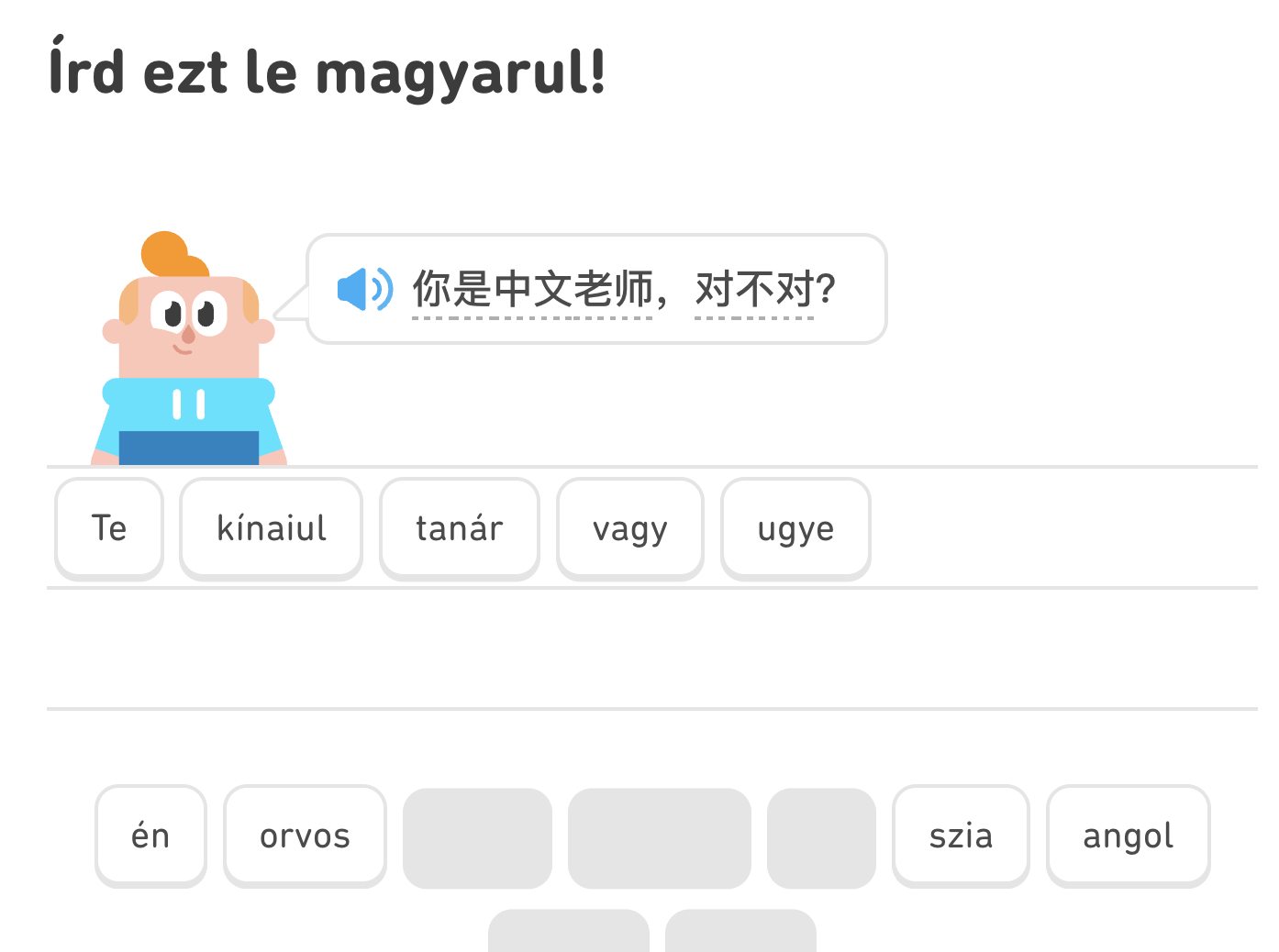
The Chinese course otherwise mostly lacks cultural content, except if one finds such example sentences as “My mom threw away my game” as typically Chinese culture – I find it so since I know a few Chinese parents who, sadly, often react in such aggressive manner to their kids’ actions. Later on, the course suddenly jumps on features like Otaku, a Japanese word meaning “people with consuming interests, particularly in anime, manga, video games, or computers” (Wikipedia) or Weibo, Chinese for a microblogging website. Unfortunately, these are completely out of scope for most non-Chinese learners or those without an interest in such things, or those simply older than game-besotted young teenagers. Again, this is very similar to the food on the Dutch course, where we would be supposed to learn or remember meaningless things we have no idea about. Add to theses problems the hilariously wrong English that the Chinese course actually demands.
At a later stage of the course, in Unit 10 of Section 3, where they suddenly delve into investing and business risks, supposing perhaps that the learner has learnt everything before, beside such sentences to be translated as “No need for the honorable, my last name is Wang” or “Excuse me, what is your honorable last name?” where, obviously, no native or highly educated learner would ever use hono(u)rable, there are really disturbing translations demanded, from or into, “What is your honourable’s business/company/investment etc.” on account of the fact that, in such situations, polite Chinese does use 贵 (guÌ) a lot, and the word “honourable” does exist in English. But is not used in this way! I can’t even understand what the authors had in mind there. Compared to the strangeness and folly of such sentences, it matters really little that the pup-up meanings of Chinese words, even the new ones, are so often wrong throughout that the English speaker is usually left scratching their head as to what to do with the translations.
As far as the Russian course is concerned, it lacks culture other than, in parts of the course, containing sentences that, to me at least, harks back to the times of the party state and the questions a KGB agent might have asked people. Otherwise, this is the only course that deals extensively, to my mind a bit too much, with spacecraft, space research or the size of the cosmos and contains references to the world wars. How much that is due to Russian culture is a matter to ponder but the German courses also contain some references to cities or structures destroyed in the wars. No wonder. Then, towards the end of Section 3, after not very deep into daily language, the course plunges into deep science, experiments with elements and such, becoming completely irrelevant to the average language learner’s needs. And then the whole course is suddenly cut short.
The whole system features cartoon characters on the side representing various speakers all through all the courses I’ve seen. They make various movements probably intended to be funny. But these cartoons do not help learning itself except in the EN-French course, where they are sometimes used as background to what happens in the example sentences. Otherwise, some characters are outright exasperating, especially when one of them, Eddy, needs at least five seconds to pronounce some things like “Natürlich, Junior! Es ist dein Geburtstag!”, like this, “Natürlich… Junior! … Es ist… dein… … Geburtstag” on the Dutch-German course, or when, having finished a pronunciation practice session, Duo the owl begins to dance, apparently happy and in wait for the programme to provide you with your points so that you can go on to the next task but he goes on dancing and dancing for a minute, two minutes,… who knows how long the programme can get stuck – at such points you have to stop it altogether and start another practice task. A lot of time wasted.
Cartoon characters used for good mood is fine (for some…) but a further important element is the collection of points, which ranks people from beginners, and it all allows learners to move up from the lowest tiers called precious metals and stones like ruby up to the highest one called the Diamond League. Utilising people’s urge to compete, urged by silly figures, is one thing, however, and creating an unlevel field to do so is completely different: there are big differences as to the provision of opportunities to collect points among various languages, which I find quite disturbing.
Several language pairs, I guess mostly involving the large western languages, contain conversations along the courses to practice and collect points by. Additionally, they offer revision opportunities. Completing such sections of 10 sentences, which could be revision batches, listening or speaking sets, awards the user 20 points instead of the maximum 15 points for successfully going through a normal set of 17 or 18 learning examples of fill-in or choice questions or sentences. This is a bit lop-sided, but when one considers that some courses have no stories to listen to on the course, or even worse, no speaking practice sets at all, like the EN-Chinese course, which, in itself, is a lot more difficult than most other courses, given the fact that one has to master characters, the gap among the possibilities offered by different languages can be considered outrageously huge. And I can’t even start to explore these features with the Arabic course, given the almost insurmountable obstacle of learning the special writing system. I’ve spent a good amount of time on Arabic but did not get anywhere further than the first few characters without remembering anything solidly so gave up.
The Chinese course has a lot to be wished for even on its own. I’m quite sure that one can’t learn those characters simply by pairing them up with what one hears pronounced and other very simple methods while no meaning to the characters is provided whatsoever. Except in Chinese primary and secondary schools, where the little ones are tortured hours on end per week for over a decade to memorise those characters – but they have an advantage: they already speak their mother tongue, so when they hear how a character is pronounced, they have a meaning to it, helping the memory. Still, even university students don’t always perform well enough on their Chinese final exams. Here, the character is pronounced, we have to match it to the one where it is written in Pinyin (the Latinised writing can be used for the sake of foreign learners to recognise at least the pronunciation) with the intonation provided, then it is done vice versa once, which can be done except if one has no hearing at all, and then that’s it – no meaning to anything at all, just recognise it! Then go on and learn it. So, one is supposed to remember meaningless scratches on the screen, basically, based on a pronunciation system totally new for speakers of European languages. Shall I say, well done!?
Fortunately, after months of trudging through the material – if you haven’t already given up and thrown your gadget in the corner –, you do have a chance to scrape, from parts of various words or sentences here-and-there, a couple of characters the meanings of which suddenly light up the darkness in your head. Otherwise, you can trust yourself to remember and sooner pair up the Chinese words based on the EN meaning and their Pinyin than remember the meaning of any character simply based on the sound. Or you can turn off the Pinyin, but then, how do non-Chinese learners recognise the differences among so many characters and remember them for good?? And again, in 15 minutes a day? Crazy if you ask me!
Added to this is the problem that there are no pronunciation practice sections at all, which is not only a difficulty if the learner wants to collect points but also given the fact that Chinese syllables can have four different tones, and each tone provides a distinctive character to the syllable, which is a basic problem to speakers of any Western languages used to sentence intonation, not to this syllabic kind. So, adding pronunciation practice would help a lot. Its lack doesn’t mean it is impossible to learn Chinese or similarly character-based languages like Japanese or Korean, or Vietnamese, which is reputed to have seven, not only four intonation variations, but understanding what one is trying to learn and practicing it as it is spoken would probably speed up the speed of learning somewhat – or considerably, which would suit the self-proclaimed best learning method in the world.
Speaking of pronunciation practice, which – probably – most other languages offer, there you may encounter some strange problems. Normally, the speech recognition system can correctly identify your sentence as correct, sometimes otherwise when it’s incorrect, but not very rarely, it simply cannot hear and accept correct sentences. In such cases, the learner can repeat the sentences twice more. You will often find that where for the first time it says something was not correct, it instantly accepts the same pronunciation for the second time. Sometimes only for the third time. Sometimes even then it does not, and in such instances you are allowed to go on to the end of the ten-sentence set where it will face you with the one that you – or the system – missed earlier. Strangely, it sometimes happens that your sentence is accepted at last. Or it will not be. Never. This forever-impossible obstacles are mostly numbers or ones associated with them, like kilometre. This can happen on any course in a way that, if the larger part of a sentence, mostly the short ones, consists of numbers, you will never manage to be accepted. In such cases you receive the message, Hm… that doesn’t sound right, then, That still doesn’t sound right, meaning the system is not geared to its acceptance.
Sometimes other bits are also impossible but, and this is interesting, if you start experimenting with various sounds instead of the correct ones, you may hit upon a sequence that makes it possible for you to be accepted. However, especially on the Russian course, even this is mostly impossible and such sentences like “Мария пробежала пять километров за двадцать минут” will prove forever impossible to pronounce, simply on account of the words kilometres and twenty even though you’ve said everything correctly. On the Dutch-French course (and probably on other French courses as well), sentences containing “Qu’est-ce qu’elle” or “Qu’est-ce qu’il” are difficult but there are sentences on the normal course material that only add one short word to these forever (like in “Qu’est-ce qu’elle fait?)” and then you’re stuck in the middle of Section 2 – there’s no way you finish that set of tasks and reach the next one if you don’t click on “Kan nu niet praten” (I can’t speak now), which is ridiculous and time-consuming. I suggested to their helpdesk to try and let the system listen to the original speaker to prove me right but, of course, I never received an answer and these problematic sentences go on and on being problematic.
Compared to the general difficulty of the language and considering the missing pronunciation practice, Chinese sorely misses advice about the characteristics and usage of the language in what they call “language tips” in their Guidebooks to sections of material. Seeing that what Western languages consider grammar hardly exists in Chinese, perhaps not much is needed but quite often word-order help would go a long way because that’s where the difficulties of such a domino-like language lie.
Unfortunately, about two years ago Duolingo scraped almost all the grammar explanation sections then still existing. As they had already been there, and because the site sometimes mentions that it is mostly for adult learners, they provided important help to learners, who are admittedly at least older teenagers or young adults if not elderly, to whom a considerable amount of the material is also geared. Such learners need a lot more grammar than toddlers learning their mother tongues.
Grammar help is especially sorely missed on the Russian course, which is relatively the most difficult language I’ve met, with its various forms conforming gender, case, number etc., which are not practiced enough at all. As even with the same gender, case or number, etc., different nouns and especially verbs conform to several patterns of their own, a lot more discussion of those and exceptions, and a lot more practice would be necessary. It is sadly missed. But this is a huge shortcoming of all the courses as they are now as a handful of example sentences is hardly an equivalent of meaningful grammar explanations
Sometimes courses of a certain language with different source languages differ considerably as to the treatment of grammar and the expansiveness of practice. In this regard, the French course for English learners offers a lot more than the one for Dutch learners so, with the extra benefit of more practice, a second course on the same language sometimes yields a lot more than more practice: more language help.
On top of all things discussed above, although one can send complaints to a couple of Duo helpdesk e-mail addresses, they never answer you, stating in their response mail acknowledging receipt of your mail that you may not receive an answer. You should not take it at face value: they never ever answer. It may happen sometimes that you receive mail about an adjustment to the accepted translations based on your suggestion but not to complaints about grammar or the pronunciation sets. “Duolingo ist tatsachlich hilfreich”, “Duolingo is inderdaad nuttig”, i.e., Duolingo is really helpful, an oft-recurring, audaciously self-promoting sentence advertises the platform to users on the German courses again and again – except that Duolingo is not helpful at all with our problems – staff don’t even deign to respond!
It is true that even without thinking (much), one can sooner or later be able to remember words, expressions or sentences of a foreign language. But to speak it, like in having a conversation with a – native? – speaker of that language, as in the English meaning of “Do you speak …?”, not in the meaning of some other languages where people ask “Do you know (German/French/Chinese etc.)”, well, that’s in a totally different league. If that can be achieved, we can be certain that the person understands the spoken and written language and can respond meaningfully in speech or writing – in the meaning of the four basic skills. Strange facts (surprises??): one can only learn to speak if one speaks, can only understand speech if one listens, one can only understand what’s written if one reads and one can only achieve a reasonable level in writing if one writes. But what in the world of Duolingo one has to do is mostly translate, which is a totally separate skill! True, during the course, one has to read and write some, but mostly one has to write what a word or sentence in the known language means in the target language, sometimes vice versa – which means one has to translate. As long as our brain needs to translate, the person can’t speak freely, that is, can’t speak the language fluently but has to decode that language in both directions first.
How does one learn to understand and respond to another’s spoken or written language fluently by translating what is artificially – and without context – put in front of him/her remains to be seen. Remember my Russian exam?
The only positive of the courses is that there’s an almost infinite possibility to repeat or translate sentences or phrases, which may (or may not), sooner or later, stick in the mind and the learner will slowly – very slowly – have enough neural connections to utilise in real-life circumstances. Once, in an earlier film, a character played by Antonio Banderas, who was captured and held captive by the Moors in a respectful manner, suddenly, after a few years, started to join the conversation of the Moors, who were taken aback and asked, Can you speak our language? The Banderas-character responded, I’ve had a lot of time listening to your discussions so I learned it.
It would be ideal if this fib could befall to real people. I am honestly afraid that there were people who believed him. In reality, this is impossible above the age of the babies and very small children. Above that age, the human brain needs more and explicit information and a lot more practice than those of babies. Here on Duolingo, we get a lot, we can repeat words and sentences endlessly but, mostly lacking grammar explanation and without conversational practice, the learner is in a very difficult situation. True, as it happened to me with German, the – almost – total ignorance of a target language can disappear as a result of the lot of spoken (recorded) input and the lot of repetitions in various forms of the target structures. But after two and a half years of relentless work of about 20 or more hours a week I have so far only been able to say a couple of sentences when necessary in Germany or Austria. Not much, not very confident, especially if I compare it to the progress of some of my – or my colleagues’ – English classes of yore, where students were able to conduct meaningful, though short and limited, conversations after a year or two of three hours of English classes a week.
So, to what extent can the learner accept and appreciate that insight Duo put up there suggesting that we can learn a language in 15 minutes a day? Given the circumstances on these courses, my informed guess is, almost zero within the framework of an average adult’s life span. One can collect “friends” in the system but can’t converse with them so, without that and without grammar explanations, I’m sure I’m right. The only viable feature is the fact that you can hammer the thousands of sentences into your brain as much as you wish – and endure. ”Repetitio est mater studiorum” may have been the only motto the devisers of Duolingo relied on. That was the way people of my father’s generation studied Latin (and German as well), short of any other method, in the 20’s and 30’s of the previous century in Hungary. As a result, my father could sometimes quote a famous Latin philosopher but neither of them ever spoke a foreign language.
The only question remains, to what extent we can believe that we may be able to converse in a target language in the distant future using Duolingo. How many hours a day do we need over how many years to be conversational? In some languages, like in Dutch, or without English as the basis, the easy answer is never, as some of the courses are very (-very) short. With other languages, if you’re young enough and find frequent opportunities to talk to native speakers often enough, there’s a chance. But without that, and if you’re a bit (or more than a bit) older than young, I’m quite afraid you won’t ever speak, or at least understand spoken language, fluently. This is simply not the way to achieve that. Better go back to school or take a private course instead of, or at least besides, Duolingo.
by P.S.



 Learning and teaching languages in the Netherlands - and taking photos in the process