• Privacy policy
  • Translator – ProZ.com Pro member
  • About

Learning and teaching languages in the Netherlands – and taking photos in the process

~ A fine WordPress.com site

Learning and teaching languages in the Netherlands – and taking photos in the process

Category Archives: language learning

The situation of language teaching – comparisons: the Netherands

24 Wednesday Oct 2012

Posted by ZJShen-PSimon in English teaching, language learning

≈ 1 Comment

Tags

education, English language, Great Britain, Language education, Netherlands

In this new post, I’d like to compare the language education systems in a few countries where I’ve had some experience. Because I suppose most people properly educated in English have a fair idea about the education systems of Great Britain and the United States of America, I only draw a few parallels where this seems practical, but I’m not going into details there. I also have very little first-hand experience about the US.

Firstly, I’d like to discuss the situation in the Netherlands. This is the country that has come out on top of Europe in a recent poll about the ratio of people speaking at least one foreign language, so it can be assumed that language teaching is of utmost importance and in a very modern state here.

As far as I can see, in the Dutch education system, there are lots of choices for people as to denomination, educational philosophy and the like: this is a country for catholic, protestant, muslim, Montessory, ‘themaonderwijs’ (theme-oriented teaching), Dalton, Jenaplan, adaptive or development-oriented schools and a lot more. I personally haven’t seen a system in which the force of competition led to a greater variation of idea-based, philosophy-based, theory-based schools than in the Netherlands. There is great pressure on schools of different levels to stand out in one way or another, perhaps at all cost. True, this leads to a variety of choice perhaps unprecedented elsewhere. This also means that it is next to impossible to generalize about the kind of educational practices followed, it’s only possible to draw a few wild conclusions. However, that’s what I’m trying to do below.

The different levels of education in the Nethe...

The different levels of education in the Netherlands (Photo credit: Wikipedia)

As can be seen in the chart, education in the Netherlands starts at age four and secondary education starts at twelve. How much foreign language education goes on between these two points depends on the kind of school the kid goes to. From secondary age, studying at least two foreign languages is compulsory, often one changed to a third one after a couple of years. There’s a wide range of choice, but at schools in the VWO section, which prepare students for higher education, especially at ‘gymnasia’, students must choose between Latin and ancient Greek. The number of lessons for modern languages is very low, maximum two or three in all three types of secondary schools, but students often have only one class per week per language in HAVO or VMBO-schools. One may wonder whether the system itself is designed to give no chance for students to learn a language properly, or to economize on the likelihood that they will do so later anyway. For the brighter ones, some larger, comprehensive-like institutions, like in lyceums, give the possibility to upgrade their studies by shifting upwards from VMBO or HAVO level, but then they get a compulsory dead language for their efforts.

English: Education System in the Netherlands N...

English: Education System in the Netherlands Nederlands: Schema van het onderwijssysteem in Nederland (Photo credit: Wikipedia)

What really strikes me as a language teacher and a foreigner is that teachers at interviews and other colleagues admitted that most students don’t speak English until about age fifteen, or two or three years of instruction. This is further attested to by former student friends, who maintained that they didn’t really learn anything about English at their schools, especially at the more technically-oriented HAVO and VMBO. The stress here is on learning about the language, as if English was one of the classical, i.e. dead languages. It seems widely accepted that classical languages are necessary for higher education, which may or may not be the case from other points of view.

What is further interesting is the opinion of a colleague at an institution between secondary and tertiary institutions, where English language training for university entrance exams takes place for those who have failed first. The course at his institution consists of test- and reading practice and a little writing, but apart from occasional listening to their own reading, there’s no listening practice, and no speech practice. Out goes the complex views of language learning prevalent in the English-speaking world, or where they have strong impact. The reasons are that students must be prepared for reading almost all, or at least most, university material in English, have to write in English for their papers, and there’s no time for other activities at the course. Besides, the students can practice listening from the television, and speaking in their private lives.

This all points to a strong leaning on the grammar-translation methods of yore. At an interview, I felt that time has stopped in that one school, and since then I feel it has stopped in this country as a whole. My own experience supports the now wide-spread wisdom that teaching through grammar and translation without real communication slows down the learning process. I’ve reached a stage in my Dutch studies when I’m able to just talk Dutch without thinking first in my own language or English about what I want to say. This is the aim of all learners, but it has to be on a level when one can really express everything. I’m not at that level, so when I can’t find a word in Dutch, I try to fall back on my English, and that’s the point when I find that not only can I not say that particular word in English, which I’ve been speaking for over forty years, but in my own mother tongue either. So, how can, I wonder, Dutch English teachers effectively teach their students a foreign language through Dutch? I didn’t have the presence of mind to ask the panel this at the time of being asked how I can teach without Dutch. Obviously, they have no idea about the truism that translation is a separate skill, to be taught separately from the others.

I should perhaps add that the Netherlands has a strong system of teaching Dutch to immigrants, with support from ‘vrijwilligers’, or volunteers from all walks of life. The preparatory phase for full-time employment in education, as well as with perhaps all jobs, called ‘stage’, is general, which creates the foundations of effective workers in the education as well. On the other hand, the job of teacher assistant is not wide-spread at all to the extent it is in Britain, although it exists. For foreign teachers trying to get a job here it would be a useful step.

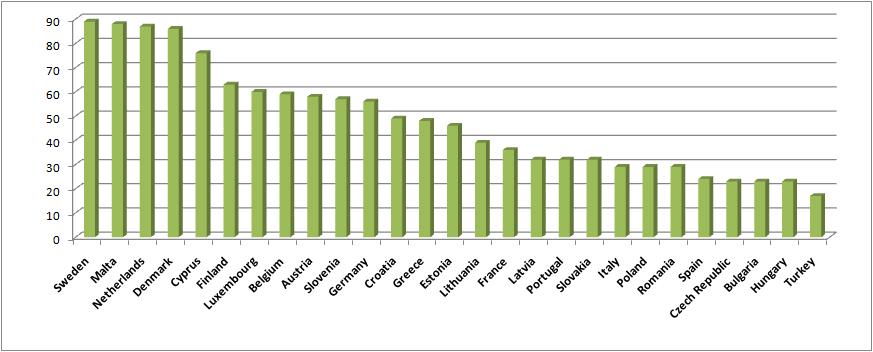
So how does it come about that the Dutch are so proficient in foreign languages in general, and in English in particular?
As was suggested above, the Netherlands has come out on top of a recent survey of Europe about language proficiency. Irrespective of methods, this result shows a wide-spread use of second languages here. We can hear it in the streets of most towns and cities, and it not only means the use of their mother tongue by the lot of immigrants to the country, but also the use of English, German, French and other major languages. True, it’s not very usual to hear German, French of Spanish, perhaps because visiting speakers of those languages already know that if they speak English here, they will surely be able to communicate. So one hears mostly English by tourists asking for tickets, ordering hotel rooms or asking for beer at pubs, and even train or bus conductors answer them as a matter of fact.

People in the Netherlands like to travel and discover the world. One of the closest neighbours is also one of the most popular destinations: Britain. The reasons could be anything from studies or work to following a match of favourite football clubs there. Instead of animosity, there’s a strong sense of rivalry towards the English in the Netherlands. Historical animosity may already have been forgotten towards England, much more, than towards Germany. I know of young people who have been to Spain or France to work in the summer holidays, and they have gradually learned those languages, especially if they already had a course about them. I also know about German spouses or Dutch people who live in Germany, but on the whole, the use of these languages seems to be very limited. Besides personal and possibly historical reasons, these languages are also not very often used in television programmes or in cinemas. On the other hand, English-language programmes and films abound in the Netherlands. Young people have the opportunity to watch relatively good quality English soaps and at least one TV channel airs an English or American film every evening, often without subtitles, but those with subtitles also benefit learners a lot. Besides, programmes about fashion, famous people and lots of other, sometimes strange topics abound on several channels even in peak time. I have to underline the fact that dubbing is not used in this country at all. Besides, to follow university courses, one has to be able to read any literature pertaining to their subject more or less fluently, as a colleague has pointed out. All this leads to an overwhelming knowledge of English (87% of the adult population, 5th in Europe after the English-speaking countries, and Norway and Sweden, according to a recent survey here, or the latest full results downloadable here), but less so of other second languages, or the others are simply and clearly far less popular and accessible.

If we look beyond the convenient everyday use of everyman, then specialists of English, like travelling businessman, language teachers and linguists, must rely on more than watching films. The businessman meets native speakers often enough to have no problems with English, or other languages, and the Dutch are a great nation of travelling businessmen. On the other hand, they may be less great with linguistics, as far as I can see. University students, or those aspiring to become one, must rely on dictionaries. In this field, I must feel sorry for them, because dictionaries available in two languages are not unlike their Hungarian counterparts: some words are translated with only a single word, many without example phrases or sentences that would help the learner to understand the contextual use of the word or phrase, and I’ve come across several mistakes, whereby the equivalent is given in an English word that is not used or doesn’t exist in that sense. I find this mostly with my big van Dale Studiewoordenboek, but sometimes with Kramers too. It disturbs me as a learner of Dutch greatly, but this is also the source that learners of English are supposed to rely on. Enough? Hardly so sometimes. I also find it conspicuous that it’s very difficult to find the single-language English dictionaries and specialized dictionaries like slang, or phrasal-verb dictionaries here, just like it’s next to impossible to find internationally-published, modern coursebooks that abound in Hungary and other countries. I still have to dig deeper into the local offer to offer views on those, but if the Dutch coursebooks we receive at the Dutch course are anything to go by, I have little to expect in organization, methodology or life-like interest enticing the young learner.

Just as a by-thought, I’d like to add that the perhaps largest and best institution to teach English as a foreign language around the world, IH, or International House, only has no school in Europe in the Netherlands, Denmark and the two Scandinavian countries mentioned, thereby ridding their learners of English of a direct possibility of learning from native speakers, or their highly competent equivalents. May it be down to self-confidence, or self-deception, or sheer arrogance, which countries like Germany or Switzerland give a wide berth to by giving the possibility to their learners to study with IH?

Next, I’d like to give a general overview of the Hungarian system of language education. So that each post doesn’t become too long and tiring to read, I’m going to do that in the following post.

regularly updated with new ideas if possible

by P.S.

Related articles
  • 5 tips to learn a new language for expats (expatsincebirth.com)
  • The effects of grammar translation method and communicative language teaching grammar instruction in EFL university students in Taiwan (udini.proquest.com)

Learning languages and teaching in the Netherlands

21 Sunday Oct 2012

Posted by ZJShen-PSimon in English teaching, language learning

≈ Leave a comment

Tags

Eastern Europe, education, English as a foreign or second language, Netherlands, Teaching English as a foreign language

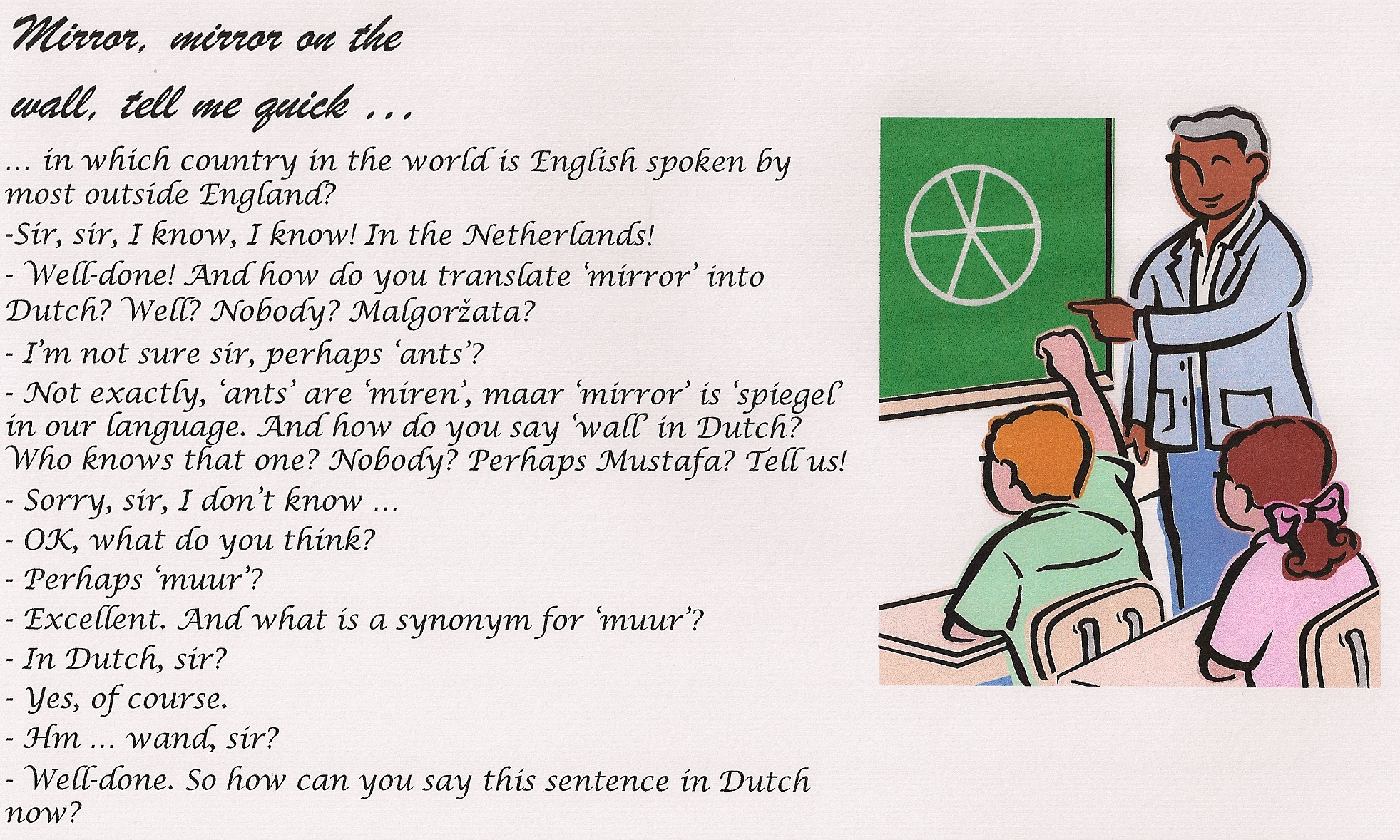
Learning languages means learning to communicate with people who don’t speak our mother tongue. So how do we go about it? And how do teachers go about it? Are there fool-proof methods, perhaps one method that could be perfect for every learner, and most people just don’t know about it? Or is even this question, well, amateurish? Then have a look at this:

What is, then, amateurish? Who thinks that this activity in class helps students best to acquire and use English for communication? Hardly anyone, I think, outside the Netherlands. Doesn’t this resemble the way my father used to study Latin in the 1920’s and 1930’s in Hungary? In the end, he was able to quote a few lines from some famous texts, but nothing else. And that was just as well because he and similar others never had to and still don’t have to communicate in Latin. Yet, in the

English: Main dialects, regional languages and...

English: Main dialects, regional languages and minority languages in the BeNeLux (Photo credit: Wikipedia)

Netherlands, Latin, along with ancient Greek, is a compulsory choice in gymnasia, the highest-ranked kind of secondary schools, the equivalent of grammar schools in the Netherlands. Besides, a teacher is required to speak fluent Dutch to be able to teach English there and at other secondary schools.

Why, should we ask! The Netherlands as a country is still very helpful to immigrants at the moment with teaching Dutch to them often free, or almost so. In my city, people can receive 3 hours of teaching 4 days a week if they have their middays free. So how do those teachers there teach their own language? Like this, may I ask?

Well, to be honest, no English, or any other languages are spoken there. The teachers speak some or good English and very occasionally help someone with a word if absolutely necessary, but it’s avoided – students have to talk and understand the target language.

This is the point: use the target language! Most English teachers would agree that this is one of the most important elements of a language class. Of course, with a modern language the aim is not to translate texts and fill tests about the language but to learn to think in that language and thereby communicate as effectively and fast as possible. Do English speakers only forward this notion so that they can get jobs around the world? True, without this aspect, nobody from America or Britain or Australia could get jobs in Eastern Europe, or further to the East, nobody could get jobs in China or Thailand, or other exotic but developing countries where English learning is needed. I wouldn’t have been able to teach English in China either. The German guest teachers couldn’t have worked in my school’s German classes in Hungary either.

Do we fail? Not at all. I haven’t failed, and neither have those whom I’ve seen in Hungary or China do their jobs in class, whose classes have been enjoyed by students who have benefitted greatly from the experience and even taught their mother tongue to the guest teacher a bit.

The different levels of education in the Nethe...

The different levels of education in the Netherlands (Photo credit: Wikipedia)

So why can’t I get a teaching job in the Netherlands, and neither could anyone else without fluent Dutch? I’ve been told on several occasions that this is basic if I want to teach here. I know that the law prescribes having our degrees assessed and approved by the “Ministerie van Onderwijs, Cultuur en Wetenschap”, the Dutch Ministry of Education. It is necessary for all teachers from abroad, for obvious reasons. But I am not usually asked about it even when I am sometimes not rejected outright without any serious explanation. The few times somebody got to communicate with me about my application, I was asked instead how I keep contact with the students, with the parents and the colleagues at school without fluent Dutch.

Fluent seems important because at these occasions we communicated in Dutch all right. Still, it didn’t suffice. May I ask if my job is to teach English, or to chat and bide my time with the students? For the heap of money I would get, in comparison to my Hungarian salary at least, I’d happily do that, but no, no way.

I would also very much like to know who can decide what it means to be a fluent speaker of Dutch on the basis of a two-minute telephone conversation in which I’m praised for my language level but told outright that still, being a foreigner, I can’t speak fluently. What if I can? How does anyone know if I’m not given a chance?

On the other hand, earlier, when I was interviewed once, the panel didn’t want to hear my English at all. I wasn’t even asked how well I could speak. They asked me, in Dutch only, how I could keep in touch with everybody only in English. As if nobody here, no parents and no colleagues could speak English in this country, which, according to the EU report published recently and downloadable here, is on top of Europe with regard to foreign language competency, especially to English. At the end, my interviewrs admitted that at  around age 14 or 15, their students didn’t speak English. They start English teaching at the beginning of secondary school at least, at the age of 12. How could they not teach them some reasonable level of English in two or three years?

Very possibly with methods seen above in the first example. People learn English later, outside school, from TV, films, music, whatever, and by travelling to the other side of the English Channel. Easy. For school as well – people will learn English without them doing anything serious. Except tests for those going to university. Thus is the English level of  an applicant not really important at all, but his/her Dutch is of utmost importance.

My further question is, how could teachers here be so incompetent?

Possibly, because they haven’t had to learn the language in language classes either. Perhaps they’re just jealous of their positions. Isn’t it their job to teach English? Do they not do their job? Yes, lots of foreigners could do it a lot better.

by P.S.

Related articles
    • ‘English language learning must go hand in hand with multilingualism’ (thehindu.com)
    • How to Learn English (answers.com)
    • Welcome to LEFLa (Learning English as Foreign Language) (lefla.wordpress.com)
    • Update: Dutch learning resources.

Hello world!

21 Sunday Oct 2012

Posted by ZJShen-PSimon in English teaching, language learning

≈ 4 Comments

Tags

education, English as a foreign or second language, Netherlands, Teaching English as a foreign language

Een beeld van een leraar in Amsterdam

Learning languages means learning to communicate with people who don’t speak our mother tongue. So how do we go about it? And how do teachers go about it? Are there fool-proof methods, perhaps one method that could be perfect for every learner, and most people just don’t know about it? Or is even this question, well, amateurish? There’s a lot of research going on about the problem of helping students and of students trying, or quite often not even trying, to use ways that help the memory, the understanding, the spoken or written communication, the correctness which most call, correctly or less so, grammar. As a student of English in Hungary and a teacher ever since, I’ve listened to lots of wise thoughts about it all at university and at conferences, and even sometimes contributed somewhat. I’ve attended very many classes by other teachers too, mostly while it was my job to train young English teachers at my own school for the university. But most teachers would attest to it that teachers learn to do their job mostly by doing it as best as they can. So here I don’t want to pursue research projects, only to share experiences about this whole process, and mostly with a view to the situation in the Netherlands, which I’ve come to find, well, strange, in spite of this nice statue in Amsterdam.

After working in language education for so long, and getting so little response in the Netherlands, I’ve decided to open up to the world and put my ideas to the test on this site. I would like to receive comments on what I say because I would like to go on learning about language education here or anywhere.

I would advise my readers to go about the articles in chronological order, it would make more sense I think. If the reader finds them provocative, it’s because I intend them to be so. I believe that my provocation has a better chance to provoke or invoke contrasting ideas, without which my own ideas, coming from one person only, may prove to be limited, or one-sided, therefore not true or realistic enough. Besides, feedback is a central tenet of the British teaching ethos, right?

by P.S.

Newer posts →

ProZ.com Pro translator

Recent Posts

  • News about Learning with Duolingo April 10, 2025
  • Treasures of Austria – lesser known towns and cities, churches etc.: Schallaburg October 11, 2024
  • Treasures of Austria – lesser known towns and cities, churches etc. – Sankt Pölten October 5, 2024
  • Treasures of the Thaya valley in Niederösterreich – Raabs an der Thaya, Schloss Raabs September 22, 2024
  • Treasures of the Thaya valley in Niederösterreich – Burgruine Kollmitz September 20, 2024
  • Changing direction September 16, 2024
  • Learning Languages with Duolingo – extra no.2 June 22, 2024
  • Learning Languages with Duolingo – extra June 19, 2024
  • Learning Languages with Duolingo April 21, 2024
  • Language teaching (?) March 28, 2021
  • And the First Prize in Chinglish Goes to… July 8, 2020
  • Statistical truth about problems caused by asylum seekers in the Netherlands February 1, 2018
  • In honour of the immigrant 2 April 20, 2017
  • In honour of the immigrant 1 April 17, 2017
  • Can something, anything, be more stupid? December 14, 2016
  • Intercultural life in the Netherlands June 6, 2016
  • Good books to learn from May 22, 2016
  • Teach Dutch to refugees January 17, 2016
  • Arnhem’s cultural week and the famous Dutch railways September 12, 2015
  • Hilarious Hungarian-English mistranslation June 19, 2015
  • Cello concertos almost forgotten June 1, 2015
  • Send Dutch applicants … no. 2 March 13, 2015
  • Eastern-European views on the Netherlands November 23, 2014
  • Everywhere … October 16, 2014
  • Chinglish, or Dunglish? June 9, 2014
  • English testing issue in Hungary May 13, 2014
  • Effect of Grammar Teaching on Learners and Translators April 4, 2014
  • Neurobiologist on the brain development of children – part 3 March 28, 2014
  • Neurobiologist on the brain development of children – part 2 March 26, 2014
  • Neurobiologist on the brain development of children March 25, 2014
  • The extent translation is ‘correct’ March 14, 2014
  • Translating using translation software January 19, 2014
  • Translation problems with machine translation January 13, 2014
  • Translation difficulties January 11, 2014
  • Translation in the extreme November 16, 2013
  • Life is looking up at long last October 4, 2013
  • Summer disappointment on the Dutch job market August 2, 2013
  • Send Dutch applicants abroad back home! June 21, 2013
  • What Teacher Education Programs Don’t Tell You June 10, 2013
  • Werkloos = waardeloos, i.e., jobless = worthless? May 27, 2013

Enter your email address to follow this blog and receive notifications of new posts by email.

Join 55 other subscribers

Archives

Categories

  • applying for a job in the Netherlands (2)
  • Austria (5)
  • Austria (1)
  • castles in Austria (3)
  • child development (4)
  • child rearing (3)
  • Chinese speakers of English (2)
  • Dutch culture (4)
  • education (17)
  • English teaching (29)
  • European Union (5)
  • foreign language teaching (19)
  • Hungary (6)
  • immigration (8)
  • intercultural learning (1)
  • job application (1)
  • joblessness (2)
  • language courses for Dutch people (1)
  • language courses for Hungarians (1)
  • language learning (33)
  • language teaching (22)
  • language testing (5)
  • learning Chinese (1)
  • learning Dutch (4)
  • learning languages with DuoLingo (1)
  • museums (1)
  • nature photos (1)
  • Netherlands (12)
  • Nieder-Österreich (3)
  • refugees in Europe (4)
  • River Thaya (3)
  • teacher training (7)
  • teaching Dutch (1)
  • translation (12)
  • university education (4)
  • work in Dutch education (6)

Meta

  • Create account
  • Log in
  • Entries feed
  • Comments feed
  • WordPress.com

Blog Stats

  • 23,549 hits

Spam Blocked

59,628 spam blocked by Akismet

Categories

applying for a job in the Netherlands Austria castles in Austria child development child rearing Chinese speakers of English Dutch culture education English teaching European Union foreign language teaching Hungary immigration intercultural learning job application joblessness language learning language teaching language testing learning Dutch museums Netherlands Nieder-Österreich refugees in Europe River Thaya teacher training teaching Dutch translation university education work in Dutch education

appreciation of variety Austria British Council Bulgarian castle ruins in Austria castles castles in Austria CELTA China Chinese language cognitive science Common European Framework of Reference for Languages Culture of Hungary duolingo Dutch Dutch as a foreign language Dutch dictionary Dutch people Eastern Europe education education in the netherlands English as a foreign or second language English language European Union freedom in class Frigyes Karinthy German German language grammar-translation method Grammar translation Great Britain Hearing (sense) Higher education higher education in Hungary Hungarian Hungary IELTS Immigration Jiaozi Language Language acquisition language correction approaches Language education language learning Learning learning to communicate limits in class mistranslations Netherlands Niederösterreich NRC Handelsblad Romanians Rote learning Schallaburg Secondary education Second language Staatsexamen Student talent Teacher Teacher education teacher training Teaching English as a foreign language teaching foreign languages Teaching qualification tests Thaya Thaya river Training Translation travel use of translation softwares Van Dale Western Europe work in the Netherlands
  • Unknown's avatar
  • Unknown's avatar
  • Unknown's avatar
  • thanefurrows's avatar
  • Unknown's avatar
  • Noah's avatar
  • fashbazar's avatar
  • Bogdan Marius Beleuz's avatar
  • humanity777's avatar
  • Ido Lanuel's avatar
  • International Bellhop's avatar
  • Katsness's avatar
  • Unknown's avatar
  • rrcmrt's avatar
  • Sofia's avatar
  • iGameMom's avatar
  • Blake's avatar
  • Unknown's avatar
  • Unknown's avatar
  • robert okaji's avatar
  • fitnesscoachjohn's avatar
  • Kale's avatar
  • liane {meraki geek}'s avatar
  • JustEnglish.me's avatar
  • Aid To Stop Smoking's avatar
  • Unknown's avatar
  • petchary's avatar
  • nisbetkara's avatar
  • Unknown's avatar
  • Unknown's avatar
  • Unknown's avatar
  • Unknown's avatar
  • Unknown's avatar
  • Cam's avatar
  • toemailer's avatar
  • Unknown's avatar
  • Unknown's avatar
  • Unknown's avatar
  • Unknown's avatar
  • Unknown's avatar
  • plerudulier's avatar
  • Katie Harris's avatar
  • Chris Speck's avatar
  • lemanshots's avatar
  • Texture of Parlance's avatar
  • Unknown's avatar
  • Unknown's avatar
  • Unknown's avatar
  • Unknown's avatar
  • Jenny Ebermann (bxljenny)'s avatar

Top Posts & Pages

  • News about Learning with Duolingo
  • Treasures of Austria - lesser known towns and cities, churches etc.: Schallaburg
  • Treasures of Austria - lesser known towns and cities, churches etc. - Sankt Pölten
  • Treasures of the Thaya valley in Niederösterreich - Raabs an der Thaya, Schloss Raabs
  • Treasures of the Thaya valley in Niederösterreich - Burgruine Kollmitz
  • Changing direction
  • Learning Languages with Duolingo - extra no.2
  • Learning Languages with Duolingo - extra
  • Learning Languages with Duolingo
  • Language teaching (?)

Protected against copying

Protected by Copyscape DMCA Takedown Notice Search Tool

Create a free website or blog at WordPress.com.

Privacy & Cookies: This site uses cookies. By continuing to use this website, you agree to their use.
To find out more, including how to control cookies, see here: Cookie Policy
  • Subscribe Subscribed
    • Learning and teaching languages in the Netherlands - and taking photos in the process
    • Join 55 other subscribers
    • Already have a WordPress.com account? Log in now.
    • Learning and teaching languages in the Netherlands - and taking photos in the process
    • Subscribe Subscribed
    • Sign up
    • Log in
    • Report this content
    • View site in Reader
    • Manage subscriptions
    • Collapse this bar
 

Loading Comments...