• Privacy policy
  • Translator – ProZ.com Pro member
  • About

Learning and teaching languages in the Netherlands – and taking photos in the process

~ A fine WordPress.com site

Learning and teaching languages in the Netherlands – and taking photos in the process

Category Archives: Chinese speakers of English

News about Learning with Duolingo

10 Thursday Apr 2025

Posted by ZJShen-PSimon in Chinese speakers of English, Hungary, language courses for Dutch people, language courses for Hungarians, language learning, learning Chinese, learning languages with DuoLingo

≈ Leave a comment

Tags

chinese, Dutch learners, entertainment, Hungarian learners, language learning, learning Chinese, learning languages with DuoLingo

Dear readers,

I have some interesting news to share about this language learning site that purports to be the best and largest one – some news are good, some bad, and also, at the end, some could be funny or absurd or annoying, depending on your disposition.

First, some good news. Those who are native Dutch or Hungarians can now learn Chinese, Japanese and Korean as well as the previous basic pairs. What’s more, the new courses, at least into Chinese, improved the methodology: it is not only possible to switch off the so-called pinyin version, which is the Latinised and accented pronunciation and writing help to the Chinese signs, but they make you actually type the pinyin to insert, and thereby learn, the signs. Not using the pinyin together with the signs has helped my memory well so far from English, now I hope actually writing the signs will help me further. A problem could be, though, for most Hungarians that the course doesn’t help us to learn how to use the keyboard to that effect, so you’ll need somebody to help first. And it doesn’t hurt for you to get a Chinese dictionary to be able to check yourself first and get familiar with the Chinese writing system.

Unfortunately, this new feature is still unavailable for English speakers, at least for starters this January, when I re-started my courses. And here I also feel the need for some clarification and bad news: I had to abandon my original subscription because most of the courses I had taken – and had described here last year – had finished during last year. So I had nowhere to go further, and practically no way to revise, which I badly needed even in German or Russian, but there was and is only the possibility for revision in one circle per day, which, however, was a highly repetitive and boring opportunity which did not recycle most of the previous material for weeks and months. Outright useless.

Good news is, it is possible to open a new account while letting them close down the old one. This is what I did at the end of last December. It has been working very well for me as to the revision and recycling of basic vocab and structures in all of my languages, although I haven’t re-started French yet.

One interesting fact remains, though, and this is that while on my new profile the real starting date of my new account, based on my other e-mail address, was correctly displayed, after a good month they suddenly switched and inserted February 2019 as my starting date. This is highly wrong as I hadn’t even heard about them at the time – I only started my first course with them in late 2021 but I’ve complained in vain, no response has been provided, as ever. Quite rude if you ask me, from people who brag about being so friendly and helpful.

So far so good, you could say, and because of the original bad quality of some material has also stayed the same, they stick with their – perhaps secret – policy of not responding to any criticism or request for improvement, except that they were graciously able to close down my original profile as requested. Now, finally, I have that particular final news. For the small bunch of fellow Hungarians who are wicked enough to dare to take up Chinese, the bad news is that they should re-learn their mother tongue. Or otherwise we could better understand now why Chinese people in Hungary speak our language often so badly. Here is what kind of language has appeared quite early on on the course, together with the correct solutions:
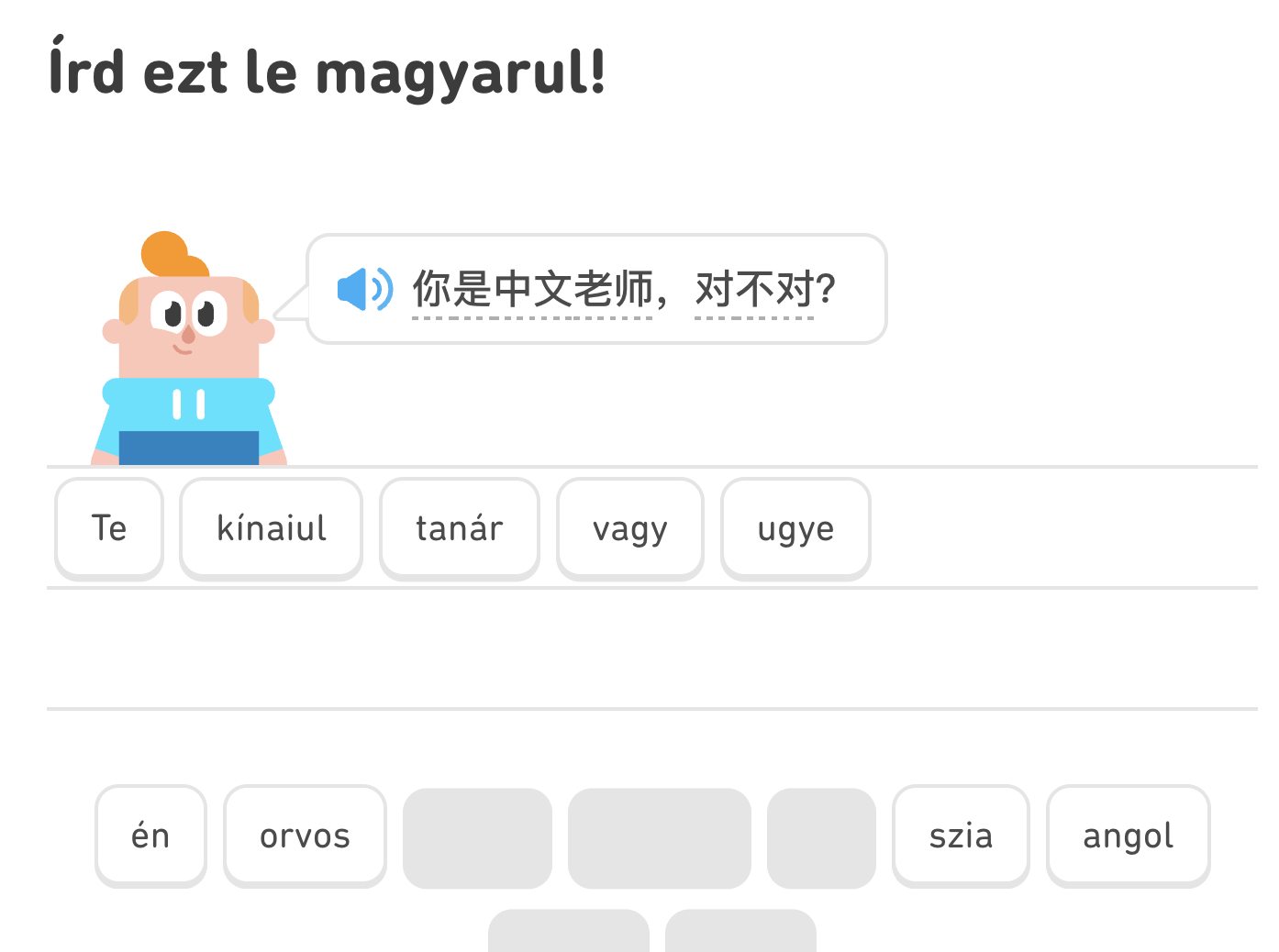
and/or

For those who do not speak Hungarian, ‘kínaiul’ is an adverb. The correct phrase above would be ‘kínai tanár’. The above examples are serious mistakes. An example of the correct use can be seen below, although the full example will also be a problem.

Unfortunately, contrary to earlier practice, the list of authors has disappeared from the menus of the courses, so I have no way of knowing who contributed to the material but my guess is that here we’re faced with native Chinese people who haven’t checked the validity of their work with native Hungarians.

My fear is that the latter is the case as there have already appeared a few other examples where totally correct Hungarian translations are rejected by the course, for example this one, where I don’t think any Hungarian would accept or say the suggested correct translation :

So once again, if you dare to start learning Chinese from Hungarian, don’t be too surprised at certain places.

Otherwise, good luck to everybody with trying to learn to speak any language with the owl – they may (or may not) succeed one day.

By P.S.

p.s.:And indeed! Not very much later on in the course, more and more very strange features prove that the authors of the Hungarian-Chinese course had/have been having difficulties with the source language. They’ve forgotten about the vary basic fact that the third person singular personal pronoun, ‘ő’ in Hungarian, refers to both sexes, as almost all nouns referring to people in this language. Although the authors sometimes remark at the bottom of a Chinese solution that, i.e. instead of 他, 她 is also possible as from the point of view of the Hungarian source the Chinese ‘he’ and ‘she’ are interchangeable, sometimes they reject one or the other Chinese solution. For no reason at all.

It is also quite basic that the Hungarian ‘tanuló’ means a student both in primary and secondary education, we don’t normally make any difference. Besides, after the course first teaches us that in Chinese a student is 学生,a couple of lessons later the same is rejected because the course has introduced 中学生 in the meantime, which means secondary school student, or, in Hungarian, the tedious-sounding ‘középiskolai tanuló’ or ‘középiskolás’ for short, although neither is used frequently at all.

Another feature of Hungarian is often neglected when the free word order is punished at various places. Although the Chinese phrase for ‘is that right/correct’, i.e. 对不对 is placed at the end of a question, in Hungarian, we often put it close to the beginning, like in ‘Te ugye nem gyakran mész étterembe?’. Similarly, ‘Ugye nem mész gyakran étterembe?’ is just as normal, the place of ‘often’ and the negative being mostly interchangeable. Except that we would usually ask, ‘Ugye nem jársz gyakran étterembe?’, if at all. Also, the personal pronouns are mostly left out, like in Russian – thankfully, this is not punished by the course.

Otherwise, the course is full of ‘tejtea’, ‘Egy csésze kávét akar’, ‘Akarod a cukrot?’, ‘Akarok cukrot’ and similar silly phrases. And I’m only through with the seventh section… Sweet Jesus, what is still ahead of us?

However, my largest laugh has been brought recently by the phrase ‘I often eat Japanese/Chinese kitchen’, i.e. in HU, ‘Gyakran eszem japán/kínai konyhát.’ 我尝尝吃日本菜/中国菜 means Jap./Ch. food but the unfortunate authors have lifted ‘kitchen’ out of the HU phrase ‘szeretem a japán/kínai konyhát’, where it indeed means the kind of food made in the kitchen(s) of the countries mentioned. But in HU you can only say you like that food, you can’t eat a kitchen! Completely preposterous, though an understandable – but huge – mistake.

Theses may seem small problems but they would probably irritate any Hungarian who’s just ventured into the discovery of the difficulties of Chinese. Some may probably give up, seeing such basic and blatant negligences coupled with the above-mentioned serious mistakes.

By P.S.

And the First Prize in Chinglish Goes to…

08 Wednesday Jul 2020

Posted by ZJShen-PSimon in Chinese speakers of English, English teaching, foreign language teaching, language learning, language teaching

≈ Leave a comment

Tags

China, education, mistakes in English, Translation

… Carole!

Well, I’m a fan of English mistakes made by Chinese people. They’re amusing and, with some experience of teaching English in China, understandable. We can’t reverse the effects of our mother tongue just like that. What’s more, such features make the world not only funnier but also more interesting and varied.

Now, as my years as a translator have been accumulating, I sometimes have new contacts with Chinese companies, mostly in the Guangzhou area. Now another one has emerged from Zhejiang province, where I used to teach English. But said Carole is already a Project Manager, not a student. She’s supposed to write reasonably. So what message have I seen from her?

The elevation of the meaning of Chinglish to a new, shining height! She’s advertising for a Dutch<>English translator. The culprit is her requirement, “Preferred native language: English Middle (ca.1100-1500)”.

First, what does English Middle mean? If she means Middle English by the phrase, why reverse the word order?

Second, she seems to require somebody to speak Middle English. Really? As a native language? Looking for somebody whose mother should be dead for more than 500 years! Or much longer, perhaps since “ca. 1100”.

Congratulations for winning first place at the stupidity race among project managers! All, not only Chinese. Well done!

By P.S.


ProZ.com Pro translator

Recent Posts

  • News about Learning with Duolingo April 10, 2025
  • Treasures of Austria – lesser known towns and cities, churches etc.: Schallaburg October 11, 2024
  • Treasures of Austria – lesser known towns and cities, churches etc. – Sankt Pölten October 5, 2024
  • Treasures of the Thaya valley in Niederösterreich – Raabs an der Thaya, Schloss Raabs September 22, 2024
  • Treasures of the Thaya valley in Niederösterreich – Burgruine Kollmitz September 20, 2024
  • Changing direction September 16, 2024
  • Learning Languages with Duolingo – extra no.2 June 22, 2024
  • Learning Languages with Duolingo – extra June 19, 2024
  • Learning Languages with Duolingo April 21, 2024
  • Language teaching (?) March 28, 2021
  • And the First Prize in Chinglish Goes to… July 8, 2020
  • Statistical truth about problems caused by asylum seekers in the Netherlands February 1, 2018
  • In honour of the immigrant 2 April 20, 2017
  • In honour of the immigrant 1 April 17, 2017
  • Can something, anything, be more stupid? December 14, 2016
  • Intercultural life in the Netherlands June 6, 2016
  • Good books to learn from May 22, 2016
  • Teach Dutch to refugees January 17, 2016
  • Arnhem’s cultural week and the famous Dutch railways September 12, 2015
  • Hilarious Hungarian-English mistranslation June 19, 2015
  • Cello concertos almost forgotten June 1, 2015
  • Send Dutch applicants … no. 2 March 13, 2015
  • Eastern-European views on the Netherlands November 23, 2014
  • Everywhere … October 16, 2014
  • Chinglish, or Dunglish? June 9, 2014
  • English testing issue in Hungary May 13, 2014
  • Effect of Grammar Teaching on Learners and Translators April 4, 2014
  • Neurobiologist on the brain development of children – part 3 March 28, 2014
  • Neurobiologist on the brain development of children – part 2 March 26, 2014
  • Neurobiologist on the brain development of children March 25, 2014
  • The extent translation is ‘correct’ March 14, 2014
  • Translating using translation software January 19, 2014
  • Translation problems with machine translation January 13, 2014
  • Translation difficulties January 11, 2014
  • Translation in the extreme November 16, 2013
  • Life is looking up at long last October 4, 2013
  • Summer disappointment on the Dutch job market August 2, 2013
  • Send Dutch applicants abroad back home! June 21, 2013
  • What Teacher Education Programs Don’t Tell You June 10, 2013
  • Werkloos = waardeloos, i.e., jobless = worthless? May 27, 2013

Enter your email address to follow this blog and receive notifications of new posts by email.

Join 55 other subscribers

Archives

Categories

  • applying for a job in the Netherlands (2)
  • Austria (5)
  • Austria (1)
  • castles in Austria (3)
  • child development (4)
  • child rearing (3)
  • Chinese speakers of English (2)
  • Dutch culture (4)
  • education (17)
  • English teaching (29)
  • European Union (5)
  • foreign language teaching (19)
  • Hungary (6)
  • immigration (8)
  • intercultural learning (1)
  • job application (1)
  • joblessness (2)
  • language courses for Dutch people (1)
  • language courses for Hungarians (1)
  • language learning (33)
  • language teaching (22)
  • language testing (5)
  • learning Chinese (1)
  • learning Dutch (4)
  • learning languages with DuoLingo (1)
  • museums (1)
  • nature photos (1)
  • Netherlands (12)
  • Nieder-Österreich (3)
  • refugees in Europe (4)
  • River Thaya (3)
  • teacher training (7)
  • teaching Dutch (1)
  • translation (12)
  • university education (4)
  • work in Dutch education (6)

Meta

  • Create account
  • Log in
  • Entries feed
  • Comments feed
  • WordPress.com

Blog Stats

  • 23,549 hits

Spam Blocked

59,628 spam blocked by Akismet

Categories

applying for a job in the Netherlands Austria castles in Austria child development child rearing Chinese speakers of English Dutch culture education English teaching European Union foreign language teaching Hungary immigration intercultural learning job application joblessness language learning language teaching language testing learning Dutch museums Netherlands Nieder-Österreich refugees in Europe River Thaya teacher training teaching Dutch translation university education work in Dutch education

appreciation of variety Austria British Council Bulgarian castle ruins in Austria castles castles in Austria CELTA China Chinese language cognitive science Common European Framework of Reference for Languages Culture of Hungary duolingo Dutch Dutch as a foreign language Dutch dictionary Dutch people Eastern Europe education education in the netherlands English as a foreign or second language English language European Union freedom in class Frigyes Karinthy German German language grammar-translation method Grammar translation Great Britain Hearing (sense) Higher education higher education in Hungary Hungarian Hungary IELTS Immigration Jiaozi Language Language acquisition language correction approaches Language education language learning Learning learning to communicate limits in class mistranslations Netherlands Niederösterreich NRC Handelsblad Romanians Rote learning Schallaburg Secondary education Second language Staatsexamen Student talent Teacher Teacher education teacher training Teaching English as a foreign language teaching foreign languages Teaching qualification tests Thaya Thaya river Training Translation travel use of translation softwares Van Dale Western Europe work in the Netherlands
  • Unknown's avatar
  • Unknown's avatar
  • Unknown's avatar
  • strafari's avatar
  • Unknown's avatar
  • Unknown's avatar
  • Unknown's avatar
  • CRAZY ART's avatar
  • http://newauthoronamazon.wordpress.com's avatar
  • Unknown's avatar
  • Unknown's avatar
  • Unknown's avatar
  • Utterances of my mind's avatar
  • Unknown's avatar
  • liane {meraki geek}'s avatar
  • Sofia's avatar
  • Unknown's avatar
  • sonypadickal's avatar
  • Unknown's avatar
  • International Bellhop's avatar
  • Unknown's avatar
  • Unknown's avatar
  • Unknown's avatar
  • Bradley's avatar
  • Tony Gurr's avatar
  • Unknown's avatar
  • Unknown's avatar
  • loolittleloo's avatar
  • Kale's avatar
  • iGameMom.com's avatar
  • Unknown's avatar
  • Unknown's avatar
  • Unknown's avatar
  • Craig Thompson's avatar
  • Unknown's avatar
  • Noah's avatar
  • Unknown's avatar
  • Unknown's avatar
  • Cam's avatar
  • petchary's avatar
  • classroomsandstaffrooms's avatar
  • Unknown's avatar
  • thanefurrows's avatar
  • fashbazar's avatar
  • Unknown's avatar
  • Unknown's avatar
  • Unknown's avatar
  • robert okaji's avatar
  • Shimky's avatar
  • Texture of Parlance's avatar

Top Posts & Pages

  • News about Learning with Duolingo
  • Treasures of Austria - lesser known towns and cities, churches etc.: Schallaburg
  • Treasures of Austria - lesser known towns and cities, churches etc. - Sankt Pölten
  • Treasures of the Thaya valley in Niederösterreich - Raabs an der Thaya, Schloss Raabs
  • Treasures of the Thaya valley in Niederösterreich - Burgruine Kollmitz
  • Changing direction
  • Learning Languages with Duolingo - extra no.2
  • Learning Languages with Duolingo - extra
  • Learning Languages with Duolingo
  • Language teaching (?)

Protected against copying

Protected by Copyscape DMCA Takedown Notice Search Tool

Create a free website or blog at WordPress.com.

Privacy & Cookies: This site uses cookies. By continuing to use this website, you agree to their use.
To find out more, including how to control cookies, see here: Cookie Policy
  • Subscribe Subscribed
    • Learning and teaching languages in the Netherlands - and taking photos in the process
    • Join 55 other subscribers
    • Already have a WordPress.com account? Log in now.
    • Learning and teaching languages in the Netherlands - and taking photos in the process
    • Subscribe Subscribed
    • Sign up
    • Log in
    • Report this content
    • View site in Reader
    • Manage subscriptions
    • Collapse this bar
 

Loading Comments...